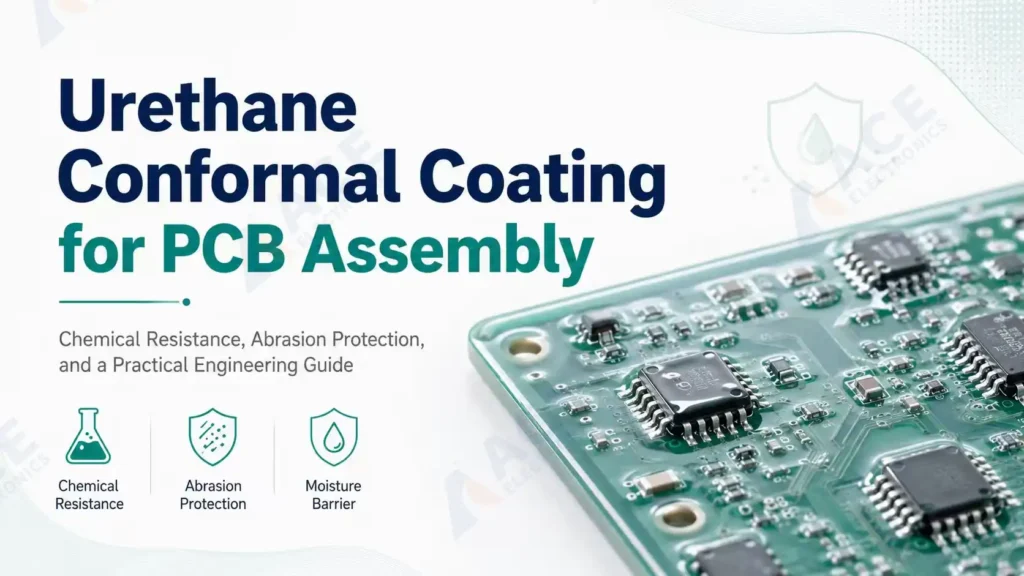
Polyurethane conformal coatings are commonly used for PCB components requiring enhanced chemical resistance, wear resistance, moisture protection, and high reliability. In material classification, they are also known as polyurethane conformal coatings or UR-type conformal coatings.
This guide is to help hardware, product, and procurement teams determine whether polyurethane coating is suitable for your PCBA project. It covers material fundamentals, typical application examples, practical limitations, rework implications, and information that should be confirmed with your assembly partner prior to quotation, prototyping, or production.
Urethane conformal coating applied to a PCBA. The coating helps protect selected board areas from moisture, chemical contamination, corrosion, and abrasion in demanding operating environments.What Is Urethane Conformal Coating?
Urethane conformal coating — also referred to as polyurethane conformal coating or Type UR coating — is a polymeric protective film based on polyurethane resin chemistry. Once applied and cured on an assembled PCB, it forms a hard, tough, chemically resistant layer that conforms to the board surface, component bodies, and solder joints.
On a PCBA, this coating material protects against solvents, fuels, oils, acids, alkalis, abrasion, humidity, moisture, salt spray, corrosion, and mechanical contact. Compared with acrylic coatings, which are softer and easier to rework, and silicone coatings, which remain flexible across a wide temperature range, a urethane film is distinctly harder and more resistant to chemical attack and physical wear.
Application methods for urethane conformal coating include spray, dip, brush, and selective coating. The choice depends on board geometry, component density, keep-out areas, and production volume. For a broader overview of available methods and process considerations, see the PCB conformal coating material and process guide.

Automated urethane conformal coating on a PCBA. The machine applies coating to selected board areas while avoiding defined keep-out zones, helping improve protection against moisture, corrosion, chemicals, oils, solvents, and abrasion.
Material Form, Curing and Handling Precautions
Polyurethane coatings are typically based on polyurethane resin chemistry and come in two main formulation types.
Single-component systems cure by reacting with moisture or heat in the environment. They are easy to apply and have a long pot life, but cure slowly—complete curing may take several days. As the curing mechanism relies on moisture, ambient humidity affects the curing rate and the final film properties. In high-humidity production environments, process control is crucial to avoid inconsistent results.
Two-component systems consist of a resin and a curing agent, which must be mixed prior to use. Once mixed, the material has a limited pot life—meaning it must be applied within a specific timeframe. The advantage is faster curing, typically completed within 1 to 3 hours. The disadvantage is that batch management and equipment scheduling must take the pot life into account, particularly in high-volume production.
Once cured, polyurethane films are hard and durable, with mechanical hardness second only to epoxy resins among common conformal coatings. Certain formulations contain UV tracers that fluoresce under ultraviolet light, thereby simplifying the inspection process.
Commonly used brands in the industry include HumiSeal, MG Chemicals, Techspray, Chemtronics, Electrolube, Dymax and CHT.
Why Urethane Coating Is Used on PCBs
Urethane conformal coating has several properties that other common coating types do not match to the same degree — most notably UL94 V-0 flammability rating, natural fungicidal behavior, and the strongest combined chemical and abrasion resistance. The table below maps typical buyer concerns to what this harder coating provides and how it affects the assembled board.
| Buyer concern | Why urethane helps | PCBA impact |
|---|---|---|
| Chemical exposure | Excellent resistance to solvents, fuels, oils, acids, and alkalis | Fits chemical plants, fuel systems, industrial controls, and cleaning-intensive environments |
| Abrasion and mechanical wear | Hard, tough film resists rubbing, scratching, and contact stress | Supports devices subject to handling, vibration, or mechanical contact |
| Moisture and humidity | Good barrier against moisture, condensation, and salt spray | Protects outdoor, marine, and humid-enclosure products |
| Mold and fungus | Urethane is naturally fungicidal and resists mold growth | Fits agricultural, tropical, and enclosed-housing products |
| Flammability | UL94 V-0 rating — the best flame class among common coating types | Supports applications with strict fire safety requirements |
| Electrical insulation | Good dielectric properties support insulation | Helps reduce leakage and arcing risk |
| Corrosion protection | Combined chemical and moisture barrier helps resist corrosive attack | Fits marine, industrial, and outdoor applications |
Best Application Scenarios for Polyurethane Coatings
Choose urethane coating when the PCBA faces chemicals, solvents, fuel vapors, or abrasive wear. Acrylic is too soft and silicone is too flexible for these conditions. The cured urethane film is hard and chemically stable, so it survives where softer coatings fail.
Common product categories requiring polyurethane conformal coatings:
- Chemical processing equipment and sensors — Exposed to acid vapors, alkaline mists, solvent spills, and harsh cleaning processes.
- Fuel system electronics — Automotive fuel pump controllers, electric vehicle battery management systems near coolant circuits, and avionics exposed to fuel vapors and de-icing fluids.
- Industrial control equipment — Equipment near lubricants, cutting fluids, hydraulic fluids, and solvent-based cleaners.
- Marine and saltwater-exposed electronics — Navigation, communication, and monitoring equipment in corrosive salt spray environments.
- Rugged handheld or field-deployed equipment — Instruments susceptible to drops, friction, and mechanical contact during everyday use.
- Agricultural and construction equipment — Electronic equipment exposed to diesel fuel, hydraulic fluids, pesticides, and high-pressure cleaning environments.
- Equipment requiring frequent cleaning — Medical device housings and food processing control devices exposed to disinfectants and bactericides.
If the product mainly faces high temperature and vibration but limited chemical contact, silicone conformal coating for PCB assembly may be a better choice. For general indoor electronics with low environmental stress, an acrylic conformal coating for PCB assembly is often sufficient and easier to rework.
Limits of Urethane Conformal Coating
No single coating type fits every PCBA project. Understanding where urethane conformal coating has practical limits helps teams avoid rework surprises, process delays, and unnecessary cost.
| Risk condition | Why urethane may be limited | What to review |
|---|---|---|
| Frequent rework | Hardest to remove among common coating types; chemical strippers required | Confirm repair strategy early; rework after coating is costly |
| Long cure time | Full cure may take days; two-component systems have limited pot life | Confirm process flow, lead time, and batch management |
| High temperature above 125°C | Maximum service temperature is typically below 130°C — lower than silicone | Review operating temperature range; silicone may be required for sustained high heat |
| Yellowing with age | Some formulations discolor over time | Evaluate if cosmetic appearance matters for the product |
Common Urethane Coating Defects and Process Controls
Urethane is harder to apply and cure than acrylic. Defects are more costly to fix because rework takes longer. The table below lists what goes wrong on the line, why it happens, and what to check before production starts.
For the broader production flow behind testing, cleaning, masking, application, cure, and post-coating inspection, review the conformal coating process guide.
| Defect | Common Cause | What to Check Before Production |
|---|---|---|
| Bubbles / Pinholes | Air trapped during mixing, spray pressure too high, or moisture on the board surface | Mix two-component systems slowly and let them sit before spraying; control spray pressure; pre-bake boards to remove moisture |
| Runs / Sagging | Wet film too thick, vertical spray orientation, or viscosity too low | Keep wet film thickness under 150 µm; spray horizontally when possible; confirm dilution ratio against the datasheet |
| Blushing / White Haze | Single-component moisture-cure systems exposed to high humidity during cure | Control ambient humidity between 40–60% RH; use heat-accelerated cure if humidity is unpredictable |
| Poor Adhesion | Flux residue, finger oils, oxide layer, or incomplete cure | verify cleaning process and cure temperature |
| Yellowing | Heat aging, UV exposure, or aromatic isocyanate chemistry in the formulation | Ask your supplier whether the formulation uses aliphatic or aromatic isocyanates; evaluate if the product has a transparent housing |
| Stress Cracking | Hard film on flexible areas, thick coating on large components, or repeated thermal cycling | Keep dry film thickness under 100 µm; review board flex zones and component height; evaluate thermal cycling profile |
| Delamination at Edges | Coating bridging to masking tape, incomplete surface preparation, or solvent incompatibility | Confirm masking material does not react with urethane solvent; check edge cleanliness before coating |
Key point: Urethane defects are harder to correct than acrylic defects because the film is chemically resistant. A pre-coating inspection step — ionic contamination test, visual cleanliness check, and bake-out — prevents most of these issues from reaching the cured board.
Urethane vs Acrylic vs Silicone: Quick Selection Guide
Teams evaluating conformal coating options often compare three common material types. The table below offers a high-level selection reference. For a complete material comparison and process overview, review the PCB conformal coating material and process guide.
| Material | Typical strengths | Typical limits | PCBA use case |
|---|---|---|---|
| Urethane | Strongest chemical and abrasion resistance, tough film, UL94 V-0 rated, fungicidal | Hardest rework, longest cure, may yellow, higher water absorption, higher rigidity | Chemical plants, fuel systems, marine, aerospace, rugged devices, cleaning-intensive products |
| Acrylic | Cost-effective, fast handling, easiest rework | Lower chemical and abrasion resistance | General electronics, indoor controls, moderate-risk products |
| Silicone | Most flexible, widest temperature range, good vibration absorption | Softer film, harder removal than acrylic, possible longer cure than acrylic | Automotive, LED, outdoor, high-temperature, vibration-prone products |
Engineering Checklist Before You Specify Urethane Coating
Specifying urethane conformal coating for a production run goes beyond choosing a material type. The checklist below covers the key points that hardware teams and buyers should confirm early — ideally before requesting a quotation. Confirming these items reduces revision loops, helps the assembly partner prepare the right process, and keeps lead times predictable.
Chemical and mechanical environment
- What chemicals, solvents, fuels, oils, or cleaning agents will the PCBA be exposed to during operation, service, and cleaning?
- Is there mechanical contact, abrasion, rubbing, or impact expected during operation or handling?
- What temperature range must the PCBA survive? Urethane typically handles approximately -65°C to 125°C. For sustained operation above 130°C, review whether silicone is a better fit.
Coating coverage and keep-out areas
- Which board areas require coating coverage?
- Which no-coat areas must stay free of coating? In chemical environments, even small coating breaches can become failure points. Common keep-out areas include connectors, test points, programming pads, sensors, LEDs, RF areas, edge fingers, grounding pads, thermal pads, and mechanical mating areas. For detailed guidance, see the conformal coating masking and no-coat areas guide.
Testing and rework planning
- What testing should be completed before coating? Urethane rework after coating is the most difficult among common material types. Finding defects before coating avoids expensive stripping and repair loops.
- Is urethane removal or rework expected later in the product lifecycle? Removal typically requires targeted chemical strippers and may involve mechanical abrasion. Confirm the removal method and repair strategy before production starts.
Formulation and processing
- Single-component or two-component? Single-component systems are simpler to apply but cure more slowly and are sensitive to ambient humidity. Two-component systems cure faster but require pot-life management and batch scheduling.
- What is the acceptable cure window and how does it affect lead time? For two-component systems, confirm that the production line can manage the pot life constraint.
Inspection and downstream assembly
- What inspection method and acceptance criteria are required? If the coating contains a UV tracer, UV light inspection can speed up coverage verification. Some projects also require thickness measurement or IPC-CC-830 compliance.
- Will the PCBA move into enclosure assembly or final product assembly after coating? Confirm chemical compatibility with gaskets, seals, O-rings, and enclosure materials.
Compliance and standards
- Does the project require a specific brand-name coating material with RoHS, REACH, UL, IPC-CC-830, UL 746E, or other compliance documentation?
- Is a specific flammability rating required? Urethane typically achieves UL94 V-0 — the best flame class among common coating types.
- Is MIL-I-46058C compliance or Class F (160°C) temperature rating required?
- Is cosmetic yellowing over time acceptable for this product?
Project Examples: Where Urethane Replaced a Weaker Coating
The cases below show why our clients switched to use Urethane coating.
Agricultural Drone Flight Controller — Pesticide Exposure
Problem. A drone flight controller used in crop-spraying operations was originally protected with acrylic conformal coating. After six months in the field, returned units showed softened coating film, visible corrosion under SMD components.
Why acrylic failed. Organic-phosphate pesticides and alkaline liquid fertilizers degraded the acrylic film over repeated exposure cycles.
What Improvements. The coating was replaced with a two-component urethane conformal coating applied at 50–75 µm dry film thickness, with a UV tracer added for faster inspection.
Outcome. After 12 months of field testing, no coating degradation was observed. The production run moved from acrylic to urethane with no increase in defect rate.
Takeaway for buyers. Acrylic degrades quickly in pesticide and aggressive chemical environments.
Chemical Plant Sensor Board — Solvent Vapor
Problem. A monitoring sensor installed inside a ventilated enclosure at a solvent recovery facility, the assembled PCB was coated with silicone conformal coating. The board was exposed to acetone, toluene, and isopropyl alcohol vapors during normal operation. After four months, the silicone film swelled and partially delaminated near connector edges, exposing copper traces to corrosive vapor.
Why silicone failed. Silicone's open polymer structure allows gradual solvent absorption over time.
What changed. The silicone was replaced with a single-component moisture-cure urethane conformal coating at 40–60 µm dry film thickness. Because the board carried dense connectors, programming pads, and test points, a selective-coating robot was used instead of dip or spray — keeping all keep-out areas clean without manual masking rework.
Outcome. 18-month field data showed no coating swelling, no adhesion loss at connector edges.
Takeaway for buyers. Silicone handles heat well but absorbs solvents over time. When the operating environment combines chemical vapors with thermal cycling, urethane is the more dimensionally stable choice.
Moving Forward with a Urethane Coating Order
If your PCBA order needs urethane conformal coating, send your chemical exposure list, temperature range, mechanical contact requirements, coating coverage areas, keep-out drawing, test sequence, approved material requirement, single or two-component preference, acceptable cure window, and production volume. The engineering team can review whether urethane coating fits the board design, chemical environment, rework expectation, and final assembly plan.
For a complete overview of available conformal coating services for PCBA, visit the conformal coating services page.
Frequently Asked Questions
What is urethane conformal coating used for in PCB assembly?
What is urethane conformal coating used for in PCB assembly?
Urethane conformal coating is used on assembled PCBs to protect against solvents, fuels, oils, acids, alkalis, abrasion, moisture, humidity, and salt spray. It forms a hard, tough, chemically resistant dielectric film and is commonly specified for chemical plants, fuel systems, industrial controls, marine electronics, and aerospace avionics where chemical exposure and mechanical wear are the primary reliability concerns.
When should I choose urethane conformal coating over acrylic or silicone?
When should I choose urethane conformal coating over acrylic or silicone?
Choose urethane when the operating environment includes chemical exposure to solvents, fuels, or aggressive cleaning agents, or when the product experiences continuous abrasion and mechanical contact. Urethane also provides UL94 V-0 flammability rating and natural fungicidal behavior — properties not available at the same level from acrylic or silicone. If the primary concern is high temperature or vibration instead, silicone may be a better fit. For general indoor electronics, acrylic is often sufficient.
Is urethane conformal coating good for chemical and solvent resistance?
Is urethane conformal coating good for chemical and solvent resistance?
Yes. Urethane conformal coating provides the strongest chemical resistance among the three most common coating types. It withstands exposure to a wide range of organic solvents, fuels, oils, acids, and alkalis that would degrade acrylic or silicone films. This makes it the standard recommendation for chemical plants, fuel system electronics, and industrial controls exposed to aggressive process fluids.
Can urethane conformal coating be removed for rework?
Can urethane conformal coating be removed for rework?
Yes, but removal is more difficult than with acrylic or silicone coatings. Urethane's high chemical resistance — the same property that protects the board — also makes it resistant to common solvents. Removal typically requires targeted chemical strippers and may involve mechanical abrasion. Single-component urethanes on softer substrates are especially challenging. If the product is expected to require frequent rework or late-stage component changes, confirm the removal method and repair strategy before specifying this coating type.
What information should I confirm before requesting urethane conformal coating?
What information should I confirm before requesting urethane conformal coating?
Before requesting a quotation, confirm the chemical exposure profile, temperature range (urethane is typically rated for -65°C to 125°C), mechanical contact requirements, coating coverage areas, no-coat areas (connectors, test points, sensors, thermal pads, grounding pads), testing sequence, rework expectation, single or two-component preference, acceptable cure window, production volume, and any compliance requirements such as RoHS, REACH, UL, IPC-CC-830, UL 746E, MIL-I-46058C, or UL94 V-0 flammability. Providing a keep-out drawing and approved material datasheet helps the assembly partner prepare an accurate quotation.