Selecting the right conformal coating for a printed circuit board assembly means understanding the operating environment, thermal demands, and long-term reliability requirements. Silicone conformal coating is one of the most widely specified coating types for electronics that face heat, vibration, moisture, and thermal cycling — the conditions common in automotive, industrial, outdoor, and LED applications.
This guide helps hardware teams, product teams, and purchasing teams evaluate whether silicone coating fits a PCBA order. It covers material basics, performance strengths, practical limits, and an engineering checklist that reduces back-and-forth before quoting and production.
What Is Silicone Conformal Coating?
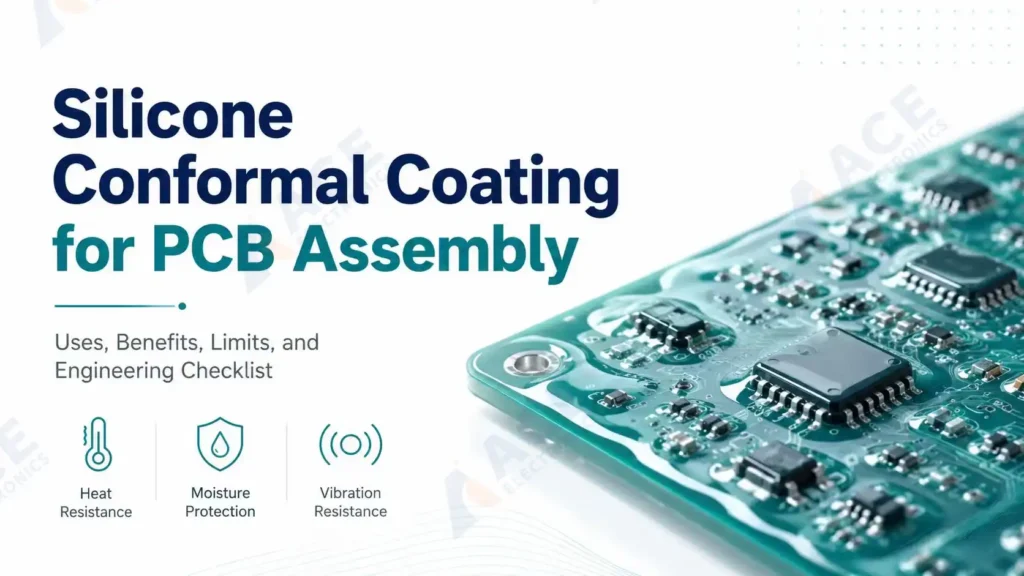
Silicone conformal coating is a Type SR conformal coating based on silicone resin or siloxane chemistry. Once applied and cured on an assembled PCB, it forms a flexible, rubbery, dielectric protective film across the board surface and component bodies. The cured film combines rubber-like flexibility with a smooth, transparent resin finish — soft to the touch yet tightly bonded to the board. When applied to LED boards or light-emitting areas, the coating typically achieves 90% to over 95% light transmittance and does not yellow under prolonged high-temperature operation, preserving LED brightness over the product lifecycle.
On a PCBA, this coating type protects against moisture, humidity, salt spray, condensation, thermal shock, vibration, corrosion, and electrical leakage. Unlike harder coating materials, the cured film remains soft and elastic, which helps it absorb mechanical and thermal stress without cracking, peeling, or delaminating.
Application methods for silicone conformal coating include spray, dip, brush, and selective coating. The choice of method depends on board geometry, component density, no-coat areas, and production volume. For a broader overview of available methods and process considerations, see the PCB conformal coating material and process guide.

Silicone conformal coating applied by spray to an assembled PCB. Once cured, the flexible film protects against moisture, dust, vibration, and thermal shock across a wide temperature range.
Material Form, Cure, and Typical Material Selection
Silicone coating materials are typically based on silicone resin, siloxane, or PDMS chemistry. Before cure, the material may be supplied as a liquid, gel, aerosol spray, or two-part mixed compound. Once cured, the resulting film is soft, flexible, and elastic — a property that distinguishes this coating from harder acrylic or urethane films.
By formulation type, silicone conformal coating products generally fall into three categories:
- Solvent-based silicone resin coatings — The viscosity can be adjusted by dilution to suit the application method. Surface-dry time is typically around 15 minutes at room temperature. After full cure, the film reaches approximately Shore A80 hardness and offers good surface smoothness and transparency. Cross-hatch adhesion testing can reach 0-level on properly prepared substrates. One trade-off is that these formulations contain aromatic solvents, so their use is gradually declining in markets with stricter environmental requirements.
- Solventless pure silicone resin coatings — These are 100% solids with no solvent content. The cured film is noticeably softer, typically in the Shore A30 to A50 range. Because of the inherently higher viscosity, the applied film thickness is difficult to keep below 200 µm. Cure tends to be significantly slower than solvent-based alternatives, and cross-hatch adhesion on untreated substrates is often around 3-level. Despite these handling trade-offs, solventless formulations remain valued for applications that demand sustained high-temperature resistance, with some grades rated for continuous service above 200°C.
- UV-cure silicone coatings — These cure rapidly under UV light, often as dual-cure systems that also respond to moisture or heat for shadow areas. They combine fast processing with the flexibility expected from silicone chemistry.
Common cure mechanisms across these formulation types include:
- Room-temperature vulcanizing (RTV)
- Moisture cure
- Heat cure
- UV cure (often as a dual-cure system)
- One-part and two-part formulations
Some silicone coating products include a UV indicator that fluoresces under UV light for inspection.
Brands commonly referenced in the industry include MG Chemicals, Techspray, Chemtronics, HumiSeal, Dow / DOWSIL, Electrolube, Miller-Stephenson, and CHT.
Benefits of Silicone Conformal Coating in PCBA Protection
Silicone conformal coating solves common PCB assembly challenges. Its flexibility, durability, and chemical resistance make it ideal for demanding environments. The table below summarizes how silicone coating addresses key concerns and the impact on your PCBA.
| Concern | How Silicone Helps | Impact on PCB Assembly |
|---|---|---|
| High temperature | Stays flexible from -60°C to 180°C (some grades >200°C) | Safe near heat sources, LEDs, and power circuits |
| Vibration & thermal cycling | Absorbs mechanical stress; cushions shocks | Reduces cracking risk in moving environments |
| Moisture & salt spray | Hydrophobic; resists humidity, condensation, salt, oil | Suitable for outdoor, marine, and industrial use |
| LED clarity | Maintains 90–95% light transmittance without yellowing | Preserves brightness and color over product life |
| Electrical insulation | Strong dielectric properties | Reduces leakage and arcing risks |
| Chemical exposure | Stable against acids, alkalis, and chemicals | Ideal for industrial environments; rework may be harder |
Key takeaway: Silicone coating adds reliable thermal, mechanical, and chemical protection while maintaining optical clarity and electrical performance.
Best Applications for Silicone PCB Coating
Common Applications
- Automotive electronics — engine modules, sensors, lighting control units, EV power electronics exposed to heat and vibration.
- LED lighting & driver boards — maintains 90–95%+ light transmittance; resists yellowing under continuous heat and outdoor conditions.
- Power electronics — converters, inverters, and motor drives operating at high temperatures or undergoing thermal cycling.
- Outdoor sensors & monitoring devices — weather stations, agricultural sensors, remote telemetry units exposed to moisture and temperature extremes.
- Industrial controls — equipment near motors, pumps, compressors, or heat sources experiencing constant vibration.
- Marine or salt-air electronics — navigation, communication, and monitoring equipment in corrosive atmospheres.
- Flexible & rigid-flex assemblies — prevents cracking in boards subject to repeated flexing or thermal expansion.
Note: For moderate indoor environments with low thermal or mechanical stress, acrylic conformal coating for PCB assembly may be a simpler and faster-handling option. Choose coating based on operating conditions, not convenience. If solvent, fuel, or aggressive chemical exposure is a larger risk than heat or vibration, compare silicone with our urethane conformal coating guide before locking the material choice.
Limits of Silicone Conformal Coating
No single coating type fits every PCBA project. Understanding where silicone conformal coating has practical limits helps teams avoid rework surprises, process delays, and unnecessary cost.
| Risk Condition | Limitation / Consideration |
|---|---|
| Frequent rework | Harder to remove than acrylic; common solvents like IPA are usually ineffective. Plan repair and removal carefully. |
| Abrasion or rubbing | Softer film may wear under mechanical contact; ensure adequate spacing and protection in enclosures. |
| Long cure or handling time | Solventless or pure resin types can take significantly longer to cure than acrylic; factor into process flow. |
| Contamination-sensitive processes | Silicone residue may interfere with bonding or secondary coatings; evaluate downstream assembly needs. |
| Extreme chemical exposure | Some harsh chemicals may degrade silicone; urethane or other coatings could offer stronger protection. |
Silicone vs Acrylic vs Urethane: Quick Selection Guide
Teams evaluating conformal coating options often compare three common material types. The table below offers a high-level selection reference. For a complete material comparison and process overview, review the PCB conformal coating material and process guide.
| Material | Typical strengths | Typical limits | PCBA use case |
|---|---|---|---|
| Silicone | Flexible, heat resistant, good for vibration and humidity | Softer film, harder removal, possible longer cure | Automotive, LED, outdoor, high-temperature, vibration-prone products |
| Acrylic | Cost-effective, fast handling, easier rework | Lower chemical and abrasion resistance | General electronics, indoor controls, moderate-risk products |
| Urethane | Strong chemical and abrasion resistance | Harder rework, slower or more demanding process | Industrial, chemical exposure, rugged devices |
Engineering Checklist Before You Specify Silicone Coating
Specifying silicone conformal coating for a production run goes beyond choosing a material type. The checklist below covers the key points that hardware teams and buyers should confirm early — ideally before requesting a quotation. Confirming these items reduces revision loops, helps the assembly partner prepare the right process, and keeps lead times predictable.
For the broader production flow behind testing, masking, application, cure, and inspection, see our conformal coating process guide.
Operating conditions and environment
- What temperature range must the PCBA survive during operation, testing, and storage?
- Will the product face vibration, thermal cycling, salt spray, humidity, or outdoor exposure?
Coating coverage and keep-out areas
- Which board areas require silicone conformal coating coverage?
- Which no-coat areas must stay free of coating? This includes connectors, test points, programming pads, sensors, LEDs, RF areas, edge fingers, grounding pads, thermal pads, and mechanical mating areas. For detailed guidance, see the conformal coating masking and no-coat areas guide.
Testing and rework planning
- What testing should be completed before coating is applied? Testing coated boards is possible, but rework after coating is significantly more difficult — especially with this coating type.
- Is silicone conformal coating removal or rework expected later in the product lifecycle? Silicone removal typically requires targeted chemical strippers and gentle mechanical agitation. Common solvents such as IPA are often ineffective. If late-stage rework is frequent, factor removal difficulty into the repair strategy.
Inspection and downstream assembly
- What inspection method and acceptance criteria are required? Options may include visual inspection, UV light inspection (using a UV indicator in the coating), or automated optical inspection (AOI).
- Will the PCBA move into enclosure assembly or final product assembly after coating? Confirm grounding, thermal transfer, and mechanical mating surfaces so the coating does not interfere.
Production volume and compliance
- What production volume and lead time are expected? Cure time, masking complexity, and inspection all affect throughput.
- Does the project require a specific brand-name coating material with RoHS, REACH, UL, IPC-CC-830, or other compliance documentation? When compliance is required, confirm the approved material and its datasheet before quoting.
Moving Forward with a Silicone Coating Order
If your PCBA order requires silicone conformal coating, send your projects details. The engineering team can review whether silicone coating fits your PCBA projects.
Find out how silicone conformal coating can protect your PCB assemblies.
Frequently Asked Questions
What is silicone conformal coating used for in PCB assembly?
What is silicone conformal coating used for in PCB assembly?
Silicone conformal coating is used on assembled PCBs to protect against moisture, humidity, salt spray, thermal shock, vibration, corrosion, and electrical leakage. It forms a flexible, rubbery dielectric film across the board surface and is commonly specified for automotive, LED, outdoor, industrial, and marine electronics that face heat or harsh environmental conditions.
When should I choose silicone conformal coating for a PCBA project?
When should I choose silicone conformal coating for a PCBA project?
Choose silicone conformal coating when the operating environment includes high temperature, wide temperature swings, continuous vibration, humidity, salt spray, or outdoor exposure. The flexibility and thermal stability of this coating make it particularly suited for products that experience thermal cycling or mechanical stress during operation.
Is silicone conformal coating good for high-temperature PCBs?
Is silicone conformal coating good for high-temperature PCBs?
Yes. Silicone conformal coating remains flexible across a wide temperature range, typically from -60°C to 180°C, with select solventless formulations rated for continuous service above 200°C. This makes it a practical choice for PCBs near heat sources, power electronics, LED driver boards, and automotive electronics. The soft, elastic film absorbs thermal stress without cracking, which is a key advantage over harder coating materials.
Can silicone conformal coating be removed for rework?
Can silicone conformal coating be removed for rework?
Yes, but removal is more difficult than with acrylic coatings. Silicone is chemically resistant, and common solvents such as IPA are often ineffective. Removal typically requires targeted chemical strippers combined with gentle mechanical agitation. If the product is expected to require frequent rework, confirm the removal method and repair strategy before specifying this coating type.
What information should I send before requesting silicone conformal coating?
What information should I send before requesting silicone conformal coating?
Before requesting a quotation, confirm the operating environment, temperature range, vibration exposure, coating coverage areas, no-coat areas (connectors, test points, sensors, thermal pads, grounding pads), testing sequence, inspection criteria, rework expectation, production volume, and any material compliance requirements such as RoHS, REACH, UL, or IPC-CC-830. Providing a keep-out drawing and approved material datasheet helps the assembly partner prepare an accurate quotation.