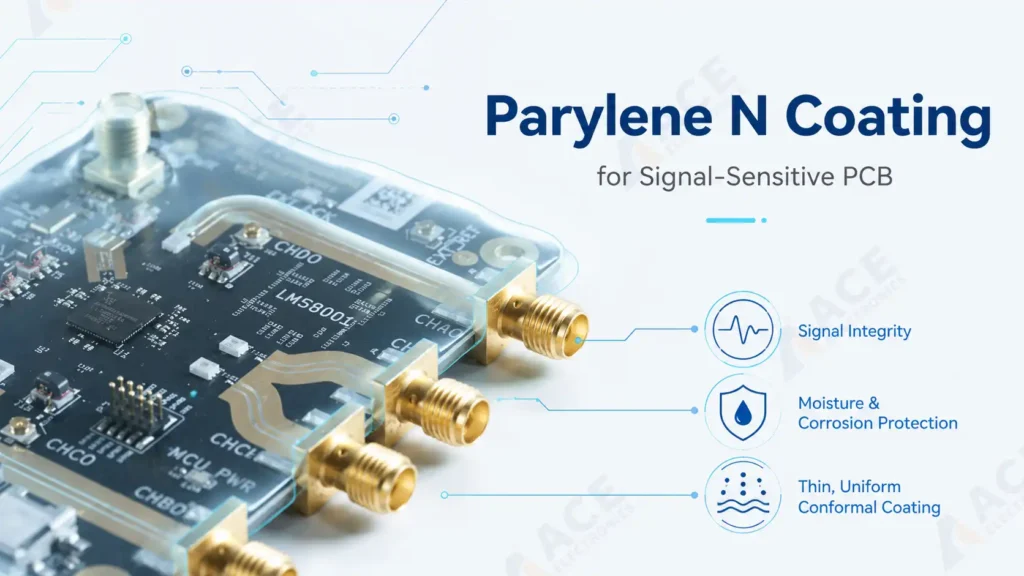
For many RF and signal-sensitive PCB assembly, Parylene N coating is one of the first coating types engineers review. When a board needs thin conformal protection but also needs low dielectric loading and very low energy loss in the coating layer, Parylene N is one of the best choice.
What Is Parylene N Coating?
Parylene N is one member of the Parylene family of conformal coatings. In PCB assembly, it is applied as a vapor-deposited polymer film rather than a liquid coating. That gives it thin, even coverage on exposed assembly surfaces, leads, edges, and narrow spaces.
Parylene N is not only an effective conformal coating but also a material renowned for its low dielectric constant, extremely low dissipation factor (dielectric loss tangent), and stable electrical properties across varying frequencies.
For a general overview of the use of Parylene in protecting assembled PCB, see the Parylene conformal coating guide.
Why Parylene N Is Suitable for RF and Signal-Sensitive PCB Assembly
Low Dielectric Constant
Parylene N is typically characterized by a dielectric constant of approximately 2.65. This is one of the primary reasons why it is considered for RF and other signal-sensitive electronics. A lower dielectric constant means that the coating exerts less electrical influence on nearby signal structures than a material with a higher k-value.
This makes Parylene N a logical choice for assemblies where the electrical environment is already sensitive—such as tuned circuits, antenna-related layouts, and other PCBs where minor changes in the dielectric constant can be significant.
Very Low Dissipation Factor
Parylene N is also renowned for its very low dissipation factor. Typical published values hover around 0.0002 at 60 Hz and 1 kHz, and around 0.0006 at 1 MHz. This is the property that underpins the common assertion that Parylene N is an attractive choice for high-frequency applications.
The point is clear: less electrical loss within the coating layer means less cause for concern that the coating itself will induce unnecessary signal loss.
Stable electrical behavior across frequency
Another reason why Parylene N is frequently recommended is that its electrical properties remain relatively stable across the entire frequency range. This is significant because signal-sensitive assemblies are not influenced solely by the absolute value of the dielectric constant; they are also affected by the extent to which that value remains predictable as the signal environment changes.
Thin, Conformal Coverage Remains Essential
Even in RF applications, the coating must still fulfill the fundamental function of a conformal coating. Parylene N provides thin, uniform coverage on the exposed surfaces of printed circuit board assemblies while adding negligible extra thickness. This is advantageous when an assembly requires electrical protection and surface coverage without the use of a thicker, liquid-applied film.
Key Electrical Properties of Parylene N
For RF and signal-sensitive PCB assembly, the most important Parylene N properties are its low dielectric constant, low dissipation factor, and high dielectric strength.
| Property | Typical published value | Why it matters in RF and signal-sensitive PCB assembly |
|---|---|---|
| Dielectric constant | 2.65 at 60 Hz and 1 kHz | A lower dielectric constant reduces the coating's electrical loading on signal paths. |
| Dissipation factor | 0.0002 at 60 Hz and 1 kHz; 0.0006 at 1 MHz | A very low dissipation factor helps reduce dielectric loss at higher frequencies. |
| Dielectric strength | 7,000 V/mil | Strong insulation is still available in a very thin conformal film. |
Where Parylene N Is Commonly Used
Parylene N is mainly used when electrical performance is more important than general environmental protection. Compared with Parylene C, it has a lower dielectric constant and lower dielectric loss, so it is often reviewed for RF, microwave, antenna, and other signal-sensitive PCB assemblies.
| Application | Why Parylene N is considered |
|---|---|
| RF modules | Helps reduce coating-related signal loss |
| Microwave circuits | Supports stable behavior at higher frequencies |
| Antenna-related electronics | Lower dielectric influence can help protect antenna performance |
| Signal-sensitive sensors | Adds thin protection with less electrical impact |
| Precision high-frequency assemblies | Combines conformal coverage with low-loss insulation |
If your project does not have RF or low-loss dielectric requirements and the priority is broader moisture protection for general electronics, our Parylene C coating guide is the better comparison point.
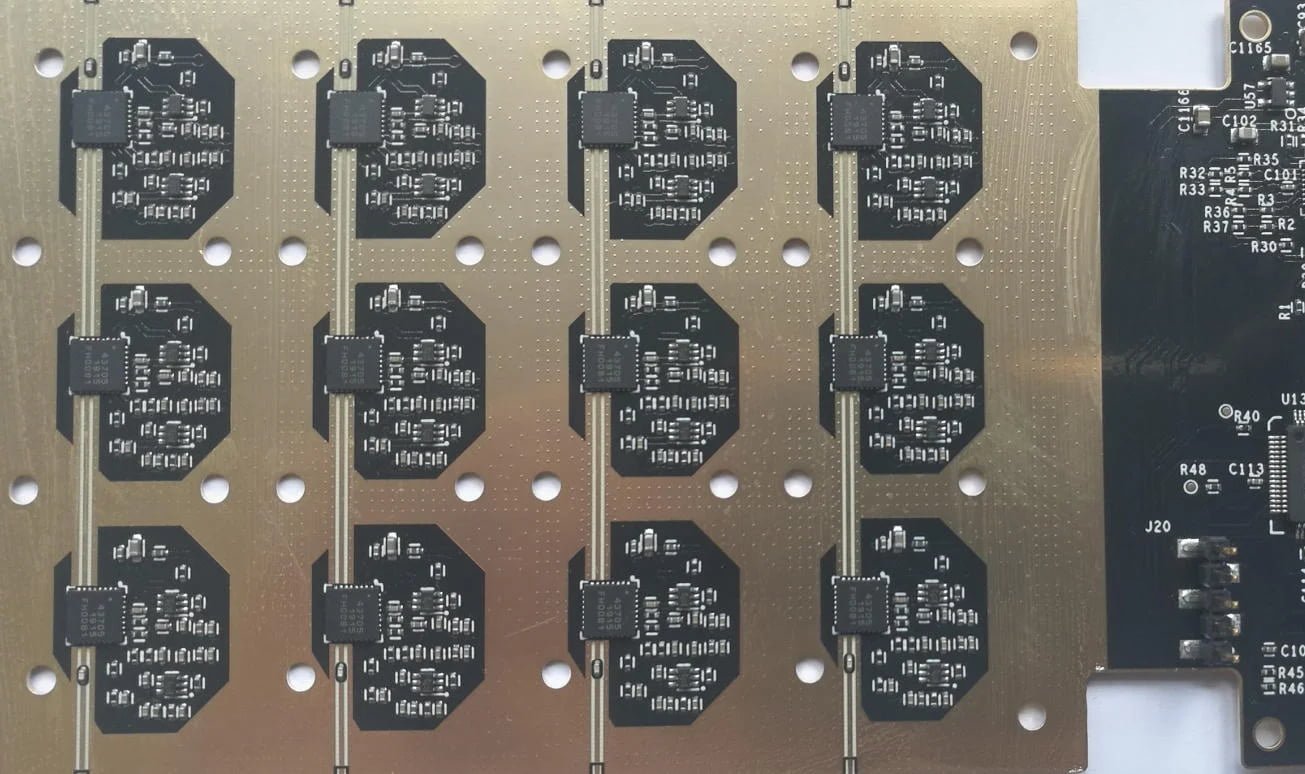
A RF attenuator PCB assembly is a practical example of a signal-sensitive board where Parylene N may be reviewed for thin conformal protection with low dielectric impact.
What to Prepare Before Requesting a Parylene N Coating Quote
Because this material is usually selected for a specific electrical reason, the quote package should make that reason clear. The most useful items to prepare are:
- PCB assembly drawings or clear board photos
- notes about RF, antenna, or signal-sensitive areas
- the operating environment
- prototype, pilot run, or production-run quantity
Conclusion
Parylene N is not a general-purpose coating choice for every PCB assembly. Its main value is electrical performance. When a board is sensitive to dielectric loss, signal behavior, RF performance, or antenna tuning, Parylene N is often worth reviewing.
For RF, microwave, antenna, and other signal-sensitive PCB assemblies that need vapor-deposited conformal coating, ACE Electronics can support production with Parylene coating service.
Frequently Asked Questions
What makes Parylene N suitable for RF and signal-sensitive PCB assembly?
What makes Parylene N suitable for RF and signal-sensitive PCB assembly?
Parylene N is often reviewed for RF and signal-sensitive PCB assembly because it combines thin conformal coverage with low dielectric constant, very low dissipation factor, and electrical behavior that stays relatively stable across frequency.
What is the dielectric constant of Parylene N?
What is the dielectric constant of Parylene N?
Typical published values place the dielectric constant of Parylene N at about 2.65 at 60 Hz and 1 kHz. That is one reason it is discussed for RF and other signal-sensitive electronics.
What is the dissipation factor of Parylene N?
What is the dissipation factor of Parylene N?
Typical published values are about 0.0002 at 60 Hz and 1 kHz, and about 0.0006 at 1 MHz. These low values help explain why Parylene N is associated with low-loss electrical behavior.
What kinds of PCB assemblies may use Parylene N?
What kinds of PCB assemblies may use Parylene N?
Common examples include RF modules, microwave-related circuits, antenna-related electronics, and other signal-sensitive assemblies where coating dielectric behavior matters as much as basic surface protection.
What should be included in a Parylene N coating quote request?
What should be included in a Parylene N coating quote request?
Include the PCB assembly drawing or photos, coated and no-coat areas, any RF or signal-sensitive zones, the operating environment, and the expected order stage or quantity. That gives the coating partner enough context to review the request properly.