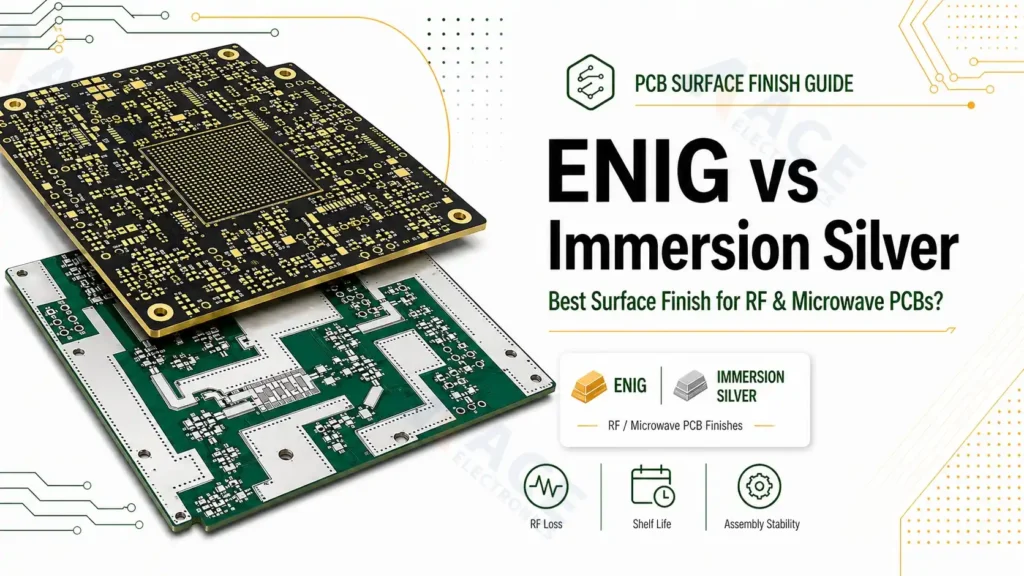
For RF and microwave PCBs, the surface finish decision is often between ENIG and immersion silver.
- Use immersion silver if nickel-free conductivity and lower insertion loss are non-negotiable.
- Use ENIG if you prioritize shelf life, solderability stability, and broad supplier availability. Accept the penalty: the nickel layer increases finish-related loss.
The right choice depends on frequency, loss budget, assembly plan, storage time, and supplier capability.
For a full overview of common finishes, read ACE Electronics' guide to PCB surface finish selection.
Quick Answer: ENIG or Immersion Silver?
| Requirement | Better starting choice |
|---|---|
| Lowest finish-related RF loss | Immersion silver |
| Nickel-free signal path | Immersion silver |
| Longer shelf life | ENIG |
| Wider supplier support | ENIG |
| Stable cosmetic appearance | ENIG |
| Fine-pitch SMT and BGA assembly | ENIG or immersion silver |
| Controlled storage and fast assembly | Immersion silver |
| Uncertain assembly timing | ENIG |
| Lower Cost | Immersion silver |
| High-reliability mixed interconnects | Review ENEPIG |
Why Surface Finish Matters in RF and Microwave PCBs
At RF and microwave frequencies, current flows closer to the conductor surface. This is the skin effect.
Because more current travels near the surface, the metal stack on the copper trace can affect loss. Surface finish matters more when the design runs at higher frequency, has a tight insertion loss budget, or uses exposed RF pads, launches, filters, antennas, or transmission lines.
Surface finish is not the only factor. Laminate material, copper roughness, trace geometry, stackup, impedance control, via transitions, connector launch, and solder mask also affect RF performance.
Use surface finish selection as one part of the RF design review, not as a replacement for stackup and layout control.
ENIG for RF and Microwave Boards
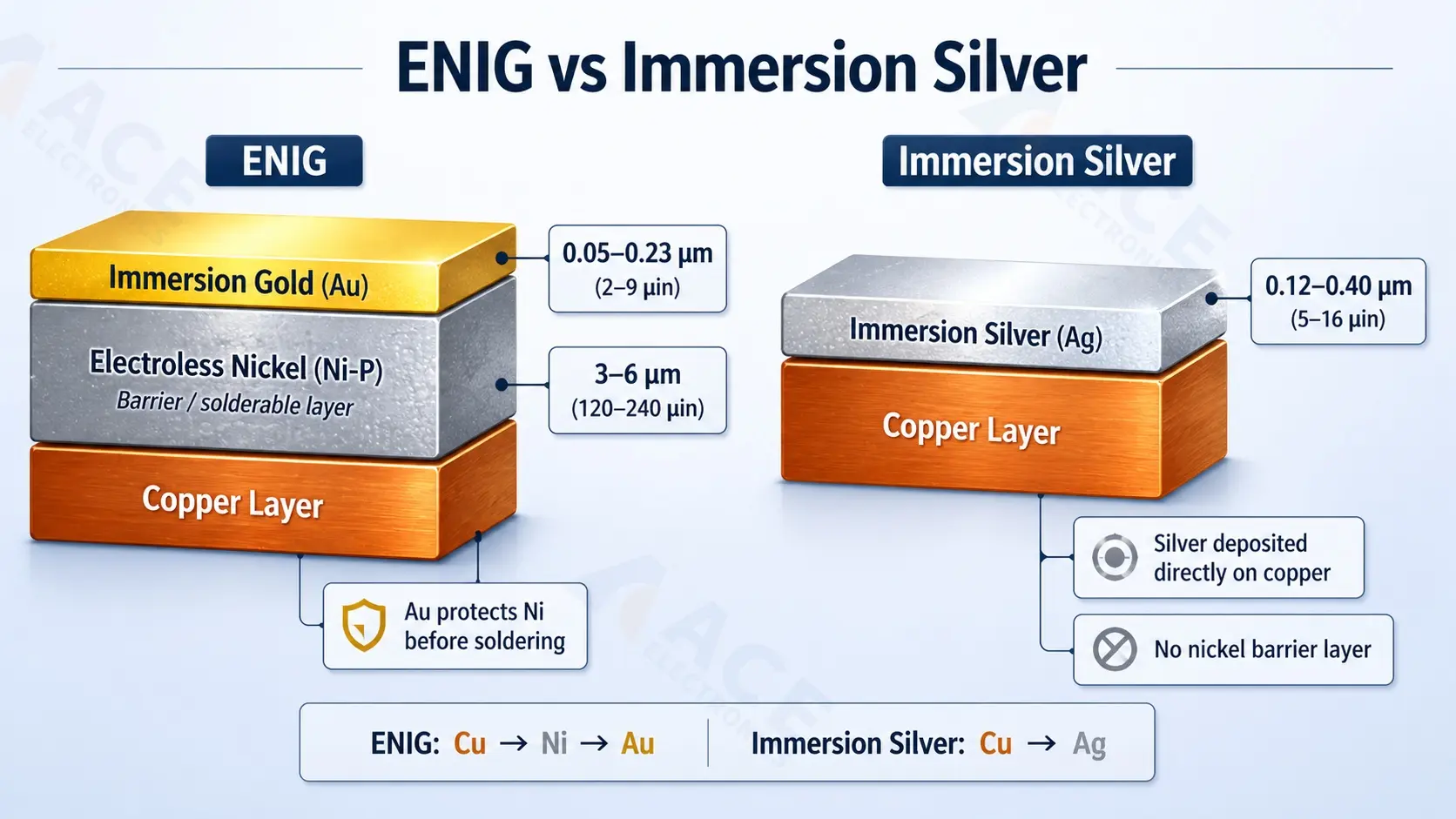
ENIG stands for Electroless Nickel Immersion Gold. Its structure is:
- Thin gold
- Nickel
- Copper
The nickel layer improves storage stability, solderability, and corrosion resistance. The thin gold layer protects the nickel from oxidation before soldering.
ENIG is widely used in RF PCBs because it is mature, flat, easy to source, and stable through normal assembly and storage.
The trade-off is the nickel layer. Nickel has lower conductivity than copper or silver. In RF and microwave designs, that nickel layer can add surface-finish-related loss.
For many RF products, the loss is acceptable. For more loss-sensitive microwave designs, review ENIG against the frequency range, line length, insertion loss budget, and test requirement.
For more detail, read ACE Electronics' guide to ENIG PCB surface finish.
Immersion Silver for RF and Microwave Boards
Immersion silver has a simpler metal structure:
- Thin silver
- Copper
It does not use a nickel barrier layer. Silver has very high electrical conductivity, so immersion silver is often preferred when finish-related loss needs to stay low.
Immersion silver works well when the production flow can control packaging, storage, and handling. The main risk is tarnish. Silver can react with sulfur, chlorine, humidity, fingerprints, and air contaminants.
For RF or microwave boards with long storage, multiple warehouse transfers, or uncertain assembly timing, ENIG is usually easier to manage.
For more detail, read ACE Electronics' guide to immersion silver PCB surface finish.
ENIG vs Immersion Silver Comparison Table
| Factor | ENIG | Immersion Silver |
|---|---|---|
| Layer structure | Copper + nickel + gold | Copper + silver |
| Nickel layer | Yes | No |
| RF loss | Higher than immersion silver in loss-sensitive designs | Lower finish-related loss |
| Surface flatness | Excellent | Excellent |
| Solderability | Very stable | Excellent when stored correctly |
| Shelf life | Often around 12 months | Often around 6 months |
| Handling sensitivity | Lower | Higher |
| Tarnish risk | Low | Higher |
| Supplier availability | Very broad | More supplier-dependent |
| Cost | Higher | Usually lower |
| Best fit | RF boards needing stable process window | RF/microwave boards needing nickel-free conductivity |
When to Choose ENIG
Choose ENIG when manufacturing stability matters more than the smallest possible finish-related loss.
Good ENIG applications include:
- RF boards with moderate loss budget
- Wireless modules with fine-pitch SMT
- RF control boards with mixed digital and RF circuits
- Industrial RF products with longer storage time
- Boards that may wait before assembly
- Projects with stricter cosmetic inspection
ENIG is also practical when the RF path is short, the design frequency is moderate, or the total loss budget is dominated by laminate, copper roughness, vias, connectors, or layout.
When to Choose Immersion Silver
Choose immersion silver when RF performance is more sensitive to finish conductivity and the supply chain can control storage and assembly.
Good immersion silver applications include:
- Microwave boards with tighter insertion loss targets
- RF feed lines where nickel-free finish matters
- Antenna feed boards
- Low-loss RF modules
- Need lower cost on PCB
For immersion silver, plan sealed packaging, glove handling, clean storage, and timely assembly after opening.
What About OSP, HASL, ENEPIG, and Hard Gold?
ENIG and immersion silver are usually the main RF surface finish choices. Other finishes may appear in specific cases.
| Finish | RF / microwave position |
|---|---|
| OSP | Possible for selected short-cycle products, but not a typical RF default |
| HASL / Lead-Free HASL | Usually limited by surface flatness and process variation |
| Immersion Tin | Flat and solderable, but shelf life and tin whisker risk need review |
| ENEPIG | Useful for special reliability, soldering, or wire bonding needs, but includes nickel |
| Hard Gold | Used for gold fingers and contact areas, not as a general RF solder pad finish |
| Soft Gold | Used for wire bonding, not common for standard RF SMT pads |
For repeated-contact areas, use hard gold only where the contact function needs it. See ACE Electronics' guide to hard gold PCB surface finish and the PCB gold fingers design guide.
For high-reliability soldering or wire bonding, review ENEPIG PCB surface finish.
Surface Finish Is Only One Part of RF Performance
Surface finish can affect RF loss, but it is rarely the largest factor by itself.
Review these items together:
- Laminate Dk and Df
- Copper roughness
- Trace width and spacing
- Stackup
- Impedance control
- Via transitions
- Solder mask over RF traces
- Ground reference continuity
- Plating and finish on exposed pads
- RF test method and acceptance criteria
For microwave boards, copper roughness, laminate loss, and launch design often affect performance more than the difference between two acceptable finishes.
Fabrication Notes for RF Surface Finish Selection
The fabrication notes should make the finish requirement clear.
For ENIG:
Surface finish: ENIG. Control nickel and gold thickness per supplier standard and applicable IPC requirement. Finish selected for solderability, storage stability, and fine-pitch assembly.
For immersion silver:
Surface finish: Immersion Silver per IPC-4553. Target silver thickness: 5-18 microinches. Boards to be sealed after fabrication. Handle with gloves and protect from sulfur, chlorine, moisture, and contamination.
For RF-sensitive immersion silver designs:
Surface finish selected for nickel-free RF performance. Maintain immersion silver finish on exposed RF pads, antenna feed areas, and connector launch pads.
For projects where RF performance is measured after assembly, include the test requirement in the drawing package or manufacturing notes.
What ACE Electronics Usually Recommends
At ACE Electronics, we review RF and microwave surface finish by balancing electrical loss and production risk.
We usually review ENIG when the project needs:
- Stable solderability
- Longer storage
- Fine-pitch SMT or BGA assembly
- Broad supplier support
- Easier inspection and handling
- A wider production window
We usually review immersion silver when the project needs:
- Nickel-free finish
- Lower finish-related RF loss
- High conductivity
- Flat pads
- Controlled storage and fast assembly
- Lower cost than ENIG
For RF and microwave projects, we also review laminate selection, stackup, impedance control, copper roughness, via transitions, connector launches, and assembly flow.
If you need fabrication support, see ACE Electronics' PCB fabrication service. If your RF project also needs component sourcing, SMT assembly, testing, and shipment, see our turnkey PCBA manufacturing.
Final Decision Checklist
| Question | If yes |
|---|---|
| Is lowest finish-related RF loss the priority? | Start with immersion silver |
| Does the design require a nickel-free finish? | Start with immersion silver |
| Does the project need long storage before assembly? | Start with ENIG |
| Is supplier flexibility important? | Start with ENIG |
| Does the board use fine-pitch SMT or BGA? | ENIG or immersion silver can both work |
| Is tarnish or handling control difficult? | Start with ENIG |
| Is the RF path very short or loss budget relaxed? | ENIG may be practical |
| Is the board a loss-sensitive microwave design? | Review immersion silver first |
| Does the board include gold fingers? | Use hard gold only for the contact area |
ENIG and immersion silver are both valid RF PCB finishes. Choose based on loss budget, frequency, assembly schedule, and supply chain control.
Frequently Asked Questions
What is the best surface finish for RF PCBs?
What is the best surface finish for RF PCBs?
ENIG and immersion silver are the most common choices. Immersion silver is better when nickel-free conductivity and lower finish-related loss matter most. ENIG is better when shelf life, solderability stability, and supplier support matter more.
Is ENIG suitable for RF PCBs?
Is ENIG suitable for RF PCBs?
Yes. ENIG is widely used for many RF PCBs. Its nickel layer can add surface-finish-related loss, but many RF designs can tolerate it, especially when the project needs stable solderability and longer shelf life.
Is immersion silver better than ENIG for microwave PCBs?
Is immersion silver better than ENIG for microwave PCBs?
Immersion silver is often better for loss-sensitive microwave designs because it has no nickel layer and provides high conductivity. ENIG may still be selected when the design has enough loss margin and the manufacturing window is more important.
Why does the nickel layer in ENIG matter for RF?
Why does the nickel layer in ENIG matter for RF?
At RF and microwave frequencies, current flows near the conductor surface. ENIG includes a nickel barrier layer, and nickel has lower conductivity than copper or silver. This can increase finish-related loss in sensitive RF paths.
Does immersion silver have a nickel layer?
Does immersion silver have a nickel layer?
No. Immersion silver is deposited directly over copper and does not use a nickel barrier. This is one reason it is attractive for RF and microwave PCBs.
Why do many RF boards still use ENIG?
Why do many RF boards still use ENIG?
ENIG provides stable solderability, longer shelf life, good surface flatness, broad supplier availability, and easier handling. Many RF designs can accept the nickel layer within the overall loss budget.
Is OSP commonly used for RF PCBs?
Is OSP commonly used for RF PCBs?
OSP is not usually the first-choice finish for RF or microwave PCBs. It may be used in selected short-cycle products, but ENIG and immersion silver are more common RF surface finish choices.
What should I specify for immersion silver RF boards?
What should I specify for immersion silver RF boards?
Specify immersion silver per IPC-4553, target silver thickness such as 5-18 microinches, sealed packaging, glove handling, and protection from sulfur, chlorine, moisture, and contamination. For RF-sensitive areas, state that the finish is selected for nickel-free RF performance.
About the Author
Bill Ho is Sales Engineer and Chief Editor at ACE Electronics, with 10 years of experience in PCB fabrication and PCB assembly.
He writes practical technical content focused on manufacturability review, fabrication communication, and assembly risk reduction.