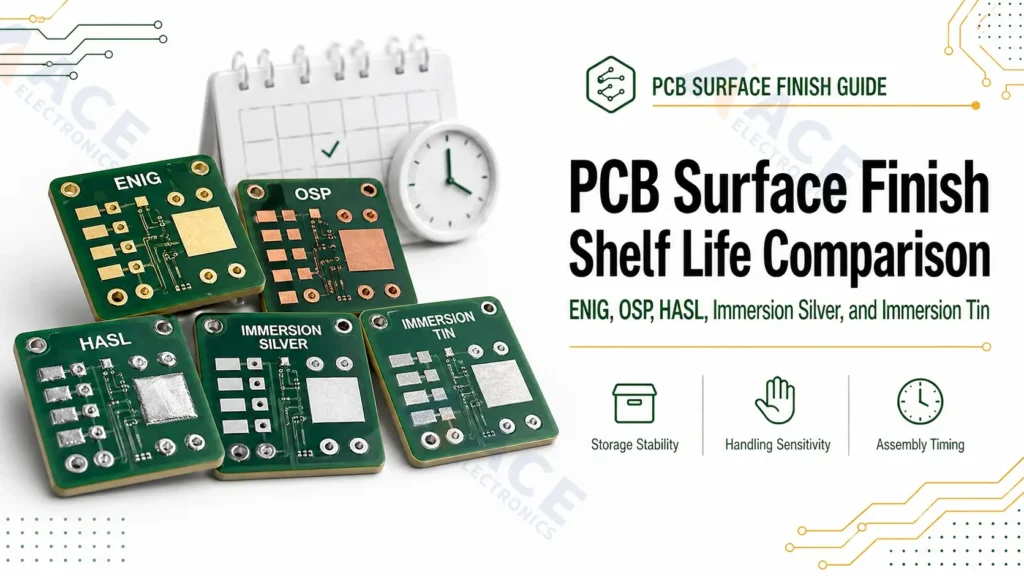
PCB surface finish shelf life is the useful storage time before bare PCBs move to soldering.
For PCB designers, hardware engineers, and OEM project managers, the decision is not only about finish chemistry. It is about how long the boards will wait, how they will be packed, who will handle them, and whether the assembly date is fixed.
This guide compares ENIG, OSP, HASL, immersion silver, and immersion tin from a manufacturing planning point of view. For a broader finish selection guide, see PCB surface finish options.
Quick Answer: Which Finish Has the Longest Shelf Life?
For most OEM projects, ENIG and HASL are easier to store than OSP, immersion silver, and immersion tin.
| Surface finish | Typical practical shelf life* | Storage sensitivity | Best project fit |
|---|---|---|---|
| ENIG | Around 12 months | Medium | Fine-pitch SMT, BGA, NPI, export projects, flexible assembly schedules |
| HASL / Lead-Free HASL | 12+ months in many controlled cases | Low to medium | Simple boards, through-hole-heavy assemblies, wide-pitch SMT |
| OSP | 3-6 months conservative estimate | High | Fast-turn SMT assembled soon after fabrication |
| Immersion Silver | 6-12 months with proper packaging | High | RF, high-speed, flat SMT surfaces with controlled storage |
| Immersion Tin | 3-6 months conservative estimate | High | Press-fit or specific tin-interface requirements with controlled inventory |
*These are practical estimates, not universal guarantees. Always confirm the PCB supplier's stated shelf life, packaging method, storage condition, and solderability test requirement.
Why Surface Finish Shelf Life Matters
The surface finish protects exposed copper pads before soldering. When the finish degrades, solder wetting becomes less predictable.
Shelf life becomes more important when bare PCBs are not assembled immediately after fabrication. This can happen because of component lead times, prototype changes, customer inventory, cross-border shipping, or separate PCB and EMS suppliers.
Before releasing files for PCB fabrication service, define the expected time from bare PCB completion to assembly.
ENIG Shelf Life
ENIG has a nickel layer over copper and a thin immersion gold layer over nickel. The gold protects the nickel surface before soldering, giving ENIG better storage tolerance than OSP and more predictable handling than immersion silver or immersion tin.
Choose ENIG when the board has:
- BGA, QFN, LGA, CSP, or fine-pitch SMT
- Long bare-board storage demand before assembly
ENIG also provides a flat surface, which makes it suitable for BGA and fine-pitch assembly. For package-specific guidance, read Best PCB Surface Finish for BGA Assembly.
ENIG still depends on plating quality. Poor process control can create nickel corrosion or black pad risk. For high-reliability projects, confirm nickel thickness, gold thickness, applicable IPC requirements, packaging, and solderability control.
For a deeper explanation, see What Is ENIG PCB Surface Finish.
OSP Shelf Life
OSP is a thin organic coating over copper. It is low-cost, lead-free, and very flat, but it gives less storage time than ENIG or HASL.
Choose OSP when:
- Assembly will happen soon after fabrication
- The production flow is stable
- Cost control is important
- Packaging and handling are controlled
OSP is best treated as a short-storage finish. It can work well in a controlled SMT flow, especially when bare PCBs do not sit in inventory.
For a dedicated OSP discussion, read What Is OSP PCB Surface Finish.
HASL Shelf Life
HASL and lead-free HASL usually provide good storage tolerance and strong solderability for simple boards.
HASL creates a solder-coated surface. That surface works well for through-hole parts, large pads, connectors, and less dense SMT assemblies. It is less suitable for BGA, QFN, LGA, CSP, and fine-pitch components because the coating thickness can be uneven.
Choose HASL when:
- The design has large SMT pads or through-hole components
- Fine-pitch coplanarity is not critical
- The product is cost-sensitive
ENIG is a good choice when your PCB needs flat pads, consistent paste printing, and reliable fine-pitch soldering, and you can accept a higher finish cost.
Immersion Silver Shelf Life
Immersion silver provides a flat, solderable, lead-free surface with good electrical performance.
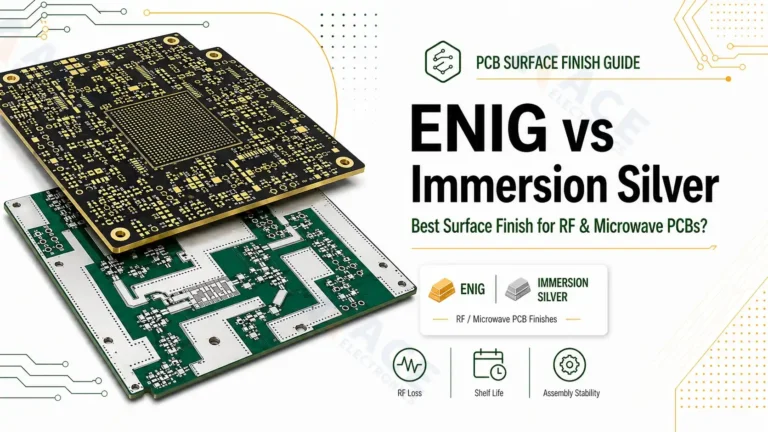
It is often considered for RF, microwave, high-speed, and certain fine-pitch SMT boards. Its shelf life risk comes mainly from tarnish and contamination.
Immersion silver needs controlled packaging and handling. Moisture, sulfur, chlorine, fingerprints, paper, cardboard, foam, rubber, and polluted air can reduce the useful solderability life.
Choose immersion silver when:
- RF or high-frequency performance matters
- A flat solderable surface is required
- Boards will stay sealed until assembly
- Storage materials are sulfur-free
- Operators use gloves and edge handling
- The assembly date is confirmed
For RF and microwave boards, review electrical performance together with storage, shipping, and assembly timing.
Immersion Tin Shelf Life
Immersion tin is a flat metallic finish applied directly over copper.
It can support solderability, press-fit applications, and specific connector requirements. Its shelf life depends heavily on supplier process control and storage discipline.
The main technical issue is copper-tin intermetallic growth. Over time, copper and tin interact, reducing the remaining solderable tin layer. Oxidation, humidity, contamination, and repeated thermal exposure can further reduce solderability.
Choose immersion tin when:
- The project has a clear technical reason for tin
- Press-fit or connector behavior is part of the requirement
- Assembly schedule is confirmed
- Incoming inspection is defined
- Reflow and rework count are limited
- The supplier has stable immersion tin process control
Immersion tin should be selected as a controlled engineering choice, not as a general substitute for ENIG, OSP, or HASL.
What Reduces PCB Shelf Life?
| Factor | Effect |
|---|---|
| Humidity | Increases oxidation, corrosion, and contamination risk |
| Temperature fluctuation | Can create condensation inside packaging |
| Open-bag exposure | Reduces shelf life |
| Fingerprints | Oils, salts, and ionic contamination reduce solderability |
| Sulfur and chlorine | Especially harmful for immersion silver |
| Poor packaging material | Some paper, cardboard, foam, and rubber materials can contaminate finishes |
| Multiple reflows | Reduces margin for OSP and immersion tin |
| Rework | Adds local heat exposure and surface stress |
| Split suppliers | Creates handling gaps between fabrication, inventory, and assembly |
Packaging and Storage Guidelines
Use packaging rules that match the finish and project risk.
For most bare PCB storage:
- Keep boards sealed until assembly
- Use vacuum or moisture barrier packaging when specified
- Include desiccant when required
- Store boards in a clean, dry, temperature-stable area
- Use FIFO inventory control
- Record fabrication date, receiving date, and open-bag date
- Handle boards by the edges
- Use clean gloves for inspection and loading
- Reseal opened packs with fresh desiccant when boards are not used immediately
- Keep immersion silver away from sulfur-containing materials
- Run solderability checks when boards exceed the supplier's stated shelf life
Opened packages should be handled as a reduced shelf life condition compared with sealed packages, especially for OSP, immersion silver, and immersion tin.
Baking may help with moisture management in some cases, but it does not restore a contaminated or degraded surface finish.
How Shelf Life Affects OEM PCBA Projects
Surface finish selection should match the real manufacturing path.
Prototype and NPI Builds
For NPI builds, confirm the assembly timing before ordering bare PCBs. If the assembly may wait for firmware, test fixtures, mechanical parts, or substitute components, include that delay in the finish decision.
Component Sourcing
When ACE Electronics manages component sourcing and assembly together, the finish can be matched to actual BOM readiness. This is one reason many OEM customers prefer turnkey PCBA manufacturing instead of separating PCB fabrication, purchasing, and SMT assembly across different suppliers.
RF and Microwave Boards
For RF and microwave designs, immersion silver may be attractive because of electrical behavior and surface flatness. The decision should also include tarnish control, sulfur-free storage, and the expected time before soldering.
Frequently Asked Questions
What is PCB surface finish shelf life?
What is PCB surface finish shelf life?
PCB surface finish shelf life is the period during which a bare PCB is expected to remain solderable before assembly under specified storage and handling conditions.
Which PCB surface finish has the longest shelf life?
Which PCB surface finish has the longest shelf life?
ENIG and HASL are generally easier to manage for longer storage than OSP, immersion silver, and immersion tin. ENIG is usually preferred when the board also needs flatness for BGA, QFN, LGA, CSP, or fine-pitch SMT assembly.
What is the typical ENIG shelf life?
What is the typical ENIG shelf life?
ENIG is commonly planned around a 12-month shelf life under proper storage, though the accepted period depends on the PCB supplier, specification, packaging, and solderability requirements.
What is the typical OSP shelf life?
What is the typical OSP shelf life?
OSP is often planned conservatively around 3-6 months for OEM projects. It is best suited for boards assembled soon after fabrication in a controlled process.
What is the typical immersion silver shelf life?
What is the typical immersion silver shelf life?
Immersion silver is commonly planned around 6-12 months with proper packaging and clean handling. Sulfur, chlorine, humidity, fingerprints, and unsuitable packaging materials can reduce shelf life.
What is the typical immersion tin shelf life?
What is the typical immersion tin shelf life?
Immersion tin is often planned conservatively around 3-6 months for controlled OEM projects. Copper-tin intermetallic growth, oxidation, humidity, and repeated reflow can reduce solderability.
Is HASL better than ENIG for shelf life?
Is HASL better than ENIG for shelf life?
HASL can have good storage tolerance, but ENIG is usually better for fine-pitch SMT, BGA, and high-density assemblies because it provides a flatter surface.
Does opening the PCB package reduce shelf life?
Does opening the PCB package reduce shelf life?
Yes. Once sealed packaging is opened, boards are exposed to air, moisture, and contamination. Opened OSP, immersion silver, and immersion tin boards should move to assembly quickly or be resealed properly.
Can old PCBs still be assembled?
Can old PCBs still be assembled?
Old PCBs may still be assembled if solderability is acceptable. For boards beyond the supplier's shelf life, use incoming inspection and solderability testing before production.
Which surface finish should I choose if components may be delayed?
Which surface finish should I choose if components may be delayed?
ENIG is usually the safer choice when components may be delayed because it gives more storage and handling margin than OSP, immersion silver, or immersion tin.
About the Author
Bill Ho is Sales Engineer and Chief Editor at ACE Electronics, with 10 years of experience in PCB fabrication and PCB assembly.
He writes practical technical content focused on manufacturability review, fabrication communication, component sourcing, and assembly risk reduction for OEM electronics projects.