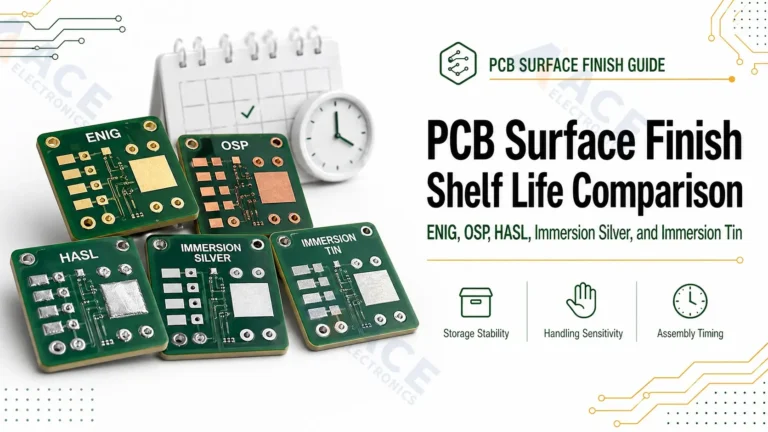
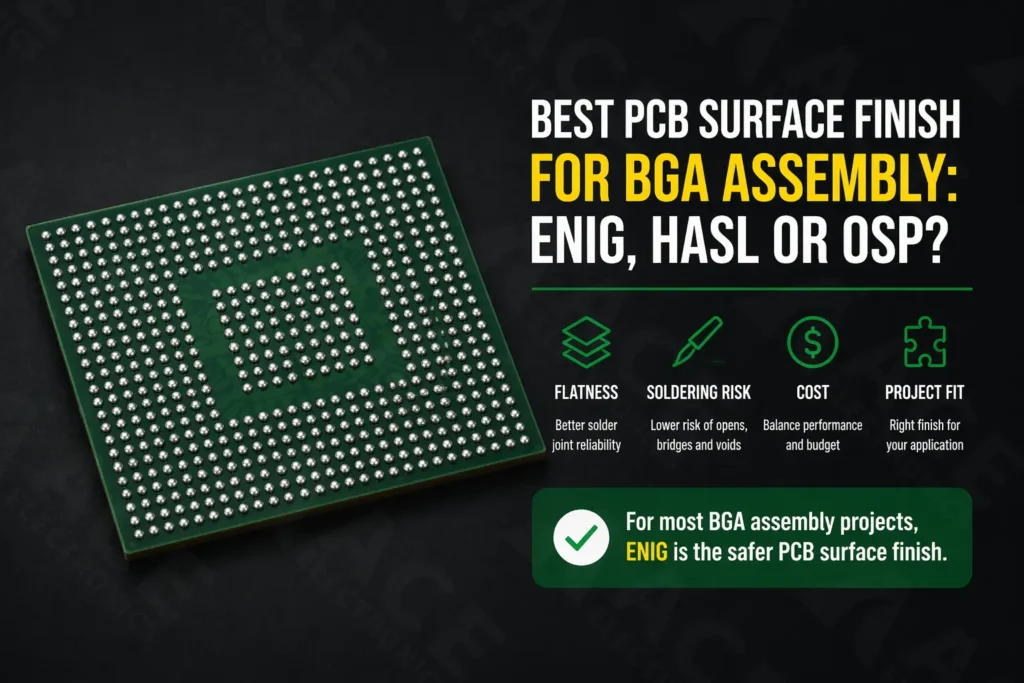
Many customers ask us the same question before PCB fabrication and assembly: if a board has BGA components, which surface finish of PCB should they use?
For most BGA assembly projects, ENIG is usually the safer surface finish.
For most BGA, QFN, fine-pitch, industrial, medical, automotive, and export PCBA projects, ENIG gives you a flatter and more stable soldering surface. That usually means lower assembly risk.
Quick Answer: Which Finish Should You Choose for BGA?
| Project situation | Better choice | Why |
|---|---|---|
| BGA or fine-pitch SMT assembly | ENIG | Flat surface, stable solderability, lower assembly risk |
| High-reliability industrial, medical, or automotive PCBA | ENIG | Better fit for demanding assembly and long service life |
| Cost-sensitive high-volume consumer product | OSP | Low cost and flat surface, if assembly happens quickly |
| Simple PCB without BGA or fine-pitch parts | HASL | Lower cost and good solderability for less dense designs |
| BGA board stored for a long time before assembly | ENIG | Better storage stability than OSP |
| BGA board with multiple reflow or rework steps | ENIG | More tolerant than OSP in complex assembly flows |
| Through-hole-heavy board with large pads | HASL | Practical and economical when flatness is not critical |
Short version:
- Choose ENIG if the board has BGA, QFN, fine-pitch ICs, high reliability requirements, or uncertain storage time.
- Consider OSP if the board is cost-sensitive, assembled soon after fabrication, and handled in a controlled process.
- Avoid HASL for most BGA projects because the surface is not flat enough for small hidden solder joints.
Why BGA Packages Need a Flatter PCB Surface
BGA solder joints are different from normal gull-wing leads or large SMT pads.
The solder balls sit under the component body. After reflow, you cannot inspect them visually from the outside. If there is poor wetting, bridging, open joints, excessive voiding, or uneven solder collapse, the issue may only show up during X-ray inspection, electrical testing, or field failure.
That makes the PCB surface finish more important.
For BGA assembly, the finish should help with:
- Pad flatness
- Consistent solder paste printing
- Stable solder wetting
- Lower risk of opens or bridges
- Better process repeatability
- Reasonable shelf life before assembly
A finish that works fine for a simple connector board may not be the right choice for a dense BGA board.
ENIG for BGA Assembly: Usually the Safer Choice
ENIG stands for Electroless Nickel Immersion Gold. It uses a nickel layer over copper, with a thin gold layer protecting the nickel surface before soldering.
For BGA assembly, the biggest advantage of ENIG is flatness.
BGA pads need consistent solder volume and stable contact between solder balls and PCB pads. ENIG provides a much flatter surface than HASL, which helps the solder balls collapse more evenly during reflow.
ENIG is usually a good choice when your board has:
- BGA, QFN, LGA, CSP, or fine-pitch ICs
- 0.5 mm pitch or smaller components
- High-density SMT layout
- Industrial control electronics
- Automotive electronics
- Medical electronics
- Communication modules
- Long product life requirements
- Uncertain storage time before assembly
- Multiple assembly, test
The downside is cost. ENIG is more expensive than HASL and OSP. But for BGA projects, the added PCB cost is often smaller than the cost of rework, scrap, delayed delivery, or field failure.
There is also a known ENIG risk called black pad. This is not a reason to avoid ENIG completely, but it is a reason to use a PCB supplier with stable plating control and proper inspection.
HASL for BGA Assembly: Usually Not Preferred
HASL stands for Hot Air Solder Leveling. The PCB is coated with solder and then leveled with hot air.
HASL is widely used because it is low cost, mature, and has good solderability. It can be a very practical surface finish for simple boards.
HASL is often suitable for:
- Through-hole assemblies
- Large SMT pads
- Low-density boards
- Cost-sensitive industrial controls
- Power boards without fine-pitch ICs
- Prototypes where fine-pitch assembly is not involved
The problem is surface flatness.
HASL can leave uneven solder thickness on pads. That may not matter much for large connectors or bigger passive components. But for BGA pads, uneven surface height can create soldering risk.
For BGA assembly, HASL may increase the chance of:
- Uneven solder paste volume
- Solder ball collapse variation
- Open joints
- Bridging
- Poor yield on fine-pitch packages
- More X-ray inspection failures
So the practical rule is simple:
Use HASL when the board is simple. Do not use HASL as the default choice for BGA or fine-pitch assembly.
OSP for BGA Assembly: A Lower-Cost Option, But Process-Sensitive
OSP stands for Organic Solderability Preservative. It is a thin organic coating applied over copper to protect the surface before soldering.
OSP has two big advantages:
- It is low cost.
- It provides a very flat surface.
That makes OSP interesting for BGA and fine-pitch designs, especially in high-volume consumer electronics. In the right production environment, OSP can work well.
But OSP is more sensitive than ENIG.
OSP works best when:
- The PCB will be assembled soon after fabrication.
- Storage time is short and controlled.
- Handling is clean and consistent.
- The assembly process is stable.
- The board does not need many reflow or rework cycles.
- The product is cost-sensitive and produced in volume.
OSP becomes risky when:
- Boards may sit in storage for months.
- Shipping and humidity conditions are uncertain.
- Operators handle boards manually without good controls.
- The assembly process includes multiple thermal cycles.
- The project has high reliability requirements.
- The customer cannot tolerate yield loss or rework delays.
For BGA projects, OSP is not “bad.” It is just less forgiving.
If your production flow is tightly controlled, OSP can reduce cost. If your project has uncertain timing, complex assembly, or high reliability requirements, ENIG is usually the better choice.
ENIG vs HASL vs OSP for BGA Assembly
| Factor | ENIG | HASL | OSP |
|---|---|---|---|
| BGA suitability | Excellent | Poor to limited | Good if process is controlled |
| Surface flatness | Excellent | Uneven | Excellent |
| Solderability | Excellent | Excellent | Good, but time and handling sensitive |
| Relative cost | High, often about 20-40% higher than OSP depending on board design and gold thickness | Low to medium, usually cheaper than ENIG | Low, usually one of the most economical finishes |
| Typical shelf life | 12 months or longer under proper storage | 6-12 months under proper storage | Usually 3-6 months, sometimes shorter if storage or handling is poor |
| Handling sensitivity | Low to medium | Low | High |
| Multiple reflow tolerance | Good | Good | Limited |
| Fine-pitch support | Excellent | Not ideal | Good |
| Best use case | BGA, QFN, high-reliability PCBA | Simple boards, large pads, through-hole | High-volume, cost-sensitive, fast-turn assembly |
| Main risk | Higher cost, plating quality control | Poor flatness for BGA | Storage, handling, and reflow sensitivity |
When You Should Choose ENIG for BGA
Choose ENIG if your project has any of these conditions:
- The PCB has BGA or fine-pitch ICs.
- The BGA pitch is 0.5 mm or smaller.
- The product is used in industrial, medical, automotive, or outdoor environments.
- The board may be stored before assembly.
- You need stable pilot production before scaling.
- The cost of rework is high.
- You need X-ray inspection confidence for hidden solder joints.
- The customer is in Europe or North America and expects strong quality documentation.
- The design is new and has not been proven in mass production yet.
For these projects, ENIG is usually not just a surface finish upgrade. It is a risk-control decision.
When OSP Can Be Acceptable for BGA
OSP can be acceptable for BGA when the project is cost-driven and the production process is controlled from PCB fabrication to assembly.
You may consider OSP when:
- The board is assembled shortly after PCB fabrication.
- The product is high-volume and cost-sensitive.
- The assembly factory has stable SMT process control.
- Storage and humidity are managed.
- The board does not require repeated reflow or repair.
- The customer accepts the trade-off between cost and process sensitivity.
OSP is common in many consumer electronics programs because the supply chain is fast and controlled. But for small-batch, high-mix, export PCBA projects, OSP can create more uncertainty.
If you are not sure how long the bare PCBs will sit before assembly, ENIG is usually safer.
When HASL Still Makes Sense
HASL can be a good choice when:
- The PCB has no BGA or fine-pitch packages.
- Most components are through-hole or large SMT.
- The board is cost-sensitive.
- The design is simple and proven.
- The assembly process does not need very tight coplanarity.
- The product does not require high-density SMT performance.
For example, a basic power control board with large connectors, relays, transformers, and 0805 or larger components may not need ENIG. In that case, HASL can save cost without adding much risk.
Practical Selection Guide Before You Send Gerber Files
Before confirming the PCB surface finish, check these questions:
-
Does the board have BGA, QFN, LGA, CSP, or fine-pitch ICs?
- If yes, start with ENIG as the default option.
-
What is the smallest component pitch?
- If the design has 0.5 mm pitch or below, avoid HASL.
-
Will the PCBs be stored before assembly?
- If storage time is uncertain, avoid OSP unless your supplier confirms the handling plan.
-
How many reflow or repair cycles are expected?
- If the process is complex, ENIG is usually safer than OSP.
-
Is this a high-reliability product?
- For industrial, automotive, medical, aerospace, or safety-related electronics, ENIG is usually the better starting point.
-
Is the product extremely cost-sensitive?
- If yes, OSP may be considered, but only with controlled storage and assembly timing.
-
Is this a new design or a proven mass production design?
- For new BGA designs, ENIG reduces early production risk.
What We Usually Recommend at ACE Electronics
For most BGA and fine-pitch PCBA projects, we recommend ENIG as the default surface finish.
This is especially true for:
- Prototype and NPI Stage
- Industrial control boards
- Automotive electronics
- Medical device electronics
- Communication modules
- High-density SMT assemblies
- Projects shipping to Europe or North America
We usually do not recommend HASL for BGA assembly unless the package pitch, pad design, and production risk have been reviewed carefully.
At ACE Electronics, our PCBA process can include SMT assembly, BGA placement, 3D SPI, AOI, X-ray inspection, component sourcing, PCB fabrication, and turnkey assembly support. If your board has BGA or fine-pitch components, we can review your Gerber, BOM, and assembly files before production and flag surface finish risks early.
Related Guides and Services
For a broader overview of PCB surface finishes, read: How to Choose PCB Surface Finish
For high-precision assembly support, see: SMT Assembly Service
For full project manufacturing, see: Turnkey Assembly Services
Frequently Asked Questions
Is ENIG always required for BGA assembly?
Is ENIG always required for BGA assembly?
No. ENIG is not always required, but it is usually the safer choice. OSP can work for some BGA projects if storage, handling, and assembly timing are tightly controlled. HASL is usually not preferred for BGA because of poor surface flatness.
Why is HASL not ideal for BGA?
Why is HASL not ideal for BGA?
HASL can create uneven pad surfaces. BGA solder joints are hidden under the package, so uneven pad height can increase the risk of opens, bridges, and inconsistent solder joints.
Can OSP be used for BGA?
Can OSP be used for BGA?
Yes, OSP can be used for BGA in controlled production. It is flat and low cost, but it is sensitive to handling, storage time, and multiple reflow cycles.
Which PCB finish is best for fine-pitch components?
Which PCB finish is best for fine-pitch components?
ENIG is usually the best general-purpose choice for fine-pitch SMT, BGA, QFN, and high-density PCB assembly. OSP can also work when the process is well controlled.
Is ENIG worth the higher cost?
Is ENIG worth the higher cost?
For BGA and high-reliability PCBA projects, usually yes. The extra PCB finish cost is often lower than the cost of rework, failed inspection, delayed delivery, or field failure.
What files should I send for surface finish review?
What files should I send for surface finish review?
Send Gerber files, BOM, pick-and-place file, assembly drawing, target quantity, reliability requirements, and any special storage or compliance needs. If the board has BGA, also share the package pitch and inspection requirements.
About the Author
Bill Ho is Sales Engineer and Chief Editor at ACE Electronics, with 10 years of experience in PCB fabrication and PCB assembly.
He writes practical technical content focused on manufacturability review, fabrication communication, and assembly risk reduction.