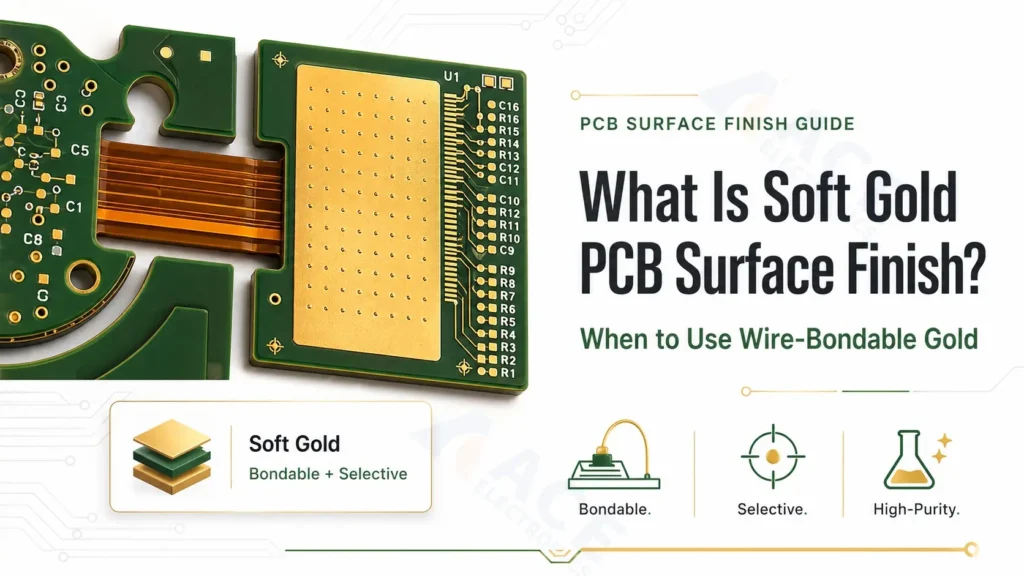
Soft gold PCB surface finish is a high-purity, low-hardness gold plating finish used mainly for wire bonding and other bondable gold pad applications.
It is not the same as hard gold. Hard gold is selected for wear resistance on gold fingers and edge connectors. Soft gold is selected when the PCB pad needs a bondable gold surface.
For a broader comparison of common finishes, read ACE Electronics' guide to PCB surface finish selection. This article focuses only on soft gold.
Quick Answer: What Is Soft Gold?
Soft gold is an electrolytic gold plating finish deposited over a nickel underplate. It uses high-purity gold with low hardness, which makes it suitable for gold wire bonding.
| Item | Practical answer |
|---|---|
| Full name | Electrolytic soft gold |
| Main purpose | Wire bonding and bondable gold pads |
| Typical structure | Copper + nickel + soft gold |
| Gold purity | Commonly 99.9% or higher |
| Typical soft gold thickness | Often 30-50 microinches for many wire-bondable PCB applications |
| Nickel underplate | Commonly 100-200 microinches |
| Main advantage | High-purity bondable gold surface |
| Main limitation | Higher cost and limited use case |
| Best fit | Wire bonding, COB, selected high-reliability bond pads |
When Should You Use Soft Gold?
Use soft gold when the PCB needs a clean, high-purity gold surface for bonding.
Typical use cases include:
- Gold wire bonding
- Chip-on-board applications
- Bondable gold pads
- Selected high-reliability interconnect areas
- Special electronic modules that require plated bond pads
Soft gold is usually a selective finish. It is applied only to the pads that require bonding, while other solderable pads may use ENIG, ENEPIG, OSP, immersion silver, or another finish.
For standard SMT assembly, soft gold is usually not the first choice. ENIG, OSP, HASL, immersion silver, immersion tin, or ENEPIG may fit better depending on the board requirement.
Soft Gold vs Hard Gold
Soft gold and hard gold are both electrolytic gold finishes, but they are used for different purposes.
| Finish | Main use | Key feature |
|---|---|---|
| Soft gold | Wire bonding and bondable pads | High purity and low hardness |
| Hard gold | Gold fingers, edge connectors, repeated contact areas | Wear resistance and durability |
Use soft gold when the pad must accept wire bonding.
Use hard gold when the surface must survive repeated insertion, sliding, or connector contact.
For contact-wear applications, read ACE Electronics' guide to hard gold PCB surface finish and our PCB gold fingers design guide.
Soft Gold vs ENIG and ENEPIG
Soft gold, ENIG, and ENEPIG can all include gold, but they solve different problems.
| Finish | Best use | Notes |
|---|---|---|
| Soft gold | Gold wire bonding | Electrolytic, thicker, high-purity gold |
| ENIG | SMT pads, BGA, fine-pitch assembly | Thin immersion gold over nickel; mainly solderable finish |
| ENEPIG | Soldering, wire bonding, high-reliability mixed interconnects | Nickel-palladium-gold stack; more flexible for mixed requirements |
Use ENIG for common solderable pads and fine-pitch SMT. Read more in our guide to ENIG PCB surface finish.
Use ENEPIG when the design needs both solderability and wire bonding support. Read more in our guide to ENEPIG PCB surface finish.
What to Specify in PCB Fabrication Notes
For soft gold, the fabrication notes should define the plated area, thickness, and bonding requirement.
Example note:
Selective soft gold over nickel on wire bonding pads. Soft gold thickness: 30-50 microinches. Nickel underplate: 100-200 microinches. Gold purity suitable for wire bonding.
If only certain pads need soft gold, mark those pads clearly in the fabrication drawing. Use another finish for the rest of the PCB when needed.
What ACE Electronics Usually Recommends
At ACE Electronics, we review soft gold only when the PCB requires wire bonding or special bondable gold pads.
For standard SMT, BGA, and fine-pitch PCBA, we usually review ENIG, ENEPIG, OSP, immersion silver, immersion tin, or HASL first.
For gold fingers and edge connectors, we review hard gold.
For OEM projects, ACE Electronics can review the Gerber files, fabrication notes, BOM, and assembly process before confirming the surface finish. If you need fabrication support, see our PCB fabrication service. If your project also needs component sourcing and assembly, see our turnkey PCBA manufacturing.
Frequently Asked Questions
What is soft gold PCB surface finish?
What is soft gold PCB surface finish?
Soft gold PCB surface finish is a high-purity electrolytic gold plating finish used mainly for wire bonding and bondable gold pads.
Is soft gold the same as hard gold?
Is soft gold the same as hard gold?
No. Soft gold is used for wire bonding because it is high-purity and low-hardness. Hard gold is used for gold fingers and edge connectors because it provides better wear resistance.
What is soft gold used for?
What is soft gold used for?
Soft gold is used for gold wire bonding, chip-on-board applications, bondable pads, and selected high-reliability interconnect areas.
What is the typical thickness of soft gold?
What is the typical thickness of soft gold?
For many wire-bondable PCB applications, soft gold is often specified at 30-50 microinches over a nickel underplate. The final value should match the bonding process and PCB fabricator capability.
Can soft gold be used for gold fingers?
Can soft gold be used for gold fingers?
Hard gold is the usual choice for gold fingers because it provides better wear resistance. Soft gold is selected for bonding, not repeated connector contact.
Is ENEPIG an alternative to soft gold?
Is ENEPIG an alternative to soft gold?
ENEPIG can be an alternative in designs that need both solderability and wire bonding support. The final choice depends on bonding method, assembly requirement, reliability target, and fabricator capability.
Is soft gold common in standard PCB assembly?
Is soft gold common in standard PCB assembly?
Soft gold is not common for standard SMT assembly. It is mainly used when the PCB requires wire bonding or special bondable gold pads.
About the Author
Bill Ho is Sales Engineer and Chief Editor at ACE Electronics, with 10 years of experience in PCB fabrication and PCB assembly.
He writes practical technical content focused on manufacturability review, fabrication communication, and assembly risk reduction.