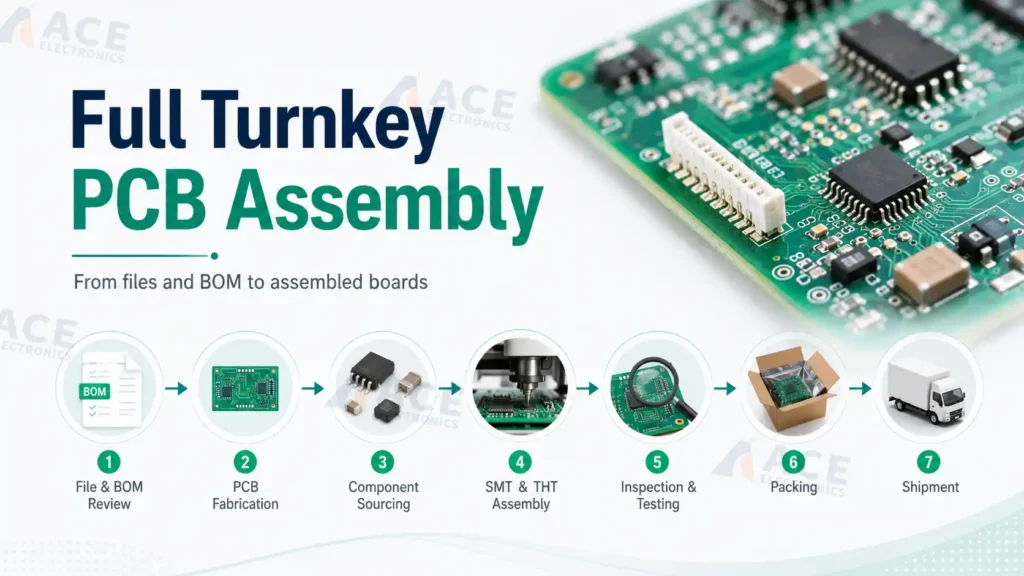
Full turnkey PCB assembly is an end-to-end PCBA production model where one assembly partner manages the main steps needed to turn design files and a BOM into assembled, inspected, and tested boards. A typical full turnkey PCB assembly order includes PCB fabrication, component procurement, SMT assembly, through-hole assembly when required, inspection, testing, packing, and production coordination.
Full-turnkey PCBA is a single-responsibility model: one supplier reviews your files, procures components, fabricates bare PCBs, assembles boards, and ships only after final approval.
Standard turnkey covers PCB fabrication, component sourcing, and assembly. For extra services — firmware flashing, functional testing, conformal coating, Parylene coating, box-build, labeling, or custom packaging — suggest to discuss with your supplier during the requesting a quote.
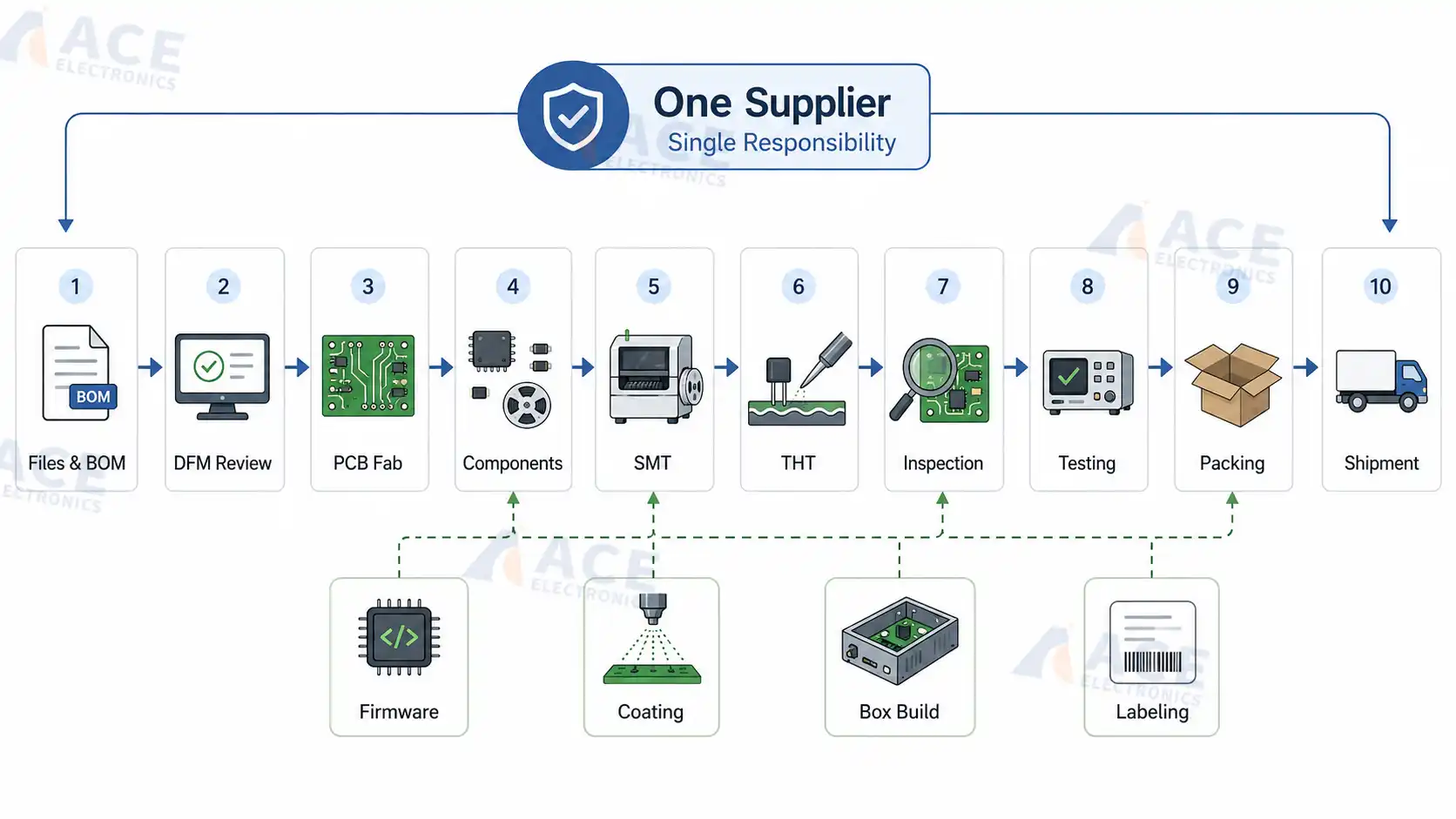
A workflow showing BOM review, PCB fabrication, component procurement, SMT assembly, through-hole assembly, inspection, testing, firmware loading, coating, final product assembly, packing, and shipment.
What Is Full Turnkey PCB Assembly?
Full turnkey PCB assembly means you ask one assembly partner to manage the major production steps for a PCBA order, instead of coordinating separate PCB suppliers, component vendors and other parts or enclosure suppliers by yourself.
In a full turnkey order, the assembly partner usually reviews the PCB fabrication files, checks the BOM, sources approved components, fabricate the bare PCBs, do SMT and through-hole assembly, runs agreed tests, and ships the finished PCBAs.
This differs from a consigned PCB assembly order, where you supply some or all components to the assembly factory. It also differs from a labor-only assembly order, where you may already have bare PCBs, parts, fixtures, and test plans prepared.
Full turnkey saves your team time coordinating multiple suppliers. Complete Gerbers, BOM, pick-and-place files, assembly drawings, test specs, and process notes get you accurate quotes and faster production.
What Is Usually Included in a Full Turnkey PCB Assembly Service?
Full turnkey covers PCB assembly production. Extended services — testing, coating, firmware, cables, plastic enclosures, CNC parts, or box-build.
| Service | Status | Clarify Before Quoting |
|---|---|---|
| PCB fabrication | Core | Material, layers, copper weight, surface finish, impedance control |
| BOM review | Core | MPNs, approved alternates, lifecycle status, package match |
| Component sourcing | Core | Authorized sources, lead time, MOQ, traceability, consigned parts |
| SMT assembly | Core | Min package size, fine-pitch/BGA, inspection level |
| Through-hole assembly | Core | Wave/selective/manual soldering, connector support, fixtures |
| Packing / shipping | Core | ESD protection, moisture barrier, labels |
| X-ray inspection | Extra | BGA/QFN void limits, record requirements |
| Electrical / functional test | Extra | Test fixture, procedure, pass/fail criteria, coverage |
| Firmware loading | Extra | File version, programming interface, serialization, verification |
| Conformal coating / Parylene coating | Extra | Material, masking, keep-outs, thickness, curing |
| Cable / wire harness | Extra | Pinout, connector types, wire gauge, length, labeling, crimp vs solder |
| Plastic enclosure / injection molding | Extra | Material (ABS/PC/PA), color, texture, draft angles, tolerances, UL rating |
| CNC machining (metal/plastic) | Extra | Material, tolerances, surface finish (anodize/powder coat), threading |
| Final product assembly / box-build | Extra | Enclosure, cables, labels, torque, accessories, packing |
Full Turnkey vs Partial Turnkey vs Consigned PCB Assembly
| Model | You Buy | Supplier Buys | You Manage | Best For |
|---|---|---|---|---|
| Full turnkey | Nothing | Components + PCB | Design, approvals, test specs | One partner, one point of contact |
| Partial turnkey | Critical/controlled parts | The rest + PCB | Sourcing for key components | Some parts must stay under your control |
| Consigned | Everything | Assembly only | Inventory, shortages, kit accuracy | You own stock or use internal procurement |
Full turnkey is often useful when you want fewer supplier handoffs. Partial turnkey is useful when several key parts are controlled by you but the rest of the BOM can be sourced by your assembly partner. Consigned assembly is useful when you already own the inventory, must use internal procurement channels, or need strict control over traceable components.
Labor price alone is a poor way to pick a sourcing model. A cheaper assembly quote often hides costs elsewhere. If your team still manages PCB fabrication, chases component shortages, approves substitutes, coordinates inbound logistics, and handles test setup on its own, the "savings" disappear quickly.
Factor in the hours your engineers and buyers spend on supplier management. Those salaries are part of the real project cost—even if they never appear on the assembly invoice.
Benefits of Full Turnkey PCB Assembly for Buyers
Full turnkey PCB assembly is most useful when the buyer wants fewer supplier handoffs and clearer responsibility across PCB fabrication, component sourcing, assembly, inspection, testing, and shipment.
| Benefit | Why It Matters to Buyers |
|---|---|
| Fewer supplier handoffs | You do not need to coordinate a PCB fabricator, component suppliers, assembly factory, test provider, and shipping contact separately. |
| Earlier BOM risk review | The assembly partner can flag obsolete parts, long-lead parts, package mismatches, lifecycle risks, and possible alternates before procurement starts. |
| Better alignment between PCB fabrication and assembly | Fabrication choices such as surface finish, panelization, solder mask clearance, fiducials, and stackup can be reviewed with assembly yield in mind. |
| Clearer quote and schedule control | PCB fabrication, component procurement, assembly, and agreed test steps can be planned under one production schedule. |
| Easier repeat production | Approved BOM revisions, sourcing records, alternates, inspection notes, and test requirements can be carried into the next production run. |
| More complete delivery scope | Firmware loading, conformal coating, Parylene coating, labeling, packing, enclosure assembly, or final product assembly can be included when they are defined before release. |
Related Production Examples
- A fixed wireless payment terminal project used a turnkey PCBA flow covering PCB fabrication, component sourcing, firmware flashing, functional testing, conformal coating, wire harnesses, housings, and export packaging.
- An energy storage inverter project shows how PCBA, wire harnesses, final product assembly, finished product testing, and packing can be coordinated under one production scope.
- A hydrogen forklift control board project shows where Parylene coating becomes relevant when PCBAs face condensation, dust, temperature cycling, and harsh industrial environments.
Buyer and Assembly Partner Responsibilities
Full turnkey does not mean hands-off. Your assembly partner handles sourcing and production, but design intent, critical substitutes, test coverage, and acceptance criteria must come from you. Agree on these boundaries before purchasing starts to avoid engineering holds.
| Responsibility area | Buyer provides | Assembly partner manages | Must align before production |
|---|---|---|---|
| Design files | Gerber, ODB++, IPC-2581, stackup, fab drawing | CAM review, DFM feedback, fabrication planning | File revision, material, surface finish, tolerance changes |
| BOM | MPNs, quantities, reference designators, approved alternates | BOM validation, sourcing review, lifecycle check | Substitutes, package changes, source changes |
| Placement data | Pick-and-place file, assembly drawing, polarity notes | Ref-des match, orientation review | Polarity issues, missing parts, DNI parts, rotation fixes |
| Testing | Test procedure, fixture status, firmware, pass/fail criteria | Test planning, fixture review | firmware version, failure handling |
| Special processes | Coating drawing, masking notes, enclosure files, label rules | Process routing, coating/assembly planning | Masking, coating material, enclosure steps, labeling |
When to Choose Full Turnkey, Partial Turnkey, or Consigned Assembly
| Situation | Better sourcing model | Why |
|---|---|---|
| You need one partner to manage PCB fabrication, parts, assembly, and test | Full turnkey | Reduces handoffs and keeps production responsibility in one scope |
| You already own critical components but need help sourcing the rest | Partial turnkey | Keeps controlled parts with you while reducing sourcing work |
| Your purchasing team must buy traceable or safety-related parts directly | Partial turnkey or consigned | Maintains procurement control |
| You already have all parts, boards, and test fixtures ready | Consigned assembly | Avoids paying the assembly partner to source items you already control |
| The order only needs bare PCB fabrication | PCB fabrication only | Full turnkey would add unnecessary scope |
| The order only needs SMT/THT labor | Consigned or labor-only assembly | Keeps the order narrow |
| Firmware loading, testing, coating, or enclosure assembly is required | Full turnkey, if included in scope | These steps need to be planned before production starts |
How to Work With a Full Turnkey PCB Assembly Partner
A full turnkey PCB assembly partner can manage more of the production path, but the order still needs clear engineering inputs and approval rules. You can reduce delays by preparing a complete file package and marking what cannot change.
Before releasing the order:
- send the complete PCB and assembly file package,
- mark critical components and no-substitute parts,
- approve acceptable alternates before procurement,
- confirm whether PCB fabrication is included,
- confirm whether test, firmware loading, coating, or final product assembly is included,
- define pass/fail criteria for testing,
- keep BOM, Gerber, firmware, and test files under revision control,
- confirm packing, labeling, and shipment requirements.
If your project requires PCB fabrication, component procurement, SMT assembly, through-hole assembly, testing, firmware loading, coating, or final product assembly under one production scope, ACE Electronics can review the quote package and identify what should be clarified before production starts. You can start from the PCBA contract manufacturing page or send the file package for review.
Frequently Asked Questions
What should I send first if I want a full turnkey PCB assembly quote?
What should I send first if I want a full turnkey PCB assembly quote?
Send the Gerber or ODB++ files, BOM, pick-and-place file, assembly drawing, quantity, target delivery date, and any test, firmware loading, coating, labeling, packing, or final product assembly requirements. If some files are not ready, state what is missing so the assembly partner can confirm whether a preliminary quote is possible.
Can I request a full turnkey quote if my BOM is not fully finalized?
Can I request a full turnkey quote if my BOM is not fully finalized?
Yes, but the quote should be treated as preliminary. Mark unconfirmed parts, approved alternates, do-not-substitute parts, and any parts that may change before production release. This helps the assembly partner separate real sourcing risk from normal BOM cleanup.
Who approves substitute components in a full turnkey order?
Who approves substitute components in a full turnkey order?
The buyer should approve substitute components before procurement. The assembly partner can suggest alternates, but package, electrical specification, lifecycle status, manufacturer, and availability should be reviewed before the BOM is released for purchasing.
Should I consign expensive, allocated, or security-related components?
Should I consign expensive, allocated, or security-related components?
Often, yes. If a part is expensive, allocated under your account, security-sensitive, serialized, safety-related, or controlled by your internal purchasing team, consigned or partial turnkey handling may be better than full turnkey sourcing for that part.
Will the assembly partner buy components before I approve the quote?
Will the assembly partner buy components before I approve the quote?
Normally, component procurement should not begin until the quote, BOM revision, alternates, lead time, and payment terms are approved. For urgent or long-lead parts, buyers should confirm the purchasing rule in writing before release.
What happens if a component becomes unavailable after quote approval?
What happens if a component becomes unavailable after quote approval?
The assembly partner should notify you, provide the affected line item, explain the shortage or lifecycle issue, and suggest sourcing options if available. Production should not continue with a substitute part unless the buyer approves the change.
How can I reduce back-and-forth before placing a full turnkey order?
How can I reduce back-and-forth before placing a full turnkey order?
Provide one controlled file package, mark the active PCB revision, clean up the BOM manufacturer part numbers, identify critical parts, include polarity and placement notes, define test requirements, and state whether firmware loading, coating, enclosure assembly, or special packing is required.
Does full turnkey PCB assembly include functional testing?
Does full turnkey PCB assembly include functional testing?
Only if functional testing is included in the agreed scope. Basic inspection is usually part of assembly, but fixture-based testing, firmware verification, test records, failure reporting, and retest rules should be defined before production starts.
Can I start with a prototype order and move to a production run later?
Can I start with a prototype order and move to a production run later?
Yes. For a smoother transition, keep the same BOM revision control, approved alternates, test requirements, inspection notes, and sourcing records from the prototype stage. Any design or component change should be reviewed before the next production run.
When is partial turnkey better than full turnkey?
When is partial turnkey better than full turnkey?
Partial turnkey is better when you want the assembly partner to manage PCB fabrication and some components, but you need to supply selected parts yourself. This is common when critical components are already owned, allocated, traceable, or controlled by your purchasing team.