ENIG is already a strong PCB surface finish for many BGA, QFN, fine-pitch, and high-reliability PCBA projects.
So why would an OEM pay more for ENEPIG?
The short answer: ENEPIG is usually worth considering when ENIG is technically acceptable but the project needs stronger protection against nickel corrosion risk, better wire bonding compatibility, or higher reliability margin. For many standard SMT assemblies, ENIG is enough. For wire bonding, complex packages, harsh environments, or mission-critical products, ENEPIG can be the safer choice.
This guide compares ENIG and ENEPIG from a buyer's point of view: cost, reliability, assembly risk, lead time, and when the upgrade makes sense.
For a basic explanation of ENIG first, read our guide to ENIG PCB surface finish. For a broader overview of all finishes, see our guide to PCB surface finish options.
Quick Answer: ENIG vs ENEPIG
ENIG and ENEPIG are both flat, lead-free PCB surface finishes used for modern SMT assembly.
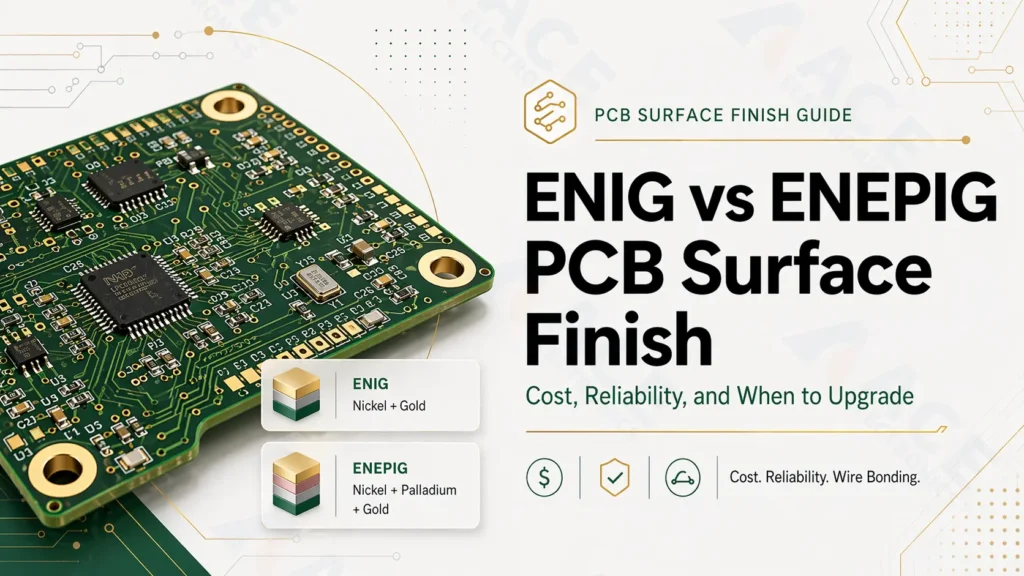
The difference is the palladium layer.
| Finish | Full name | Layer structure | Simple meaning |
|---|---|---|---|
| ENIG | Electroless Nickel Immersion Gold | Copper / Nickel / Gold | Standard high-reliability finish for many SMT and BGA projects |
| ENEPIG | Electroless Nickel Electroless Palladium Immersion Gold | Copper / Nickel / Palladium / Gold | Higher-spec finish for wire bonding, stronger reliability margin, and reduced nickel corrosion risk |
In simple terms:
- Choose ENIG when you need a flat, reliable surface for BGA, QFN, fine-pitch SMT, and normal high-reliability PCBA.
- Choose ENEPIG when the project involves wire bonding, demanding reliability requirements, complex packaging, or stronger concern about ENIG-related black pad risk.
- Do not choose ENEPIG only because it sounds more advanced. If the board does not need it, ENIG may be the better cost-performance choice.
What Is ENIG?
ENIG stands for Electroless Nickel Immersion Gold.
It has two metallic layers over copper:
- Electroless nickel
- Immersion gold
The nickel layer works as the main solderable barrier layer. The thin gold layer protects the nickel surface from oxidation before soldering.
ENIG is widely used because it provides:
- A flat surface for BGA and fine-pitch SMT
- Good solderability
- Better shelf life than OSP
- Lead-free compatibility
- Good performance for many industrial, medical, automotive, and communication products
For many OEM projects, ENIG is the default upgrade from HASL or OSP when assembly risk matters.
You can read more here: What Is ENIG PCB Surface Finish?
What Is ENEPIG?
ENEPIG stands for Electroless Nickel Electroless Palladium Immersion Gold.
It has three metallic layers over copper:
- Electroless nickel
- Electroless palladium
- Immersion gold
The key difference is the palladium layer between nickel and gold.
This palladium layer acts as a barrier. It helps reduce direct interaction between the nickel layer and the immersion gold process. That is why ENEPIG is often selected when buyers want lower risk of nickel corrosion-related defects, better wire bonding capability, and stronger reliability margin.
ENEPIG is commonly considered for:
- Wire bonding
- BGA, CSP, flip-chip, and fine-pitch packages
- High-reliability PCBA
- Medical electronics
- Aerospace and defense electronics
- Automotive electronics
- RF and communication modules
- Products with demanding thermal cycling or field reliability requirements
IPC-4556 and IPC-4556A define requirements for ENEPIG as a PCB surface finish. The exact revision should be confirmed with your customer, fabricator, and quality requirements.
ENIG vs ENEPIG Layer Structure
The layer structure is the easiest way to understand the difference.
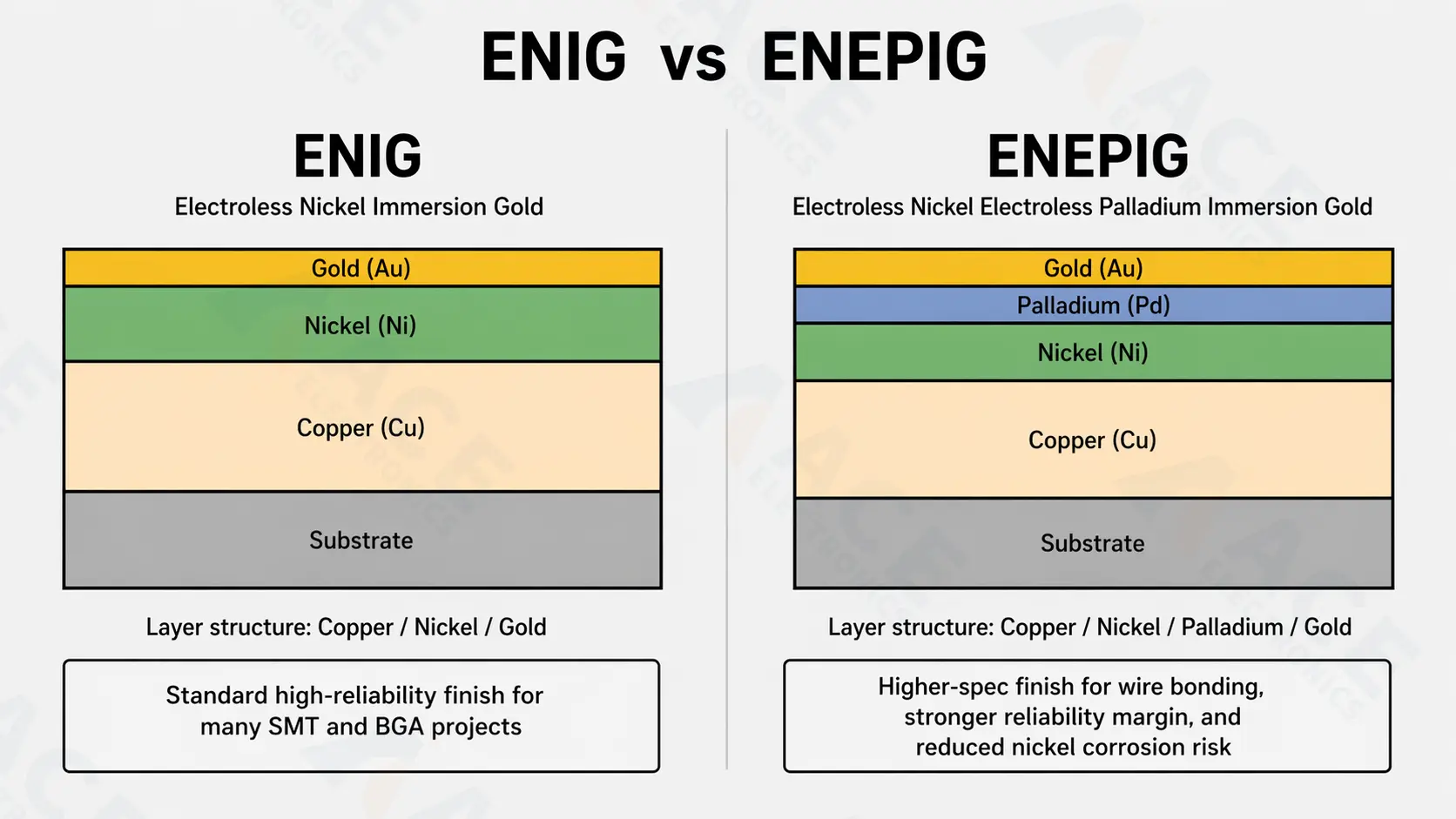
| Finish | Layer structure | Buyer takeaway |
|---|---|---|
| ENIG | Copper / Nickel / Gold | Good all-purpose high-reliability SMT finish |
| ENEPIG | Copper / Nickel / Palladium / Gold | Higher-reliability finish with added palladium barrier |
The palladium layer is the reason ENEPIG usually costs more. It also changes the reliability profile.
For buyers, the question is not only:
Which finish is better?
A better question is:
Does this project need the extra reliability margin that palladium provides?
If the answer is no, ENIG may be enough. If the answer is yes, ENEPIG may prevent much more expensive problems later.
Main Differences Between ENIG and ENEPIG
1. Cost
ENIG is usually less expensive than ENEPIG.
ENEPIG costs more because it adds:
- Palladium material cost
- An extra plating process
- Tighter process control
- More inspection requirements
- Potentially longer supplier coordination time
For simple or moderate-risk assemblies, ENIG often gives the better cost-performance balance.
For high-reliability or wire bonding projects, the extra cost of ENEPIG may be small compared with the cost of rework, failed validation, field returns, or customer quality complaints.
Simple buyer rule:
- If surface finish is mainly about flatness and shelf life, start with ENIG.
- If surface finish is also about wire bonding or reducing nickel corrosion risk, review ENEPIG.
2. Black Pad and Nickel Corrosion Risk
Black pad is a known risk associated with ENIG when the plating process is poorly controlled.
It is related to corrosion of the nickel layer during the immersion gold process. The result can be weak solder joints, brittle fracture, or reliability problems that may not be obvious during visual inspection.
ENEPIG helps reduce this risk because the palladium layer separates nickel from the final immersion gold layer. This gives the finish a more stable interface.
However, ENEPIG should not be described as "zero risk" in all cases. It still depends on proper nickel, palladium, and gold process control.
A safer way to say it:
ENEPIG can significantly reduce ENIG-related nickel corrosion and black pad risk, but it still requires a qualified plating process and proper inspection.
For high-reliability PCBA, this distinction matters. The finish is only as good as the supplier's process control.
3. Wire Bonding Compatibility
Wire bonding is one of the strongest reasons to choose ENEPIG.
ENIG is mainly used as a solderable finish. It can support some bonding requirements depending on process and specification, but it is not the best universal choice for wire bonding.
ENEPIG is more suitable when the PCB needs both:
- SMT soldering
- Wire bonding
ENEPIG is commonly used for applications involving:
- Gold wire bonding
- Aluminum wire bonding
- Copper wire bonding
- Chip-on-board assembly
- RF modules
- Sensor modules
- Hybrid assemblies
- Advanced package integration
If your PCB only needs standard SMT assembly, ENIG may be enough.
If your PCB needs both soldering and wire bonding, ENEPIG is usually the finish to review first.
4. Solder Joint Reliability
Both ENIG and ENEPIG can provide good solderability when the process is controlled.
ENIG is already widely used for:
- BGA
- QFN
- LGA
- CSP
- Fine-pitch ICs
- HDI boards
- Lead-free SMT assembly
ENEPIG adds more reliability margin by using the palladium layer as a barrier. This can help in more demanding assemblies, especially where the solder joint interface must remain stable under thermal, mechanical, or environmental stress.
For many standard industrial products, ENIG is enough.
For medical, aerospace, defense, automotive, and harsh-environment products, ENEPIG may be worth considering earlier in the design review.
5. Shelf Life and Storage
Both ENIG and ENEPIG usually offer better storage tolerance than OSP.
This is important when:
- PCB fabrication and assembly are not done immediately
- Components have long lead times
- Bare boards are shipped internationally
- The project schedule may change
- The customer needs safer inventory planning
OSP can be a good low-cost finish when assembly timing is controlled. But if storage risk is a concern, metallic finishes such as ENIG or ENEPIG are usually safer.
For cost-sensitive projects where OSP is being considered, read our guide to OSP PCB surface finish.
6. Lead Time and Supplier Availability
ENIG is more widely available than ENEPIG.
Most PCB fabricators that serve BGA and fine-pitch projects can offer ENIG as a standard finish.
ENEPIG may require:
- A more specialized plating line
- Longer production lead time
- Higher minimum order requirements
- Extra confirmation of thickness and process capability
- More detailed quality documentation
This does not mean ENEPIG is hard to source. It means buyers should confirm it early.
If ENEPIG is specified late, after quotation or after PCB release, it may affect cost, schedule, and supplier selection.
ENIG vs ENEPIG Comparison Table
| Factor | ENIG | ENEPIG |
|---|---|---|
| Layer structure | Nickel + gold | Nickel + palladium + gold |
| Cost | Lower than ENEPIG | Higher |
| Surface flatness | Excellent | Excellent |
| BGA and fine-pitch SMT | Good | Good to excellent |
| Wire bonding | Limited, depends on requirement | Stronger choice |
| Black pad risk | Possible if process is poorly controlled | Significantly reduced by palladium barrier |
| Solderability | Good with controlled process | Good with higher reliability margin |
| Shelf life | Good | Good |
| Supplier availability | More common | More specialized |
| Best fit | Most BGA, QFN, fine-pitch, and high-reliability SMT projects | Wire bonding, high-reliability, harsh environment, advanced package, or stronger risk-control projects |
When ENIG Is Enough
ENIG is usually enough when the project needs a flat, reliable SMT finish but does not have special bonding or extreme reliability requirements.
Choose ENIG when:
- The board has BGA, QFN, LGA, CSP, or fine-pitch ICs
- HASL is too uneven for the assembly
- OSP has too much storage or handling risk
- The product needs good shelf life before assembly
- The product is industrial or commercial but not mission-critical
- Wire bonding is not required
- The customer does not specify ENEPIG
- Cost control still matters
For many custom PCBA projects, ENIG is the right starting point.
It is especially practical for prototype and NPI builds where the customer wants a stable assembly process without moving into the cost level of ENEPIG.
If your project mainly needs BGA or fine-pitch SMT support, also see our guide to the best PCB surface finish for BGA assembly.
When You Should Upgrade to ENEPIG
ENEPIG is worth considering when the board has higher reliability or interconnect requirements than ENIG can comfortably cover.
Choose ENEPIG when:
- The PCB requires wire bonding
- The product uses chip-on-board or hybrid assembly
- The design includes advanced packages such as CSP, flip-chip, or fine-pitch BGA
- The customer is concerned about ENIG black pad risk
- The product is used in medical, aerospace, defense, automotive, or harsh industrial environments
- The cost of failure is much higher than the finish cost
- The board may face thermal cycling, vibration, or long field life requirements
- The customer specification calls for IPC-4556 or IPC-4556A
- The project needs both solderability and bondability on the same board
A simple way to think about it:
ENIG is a strong SMT finish. ENEPIG is a stronger mixed-interconnect and high-reliability finish.
When ENEPIG May Be Over-Specified
ENEPIG is not always the better business decision.
It may be over-specified if:
- The board only has simple SMT components
- There is no wire bonding
- The product is not used in a high-reliability market
- ENIG already meets the customer requirement
- The order is highly cost-sensitive
- Lead time is more important than extra reliability margin
- The supplier does not have strong ENEPIG process experience
For example, a standard industrial controller with QFN parts may work very well with ENIG. Paying extra for ENEPIG may not improve the final product enough to justify the added cost.
In surface finish selection, "higher specification" is not always the same as "better choice."
Procurement Questions Before Choosing ENEPIG
Before approving ENEPIG on a quotation, buyers should ask practical questions.
- Does the PCB require wire bonding?
- Is the customer specification calling for ENEPIG?
- Is the application high-reliability or mission-critical?
- Is black pad risk a major concern for this product?
- Does the PCB supplier have stable ENEPIG plating capability?
- Can the supplier confirm nickel, palladium, and gold thickness requirements?
- Which IPC specification and revision should be followed?
- Will ENEPIG affect lead time or MOQ?
- Is the extra cost justified by reliability requirements?
- Does the assembly process require both soldering and bonding?
If the answer to most of these questions is no, ENIG may be enough.
If several answers are yes, ENEPIG deserves serious review.
What to Specify in Your PCB Fabrication Notes
If you choose ENIG, your fabrication notes may include:
- Surface finish: ENIG
- Applicable specification: IPC-4552, customer-specific requirement, or supplier-approved equivalent
- Nickel and gold thickness requirements, if defined
- Lead-free assembly requirement
- Storage and packaging requirement
If you choose ENEPIG, your notes may include:
- Surface finish: ENEPIG
- Applicable specification: IPC-4556 or IPC-4556A, depending on customer requirement
- Nickel, palladium, and gold thickness requirements
- Wire bonding requirement, if applicable
- Lead-free assembly requirement
- Packaging and storage requirement
- Any customer-specific reliability or inspection requirement
Do not specify ENEPIG only by name if the project has strict bonding or reliability needs. Confirm the target standard, thickness range, and inspection expectation with the PCB fabricator before production.
What ACE Usually Recommends
At ACE Electronics, we do not choose surface finish only by unit price.
For most BGA, QFN, fine-pitch, and high-density SMT projects, we usually review ENIG first because it offers a strong balance of cost, flatness, solderability, and availability.
We review ENEPIG when the project involves:
- Wire bonding
- Advanced packaging
- High-reliability end use
- Medical, automotive, aerospace, or harsh industrial requirements
- Customer concern about nickel corrosion or black pad risk
- Complex prototype or NPI builds where finish-related failure would delay validation
Before production, we can review your Gerber files, BOM, pick-and-place file, assembly notes, and reliability requirements. The goal is not to push the most expensive finish. The goal is to choose the finish that supports your real assembly and field-use risk.
If your project needs PCB fabrication, component sourcing, SMT assembly, testing, and shipment under one managed flow, ACE can support you as a turnkey PCBA factory. For a real production example, see our turnkey PCB assembly case study.
Final Recommendation
For many OEM projects, ENIG is enough.
It is flat, reliable, widely available, and suitable for most BGA, QFN, fine-pitch, and high-density SMT assemblies.
ENEPIG becomes the better choice when the project needs more than standard SMT solderability. If the board requires wire bonding, stronger black pad risk reduction, advanced packaging support, or high-reliability performance, ENEPIG may justify the higher cost.
The best question is not:
Is ENEPIG better than ENIG?
The better question is:
Does this project need the extra palladium layer enough to justify the added cost and lead time?
If the product is simple, ENIG is usually the practical choice. If the product is high-reliability, bondable, or failure-sensitive, ENEPIG should be reviewed before PCB release.
Related Guides and Services
- For ENIG basics, read: What Is ENIG PCB Surface Finish?
- For all common finish options, read: How to Choose PCB Surface Finish
- For cost-sensitive assemblies, read: What Is OSP PCB Surface Finish?
- For BGA projects, read: Best PCB Surface Finish for BGA Assembly
- For full project support, visit: ACE Electronics Turnkey PCBA Factory
Frequently Asked Questions
Is ENEPIG better than ENIG?
Is ENEPIG better than ENIG?
ENEPIG is not always better. It is better when the PCB needs wire bonding, stronger nickel corrosion risk control, or higher reliability margin. For many standard SMT and BGA assemblies, ENIG is enough.
Why is ENEPIG more expensive than ENIG?
Why is ENEPIG more expensive than ENIG?
ENEPIG adds an electroless palladium layer between nickel and gold. This increases material cost, process steps, chemistry control, and inspection requirements.
Does ENEPIG eliminate black pad?
Does ENEPIG eliminate black pad?
ENEPIG significantly reduces ENIG-related black pad risk because palladium acts as a barrier between nickel and gold. But it should not be described as zero risk. Proper plating process control is still required.
Is ENEPIG good for wire bonding?
Is ENEPIG good for wire bonding?
Yes. ENEPIG is commonly selected when a PCB needs both soldering and wire bonding. It is more suitable than ENIG for many gold, aluminum, or copper wire bonding requirements.
Can ENIG be used for BGA?
Can ENIG be used for BGA?
Yes. ENIG is one of the most common surface finishes for BGA, QFN, LGA, CSP, and fine-pitch SMT assembly because it provides a flat and stable surface.
When should I choose ENIG instead of ENEPIG?
When should I choose ENIG instead of ENEPIG?
Choose ENIG when the board needs a reliable SMT finish but does not require wire bonding, extreme reliability margin, or customer-specified ENEPIG. ENIG usually gives better cost-performance for standard high-density PCBA.
When should I choose ENEPIG instead of ENIG?
When should I choose ENEPIG instead of ENIG?
Choose ENEPIG when the project requires wire bonding, advanced package support, stronger black pad risk reduction, or high-reliability performance in medical, aerospace, automotive, defense, or harsh industrial applications.
Which IPC standard applies to ENEPIG?
Which IPC standard applies to ENEPIG?
ENEPIG is commonly specified under IPC-4556 or IPC-4556A, depending on the project and customer requirement. Always confirm the required revision with your customer and PCB supplier.
About the Author
Bill Ho is Sales Engineer and Chief Editor at ACE Electronics, with 10 years of experience in PCB fabrication and PCB assembly.
He writes practical technical content focused on manufacturability review, fabrication communication, and assembly risk reduction.