Introduction
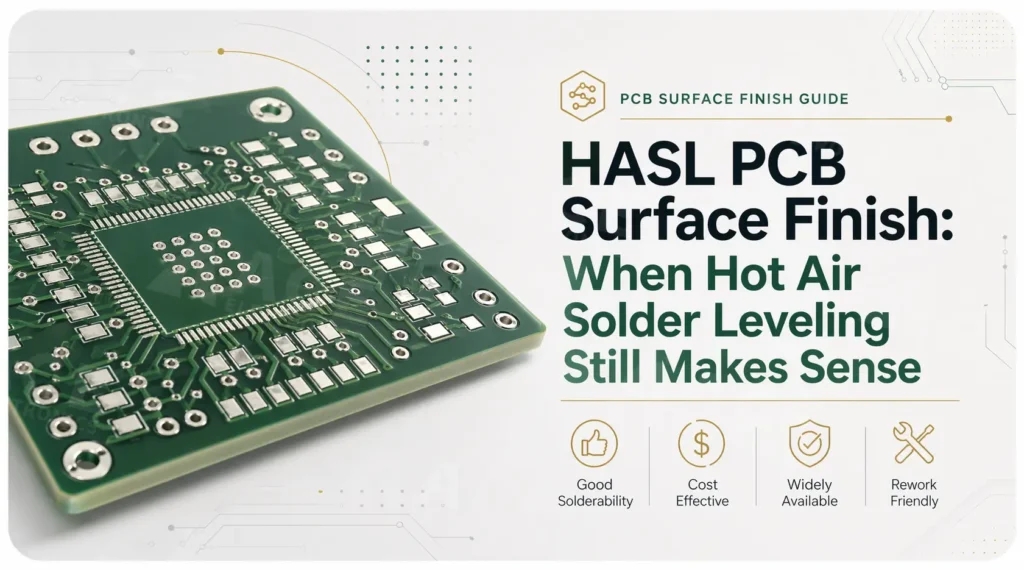
HASL, short for Hot Air Solder Leveling, is one of the oldest and most widely recognized PCB surface finishes. Even as ENIG, OSP, immersion silver, and other finishes have become common, HASL still remains a practical choice for many PCB projects.
The reason is simple: HASL is cost-effective, easy to solder, widely available, and forgiving in many general-purpose applications. However, it is not the best finish for every board. Fine-pitch components, BGAs, HDI layouts, thin boards, and certain high-reliability designs may require a flatter or more specialized surface finish.
If you are comparing HASL with ENIG, OSP, immersion silver, immersion tin, ENEPIG, or hard gold, you can also review our broader guide to PCB surface finish selection.
This article explains what HASL is, how it works, the difference between traditional HASL and lead-free HASL, and how to decide whether it fits your PCB design.
What Is HASL?
HASL is a metallic PCB surface finish used to protect exposed copper pads and provide a solderable surface for assembly.
During the HASL process, the PCB is dipped into molten solder. After the copper surfaces are coated, hot air knives blow away excess solder and level the surface. The remaining solder layer protects the copper from oxidation and helps components solder more easily during assembly.
In simple terms, HASL pre-tins the exposed copper pads before assembly.
For standard bare board production, HASL can be specified as part of your PCB fabrication service requirements, especially when cost, solderability, and practical manufacturability matter more than ultra-flat pad geometry.
How the HASL Process Works
A typical HASL process includes the following steps:
-
Surface cleaning
The exposed copper is cleaned to remove oxidation, contamination, and residues. -
Flux application
Flux is applied to improve solder wetting and help the molten solder bond to the copper surface. -
Solder dipping
The PCB is immersed in a molten solder bath. The solder covers exposed copper pads, plated through holes, and other uncovered copper areas. -
Hot air leveling
Hot air knives remove excess solder and level the coating. -
Cooling and cleaning
The board is cooled, and flux residues are cleaned from the surface.
The final result is a solder-coated surface that is relatively durable, solderable, and economical.
HASL vs Lead-Free HASL
There are two common types of HASL:
| Type | Solder Composition | RoHS Status | Typical Use |
|---|---|---|---|
| Traditional HASL | Tin-lead solder, commonly Sn63/Pb37 | Not RoHS compliant for most modern electronics | Legacy, exempt, or special-use applications |
| Lead-Free HASL | Lead-free alloys such as SnCu or SAC | RoHS compliant when properly specified | Modern general-purpose PCB production |
Traditional HASL usually has excellent solderability and a bright appearance, but it contains lead. For products sold into markets that require RoHS compliance, lead-free HASL is normally the appropriate choice.
Lead-free HASL uses higher-temperature solder alloys. This makes it compliant with lead-free requirements, but it also exposes the PCB to higher thermal stress during processing.
Why HASL Is Still Popular
HASL remains widely used because it solves several practical problems at a reasonable cost.
1. Good Solderability
Because the finish itself is solder, HASL generally wets well during assembly. This makes it friendly for through-hole components, hand soldering, wave soldering, and many standard SMT designs.
2. Low Cost
HASL is usually one of the most economical PCB surface finishes. For cost-sensitive prototypes, industrial controls, simple consumer products, power boards, and through-hole-heavy designs, it can be a sensible choice.
3. Wide Availability
Most PCB manufacturers can offer HASL or lead-free HASL. This makes it easy to source, quote, and manufacture without requiring a highly specialized process.
4. Good Shelf Life
Compared with more delicate finishes such as OSP, HASL is relatively robust during storage and handling. Actual shelf life depends on packaging, humidity, storage temperature, and supplier process control, but HASL is generally considered a durable finish for standard production workflows.
5. Rework Friendly
HASL is easier to repair and rework than some finishes. For boards that may require manual soldering, field repair, or multiple assembly steps, this can be a practical advantage.
The Main Limitations of HASL
HASL is not outdated, but it has clear design limits.
1. Uneven Surface Planarity
The biggest weakness of HASL is surface flatness. Since the finish is leveled by hot air, solder thickness can vary from pad to pad. Larger pads may retain more solder, while small pads may receive less consistent coverage.
This uneven surface can create issues for:
- Fine-pitch ICs
- QFNs
- BGAs
- 0201 or very small passive components
- Dense SMT layouts
- HDI boards
For these designs, ENIG or another flat finish is often a better choice.
2. Thermal Stress
HASL requires the entire PCB to be immersed in molten solder. Lead-free HASL uses even higher temperatures than traditional leaded HASL.
This thermal load can be a concern for:
- Thin PCBs
- High layer-count boards
- Boards with high aspect ratio vias
- Certain materials with lower thermal margin
- Designs sensitive to warpage or delamination
3. Solder Bridging Risk
Because HASL deposits solder on pads, excess solder can contribute to bridging on tight-pitch features. Good solder mask design and enough solder mask dam between pads are important.
4. Not Ideal for Very Small Vias or HDI
HASL can create issues around small plated through holes, microvias, or dense via fields. If the design uses HDI technology, via-in-pad, very small drills, or tight routing, a flatter finish such as ENIG is usually safer.
For microvias, via-in-pad structures, and very tight routing, review the finish together with your Rigid and HDI PCB manufacturing requirements.
5. Not Suitable for Contact or Wire Bonding Applications
HASL is a solderable finish, not a wear-resistant contact finish. It should not be used for gold fingers, key contacts, wire bonding, or repeated insertion contact surfaces. Hard gold, ENIG, ENEPIG, or another specialized finish may be required depending on the application.
When HASL Is a Good Choice
HASL is a strong option when the board design is not extremely dense and the main priorities are cost, solderability, and manufacturing availability.
Typical good-fit applications include:
- Through-hole-heavy PCBs
- Industrial control boards
- Power supply boards
- LED boards with larger pads
- Simple two-layer or four-layer boards
- Prototypes where cost matters
- Boards that require manual soldering or rework
- Products without fine-pitch BGA or dense QFN packages
HASL is especially practical for connector-heavy and through-hole-heavy boards, where through-hole PCB assembly and wave soldering are major parts of the build.
For these applications, HASL can deliver reliable soldering performance without the higher cost of ENIG.
When You Should Avoid HASL
HASL may not be the right choice if your PCB includes:
- BGA packages
- Fine-pitch QFN or LGA components
- Very small passive components such as 0201
- High-density SMT placement
- HDI structures
- Very small vias or high aspect ratio vias
- Thin boards that may warp under thermal stress
- Flexible circuits
- Edge connectors
- Keypad contacts
- Wire bonding pads
- High-frequency layouts where pad geometry consistency is critical
For BGA, QFN, 01005, or dense fine-pitch layouts, the surface finish decision should be reviewed together with the SMT assembly process, because pad flatness directly affects solder paste printing, placement stability, reflow yield, and inspection results.
In these cases, ENIG, OSP, immersion silver, immersion tin, hard gold, or ENEPIG may be more appropriate.
HASL vs ENIG vs OSP
| Surface Finish | Strength | Limitation | Best Use |
|---|---|---|---|
| HASL | Low cost, good solderability, durable, reworkable | Uneven surface, not ideal for fine pitch | General-purpose boards, through-hole, larger SMT |
| Lead-Free HASL | RoHS-compliant version of HASL | Higher process temperature, uneven surface | Cost-sensitive lead-free designs |
| ENIG | Very flat, good for BGA and fine pitch, strong oxidation resistance | Higher cost, more complex process | HDI, BGA, fine-pitch SMT, premium products |
| OSP | Low cost, flat surface, lead-free | More sensitive to handling and storage | Fast-turn SMT boards with controlled assembly |
| Immersion Silver | Flat and solderable | Sensitive to tarnish and storage conditions | RF, high-speed, and selected SMT applications |
| Hard Gold | Wear resistant | Higher cost, not for general soldering pads | Edge connectors and contact surfaces |
The key point is that HASL is not automatically inferior. It is simply optimized for different priorities. If your design values cost and solderability more than extreme flatness, HASL may be the right finish.
Design Checklist Before Choosing HASL
Before selecting HASL, review these design factors:
- Smallest component pitch: If the board uses fine-pitch ICs or BGAs, consider ENIG.
- Smallest passive size: For 0201 or dense 0402 layouts, confirm assembly capability.
- Pad spacing: Ensure solder mask dams are wide enough to reduce bridging risk.
- Board thickness: Very thin boards may be more sensitive to HASL thermal stress.
- Via structure: Small vias, high aspect ratio vias, and HDI structures may not be ideal.
- Assembly method: HASL works well for hand soldering, wave soldering, and many standard SMT processes.
- Regulatory target: Use lead-free HASL for RoHS-controlled products.
- Storage plan: Keep boards sealed and dry before assembly to preserve solderability.
- End-use environment: For harsh, high-reliability, or vibration-sensitive applications, discuss finish choice with your PCB supplier.
Before locking the finish in your fabrication notes, a PCB layout and DFM review can help confirm whether HASL, ENIG, or another finish is the safer choice.
Procurement Notes: What to Specify on a PCB Order
When ordering HASL PCBs, do not simply write "HASL" if compliance matters. Be specific.
Useful order notes include:
- Surface finish: Lead-Free HASL
- RoHS requirement: Yes, if applicable
- Assembly process: SMT, through-hole, wave soldering, reflow, or mixed assembly
- Fine-pitch components: List minimum pitch if present
- Minimum drill size and board thickness
- Storage or shelf-life expectations
- IPC class or reliability requirement if applicable
If the board includes fine-pitch components, BGAs, small vias, or special reliability requirements, ask the PCB manufacturer to confirm whether HASL is recommended.
Common HASL Quality Concerns
A good HASL finish should have complete solder coverage, acceptable solderability, and no severe bridging or blocked holes. However, because HASL is not perfectly flat, some visual variation is normal.
Possible quality issues include:
- Uneven solder thickness
- Solder bridges between pads
- Excess solder around holes
- Poor wetting on contaminated copper
- Oxidized solder surface after poor storage
- Warpage on thermally sensitive boards
Many HASL issues can be reduced through good copper preparation, solder mask design, controlled air knife settings, proper packaging, and appropriate storage.
Is HASL Still Relevant for Modern PCB Manufacturing?
Yes, HASL is still relevant, but it should be used intentionally.
Modern PCB design has moved toward smaller components, higher density, and more complex assembly. That has reduced the use of HASL in advanced boards. However, many products still do not require BGA-level planarity or premium surface finishes.
For standard industrial, power, prototype, educational, and through-hole-heavy boards, HASL remains a practical surface finish. It offers a strong balance between cost, solderability, and availability.
The best approach is not to ask, "Is HASL good or bad?" The better question is:
Does this PCB design need a very flat surface, or does it mainly need a reliable and economical solderable finish?
If flatness is critical, choose ENIG or another suitable alternative. If cost, solderability, and reworkability are more important, HASL can still be a smart choice.
Conclusion
HASL is a proven PCB surface finish that protects copper pads and provides good solderability at a low cost. Lead-free HASL makes the process suitable for many RoHS-compliant products, while traditional leaded HASL is now limited to legacy, exempt, or special-use applications.
The main tradeoff is planarity. HASL works well for larger pads, through-hole components, standard SMT layouts, and cost-sensitive production. It is less suitable for fine-pitch packages, BGAs, HDI boards, thin boards, and contact surfaces.
For many PCB projects, HASL is not the cheapest compromise. It is the right engineering choice when the design fits its process window.
If your project needs PCB fabrication, component sourcing, assembly, coating, programming, and testing under one controlled flow, you can review our PCBA contract manufacturing capabilities.
Frequently Asked Questions
What does HASL mean in PCB manufacturing?
What does HASL mean in PCB manufacturing?
HASL means Hot Air Solder Leveling. It is a PCB surface finish where exposed copper pads are coated with molten solder and leveled with hot air knives.
Is HASL RoHS compliant?
Is HASL RoHS compliant?
Traditional tin-lead HASL is not RoHS compliant for most modern electronics. Lead-free HASL can be RoHS compliant when properly specified and manufactured with lead-free solder alloys.
Is HASL good for BGA components?
Is HASL good for BGA components?
Usually no. BGA components require a flat and consistent pad surface. ENIG is typically preferred for BGA and fine-pitch SMT designs.
Is HASL cheaper than ENIG?
Is HASL cheaper than ENIG?
Yes. HASL is generally less expensive than ENIG because it uses a simpler and more mature process with lower material cost.
What is the biggest disadvantage of HASL?
What is the biggest disadvantage of HASL?
The main disadvantage is uneven surface planarity. This can cause problems with fine-pitch components, dense SMT layouts, and high-density PCB designs.
When should I choose lead-free HASL?
When should I choose lead-free HASL?
Choose lead-free HASL when you need a low-cost, solderable, RoHS-compliant finish and your PCB does not require the flatness of ENIG.
Can HASL be used for edge connectors?
Can HASL be used for edge connectors?
No. Edge connectors need a wear-resistant finish such as hard gold. HASL is designed for solderability, not repeated mechanical contact.
About the Author
Bill Ho is Sales Engineer and Chief Editor at ACE Electronics, with 10 years of experience in PCB fabrication and PCB assembly.
He writes practical technical content focused on manufacturability review, fabrication communication, and assembly risk reduction.