On this page
When an American agricultural technology company reached out to us, they had a working PCB prototype of a device called RootTracker — a probe module that inserts into the soil to monitor crop root growth in real time. The device was developed by a team of plant physiologists and hardware engineers, and their research on the underlying impedance-sensing methodology had already been published in Plant Physiology.
They needed a contract electronics manufacturing partner to produce and deliver 2000 sets assembled boards with fully test. After reviewing our manufacturing plan and production capability, this client placed the order with ACE Electronics.
What RootTracker Does — and Why It Needed one-stop Manufacturing
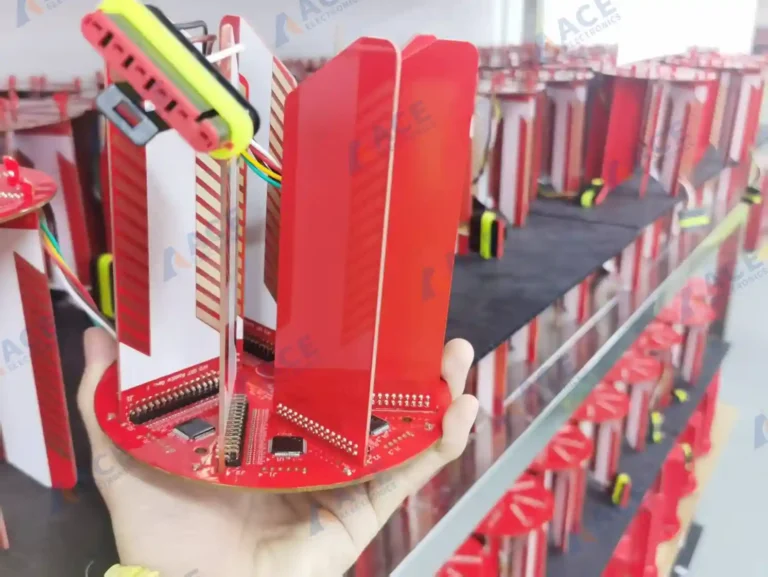
The device works like this: one main control board connects to twelve arrow-shaped sensor boards, arranged in a circular probe module. The assembled module goes into the soil near crop roots. Using impedance sensing, it tracks root growth non-destructively — meaning researchers and farmers can monitor what is happening underground without digging anything up.
The full bill of materials included 12PCS Microchip PIC microcontroller as the core processor, TE waterproof connectors for the cable harnesses that link the probe modules. The enclosure needed to survive weeks or months buried in moist agricultural soil.
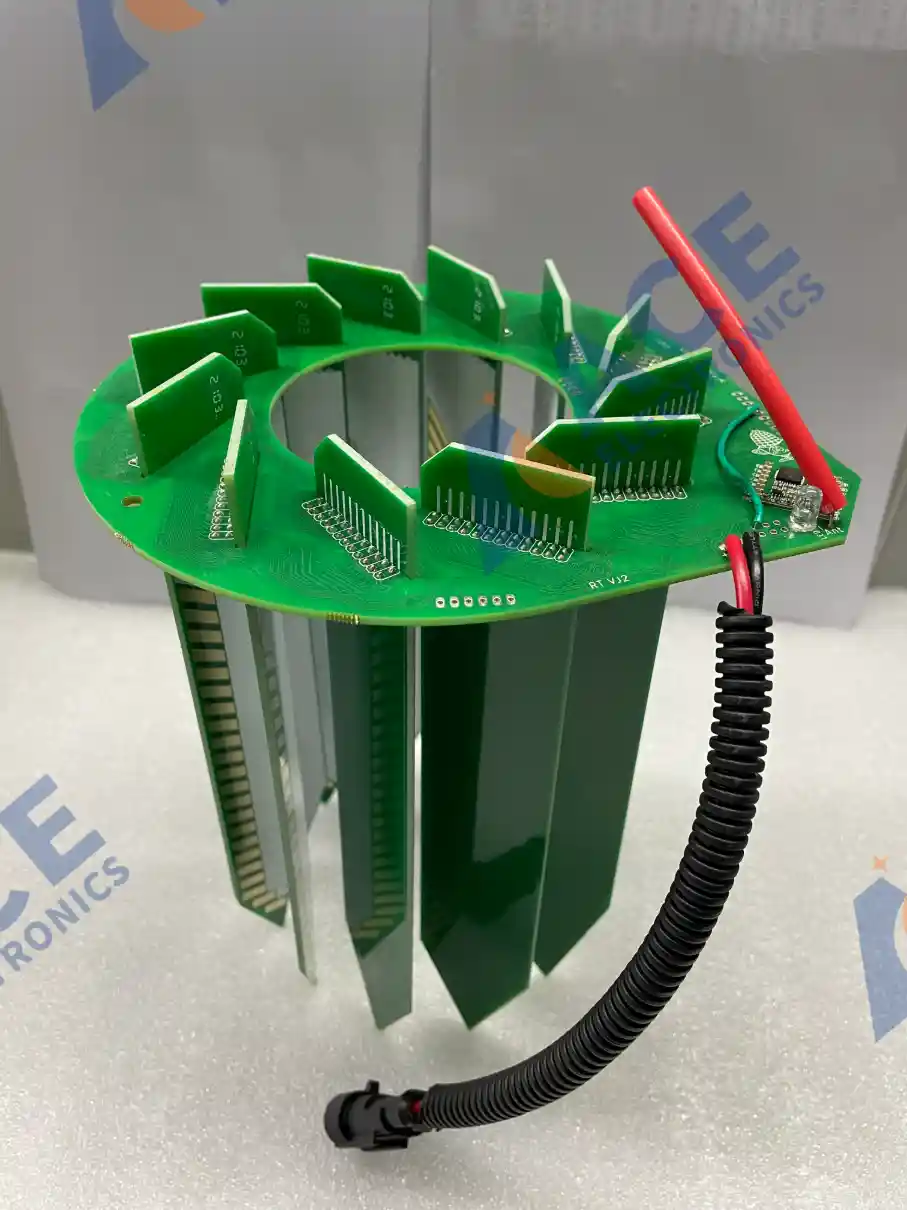
A completed probe module: one main board surrounded by twelve arrow boards, ready for soil deployment.
Our Full Manufacturing Scope
This was a turnkey electronics assembly order. The client sent us their BOM, Gerber files, schematic, and a test specification. From there, our team handled everything:
- Component sourcing: all electronic components, including Microchip PIC MCUs, TE connectors, passives.
- PCB fabrication: High TG FR4 PCB — one main board and 12 PCS of arrow boards per unit, for a total of 26,000 individual PCBs across the 2000-unit order
- PCB assembly: mixed SMT and through-hole placement, including soldering the arrow PCB with the main board by using the male PIN headers
- Functional testing: every assembled probe module went through a custom test fixture before moving forward
- Polyurethane conformal coating: Dip coating on all PCBs
- Custom wire harness: TE waterproof-terminated cable assemblies, cut to length, crimped, and continuity-tested
- Export packaging: custom corrugated boxes designed to protect the assembled electronics during ocean freight
One purchase order. One partner. That was what the client wanted, and that was what we delivered.
The Supply Chain Challenge: Microchip PIC and TE Waterproof Connectors
When we first reviewed the BOM, two items stood out as cost and lead-time risks: the Microchip PIC microcontroller and the TE waterproof connectors.
The PIC MCU was the same series we had already been sourcing for several automotive electronics projects. Over the years, we had built strong relationships with Microchip's authorized distribution network. For this project, we were able to secure the PIC chips at roughly 10% below the price the client had been quoted independently. On a 24,000-unit order, that added up.
The TE connectors were a similar story. We manufacture PCBA for automotive clients who use TE connectors a lot. Our procurement team knew exactly which distributors carried inventory, what the lead times looked like, and how to negotiate volume pricing even on a mid-sized order like this one.
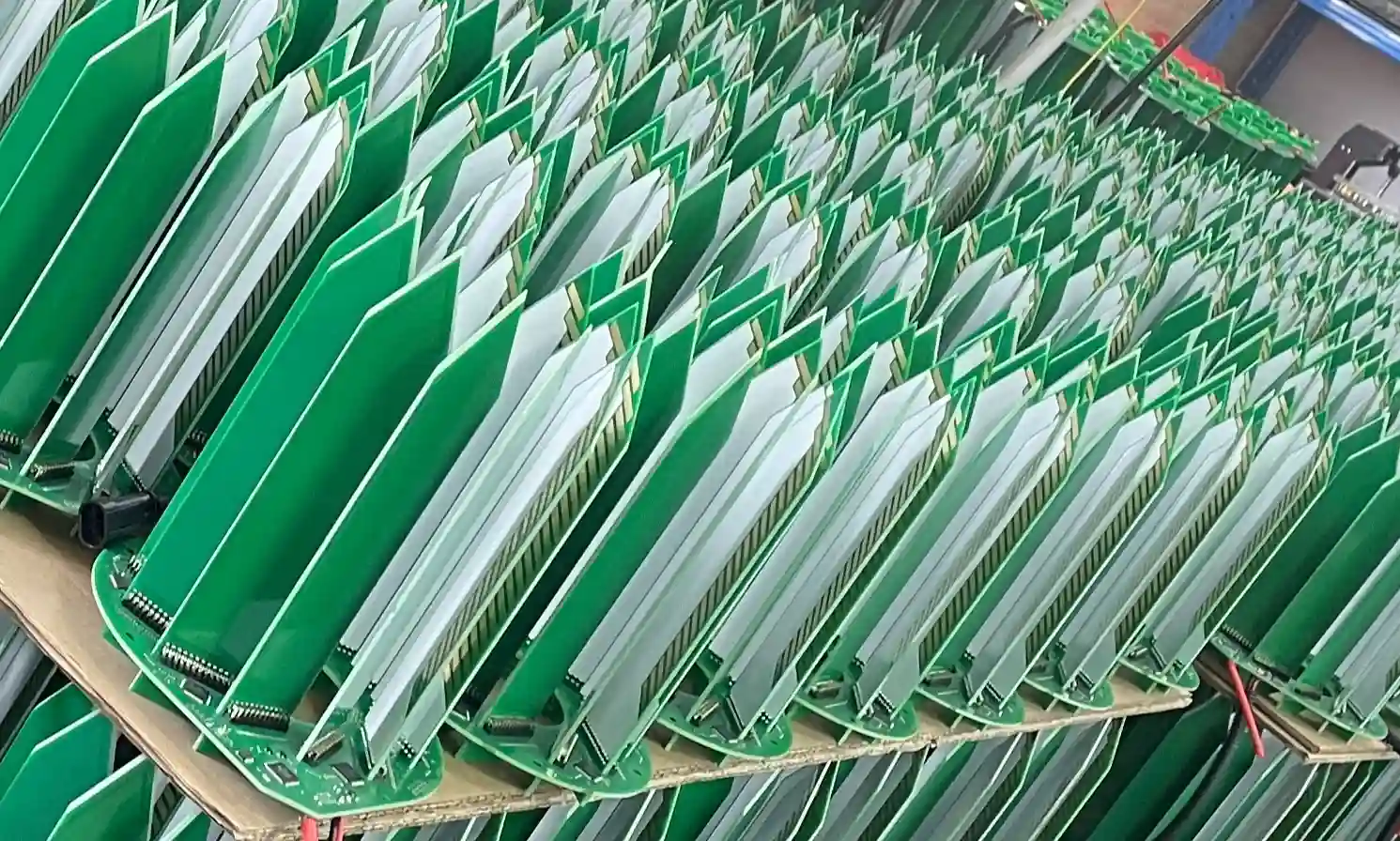
Close-up of an assembled RootTracker PCB.
PCB Assembly and Testing: Getting 2000 Units Right
The PCB assembly was a mix of SMT assembly and through-hole. The main board had the PIC microcontroller in a fine-pitch QFP package, plus supporting passives, voltage regulators, and the board-to-wire connector interfaces. The twelve arrow boards were simpler — mostly passive components and connector pads — but the volume multiplied quickly: 12 boards per unit times 2000 units meant 24,000 arrow boards alone.
One important mechanical improvement was the way the twelve arrow boards were connected to the main board. In the customer’s earlier design, the arrow boards used male pin headers that plugged into female headers on the main board. This made assembly easier, but it was not strong enough for field use. When the probe was pushed into soil, the force could gradually loosen the connection, push the boards out of position, or create intermittent contact failure.
To solve this, we changed the connection method to right-angle pin headers. Each arrow board was first soldered with right-angle headers, then inserted into the main board and hand-soldered again. This created a much stronger mechanical joint between the main board and the twelve vertical sensing boards. For a soil-insertion device, this was not just an assembly detail — it directly improved the reliability of the probe structure during field use.
We ran the order in batches, with AOI inspection on every SMT batch and manual visual inspection on through-hole solder joints. After assembly, every probe module — main board plus its twelve arrow boards connected via the test harness — went through a custom functional test fixture that simulated the impedance sensing operation. We logged pass/fail results per unit.
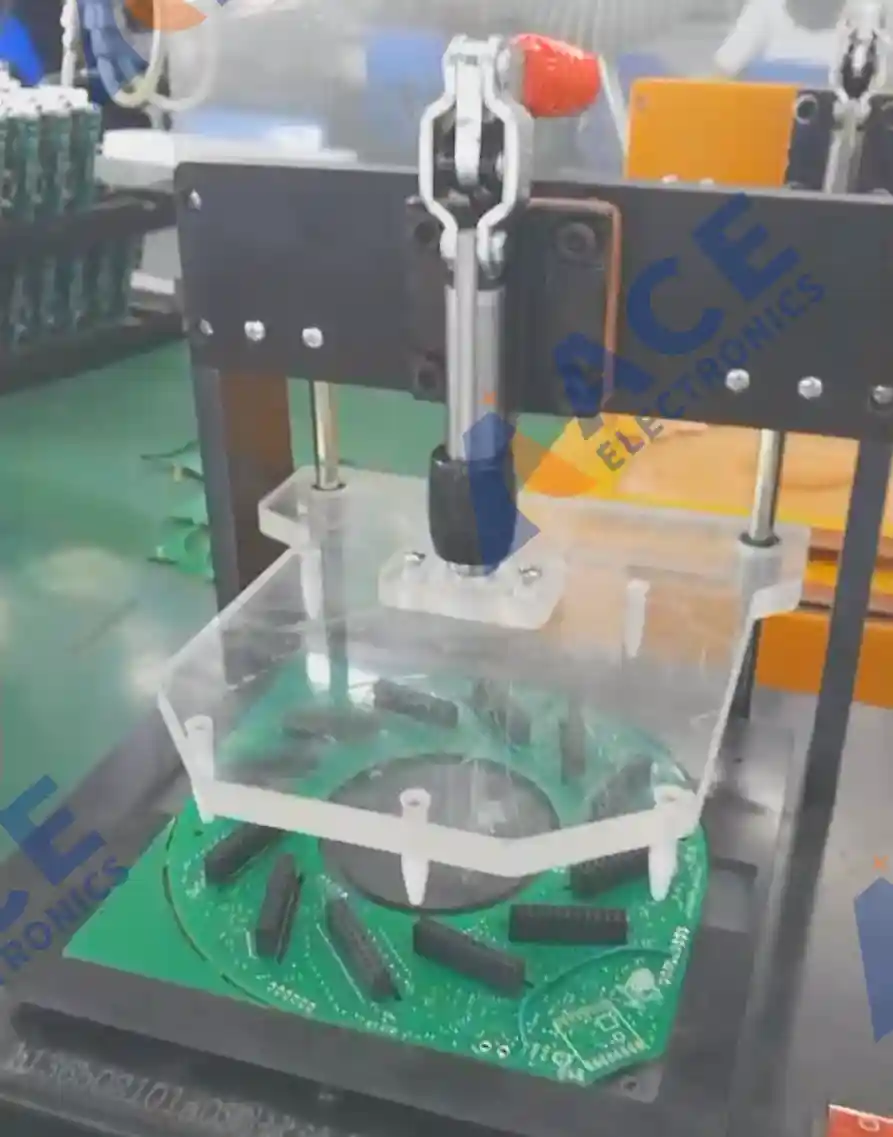
Custom test fixture for the RootTracker main PCB: each board is powered on and verified against the impedance-sensing test script before moving to the next production stage.
Polyurethane Conformal Coating for Outdoor Agricultural Use
This device goes into wet soil, for an entire growing season.
We recommended polyurethane conformal coating over the more common acrylic option. Polyurethane offers stronger moisture resistance, better chemical resistance against fertilizers and soil acids, and enough flexibility to handle thermal cycling between day and night temperatures in the field.
The coating was applied by immersion dipping. Each assembled PCB was dipped into a polyurethane bath, then withdrawn at a controlled speed to ensure even coverage across all component surfaces and under-component crevices.
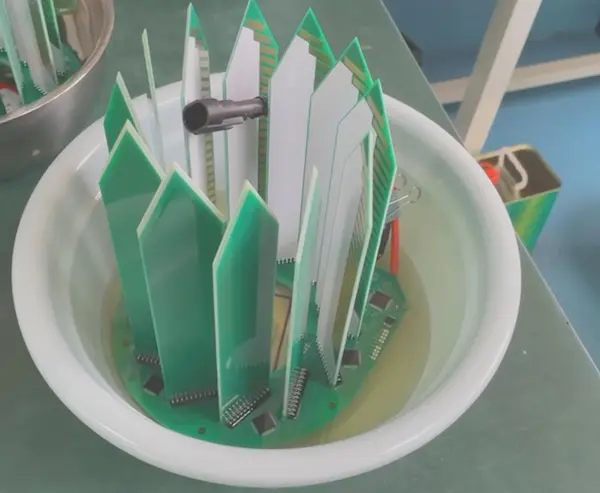
Assembled PCBs undergoing immersion dipping for polyurethane conformal coating — each board is withdrawn at a controlled speed to achieve uniform coverage across all component surfaces.
An assembled PCB is dipped into a polyurethane bath and withdrawn at controlled speed. The immersion method ensures complete coverage across all component surfaces and into under-component gaps that spraying can miss.
Custom Wire Harness, TE Connectors, and Export Packaging
The wire harnesses connecting the probe modules to the data logger were custom-built in-house: TE waterproof connectors crimped to specified wire gauges, cut to exact lengths, and 100% continuity-tested before soldering with PCB.
The packaging was not an afterthought either. The arrow-board geometry means the probe modules have delicate protruding edges. Standard off-the-shelf boxes would have resulted in bent boards and broken connectors during transit. We designed custom corrugated inserts that held each module securely, and the outer cartons were rated for ocean freight stacking.
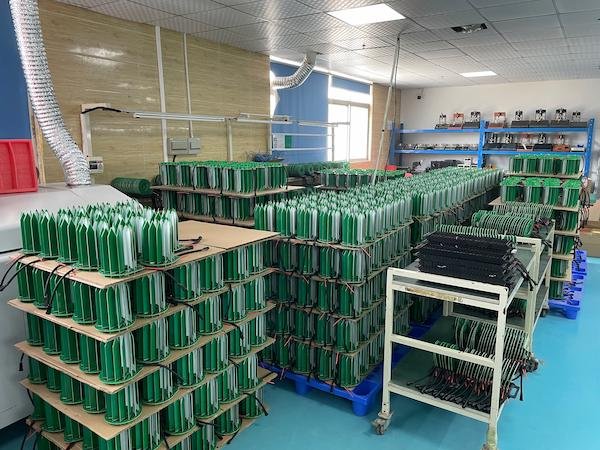
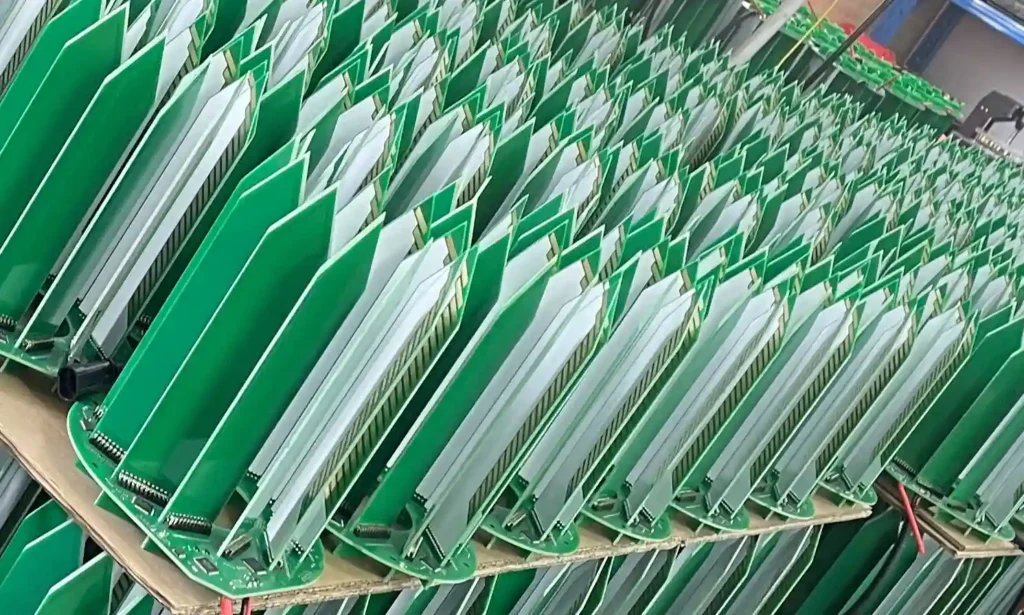
A batch of assembled PCBs after immersion-based polyurethane conformal coating, waiting for final test and package.
Results
- 2000 units manufactured, tested, coated, cabled, and packaged
- On-time delivery across all batches
- Zero field failures reported after the first growing season
- Microchip PIC MCUs sourced at ~10% below client's independent pricing
- TE waterproof connectors procured through existing automotive supply chain relationships
This project later continued into a second-generation production run. The same client returned with an updated PCB design and a larger 4000-unit order, including a separate 915 MHz RF board, batch PIC firmware programming, custom test fixtures, and upgraded export packaging. Read the follow-up case study: 4000-Unit Agricultural Sensor PCBA Manufacturing Case Study
If your agricultural or outdoor electronics project needs a manufacturing partner who can handle the full picture — component sourcing, PCB assembly, conformal coating, custom cable assemblies, and export packaging — send us your BOM and Gerber files. We run a DFM review on every inquiry.
Have a project ready for manufacturing?
Fill out the form below and our engineering team will get back to you within 24 hours.