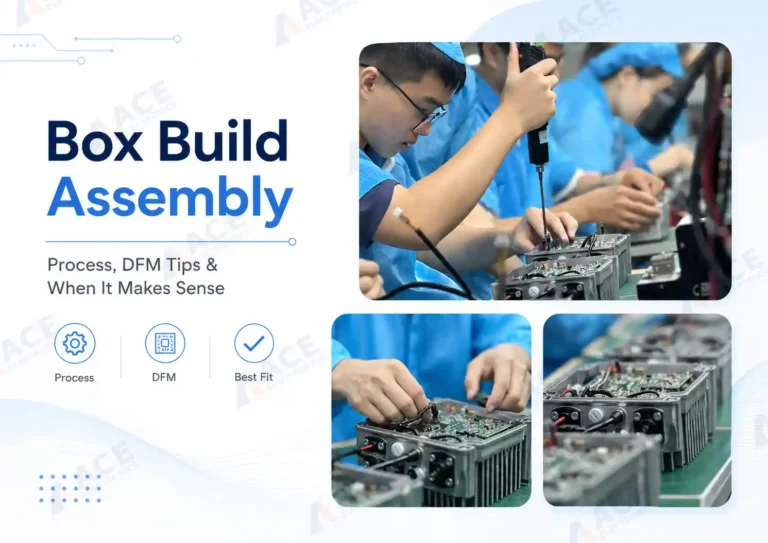
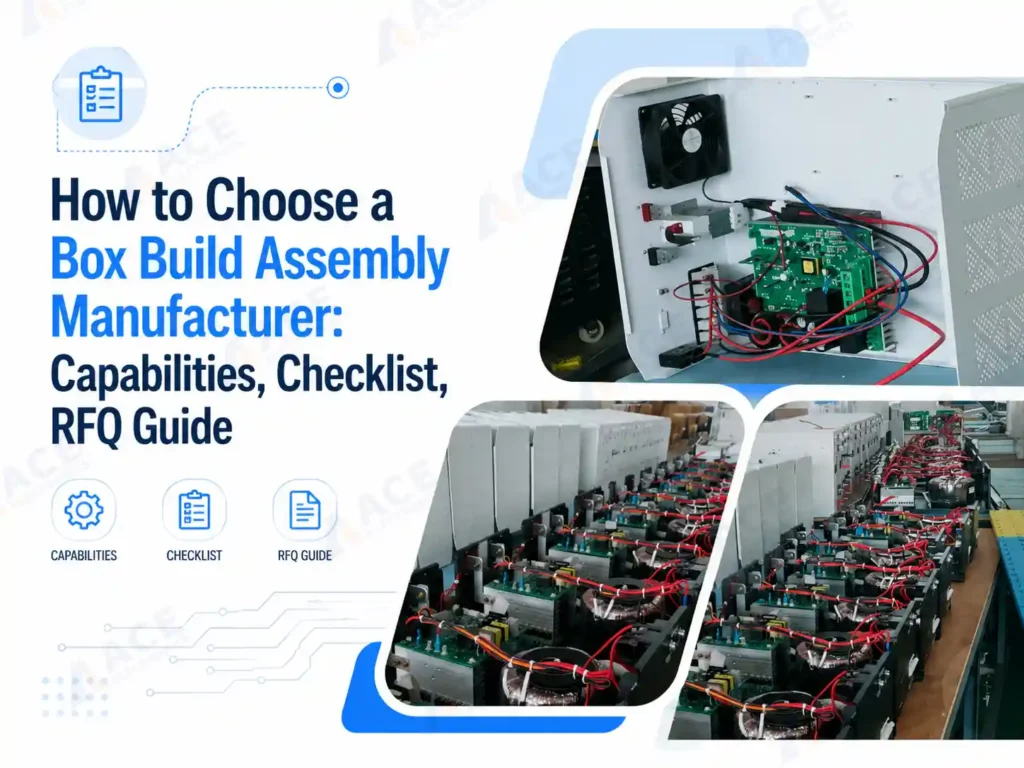
Choosing the right box build assembly manufacturer is not just about getting the lowest quote. It is about finding an electronics assembly partner whose capabilities actually match your product requirements.
A factory that cannot handle your product will cost you more than a high quote. You will redesign around their limits, absorb delays, and spend your days chasing the supplier instead of improving the product.
Two factories can both call themselves box build assemblers and deliver completely different results. One runs PCBA, cable assembly, enclosure fitting, and functional testing under the same roof. The other sends half the work to subcontractors — so when a cable fails or an enclosure does not fit, you wait longer for answers and no one takes full responsibility.
This guide breaks down what to check and how to match a manufacturer's real capability to your project.
What to Look for in a Box Build Assembly Manufacturer
Engineering and DFM Support
A capable partner reviews your project files before quoting — not just to count components, but to look for real potential risks : a connector that hits the enclosure wall, a cable that bends too sharply, or a mounting point buried under other components. These are not minor details. They become redesigns or production holds if no one catches them early. In a 1000-unit energy storage box build production run, catching 7 enclosures with over-tight panel fit during the pilot batch avoided scratching finished product and gave the enclosure supplier time to adjust — catching that problem after all 1000 units are assembled costs far more.
If you get DFM feedback at the quote stage, that partner has actual production experience. They are not just reading your BOM and adding up labor hours.
In-House Capabilities vs Outsourced Processes
Some partners outsource part of the work. That is fine if you know which parts and who does them. What you want to avoid is discovering mid-project that your enclosure assembly went to a shop you have never heard of.
Key capabilities to confirm:
- PCB assembly (SMT and through-hole)
- Cable and wire harness fabrication
- Enclosure integration and mechanical assembly
- Firmware loading and configuration
- Functional testing with documented pass/fail criteria
- Labeling, serialization, and packaging
If one partner handles PCBA through final packaging, they control revisions and can trace problems faster. If they outsource, ask for the subcontractor name and how they inspect quality at each handoff.
What Certifications Should a Box Build Assembly Manufacturer Have?
Certifications tell you whether a factory actually follows audited processes. Here is what the common ones mean in practice:
| Certification | Relevant Industries | What It Actually Means for Your Project |
|---|---|---|
| ISO 9001 | All industries | The factory has documented processes, tracks defects, and runs continuous improvement. This is the minimum. |
| IATF 16949 | Automotive | Stricter than ISO 9001. Requires defect prevention, full traceability, and supply chain risk management. Needed for automotive electronics or any product where failure creates safety liability. |
| ISO 13485 | Medical devices | Risk management, traceability, and process validation are mandatory. Required if your assembly is used in patient care or diagnosis. |
| AS9100 | Aerospace and defense | Adds configuration control and full product traceability beyond ISO 9001. Required for defense or aviation suppliers. |
| UL Listing | North American markets | Confirms the facility builds to recognized safety standards. Needed if your finished product ships to the U.S. or Canada. |
You do not need every certification on this list. But if your product serves a regulated industry, choosing a partner that already holds the right certificate saves you months of compliance work.
Testing and Traceability
Test the fully assembled unit after box build assembly process, not just the bare circuit board. A circuit board can pass every electrical check on the bench or customized functional test, but still could fail once it is inside the enclosure, wired to your cables.
Confirm with the factory whether they could do at least following four things:
- Functional tests on the finished product — power-on, interface response, button feedback, and signal output under real operating conditions
- Burn-in or aging tests — when the product must prove it will last months or years in the field
- Unit traceability — each unit tied to its components, firmware version, test results, and production batch
- First-article reports — documented inspection results for every new production order
First article inspection and DFM review reduce the risk of discovering assembly issues mid-production.
Supply Chain and Component Sourcing
A electronics assembly manufacturer that also supports component sourcing can consolidate procurement for both the PCBA and the mechanical parts — enclosures, connectors, fasteners, labels, and packaging. This reduces the number of supplier relationships your team needs to manage and simplifies the overall procurement timeline.
When the assembly partner handles sourcing, confirm how they manage component authentication, alternative sourcing when parts are on allocation, and notification timing when a BOM item requires substitution.
How to choose box build assembly factory at Different Production Stages
The factory you cooperate for five prototypes may not be the one you want for volume. But whether that matters depends on your product.
If your assembly is simple — standard enclosure, off-the-shelf cables, few components, and no real volume plan — changing manufacturers later is easy. You can switch manufacturers later without much pain. Another factory can pick up your files and build it with minimal setup.
If your product has multiple assembly steps, custom parts, or a real volume forecast, treat the prototype stage as a trial run for mass production. Changing manufacturers after the pilot run means requalifying the process, retraining operators, rebuilding traceability records, and often remaking fixtures or test jigs. That delay can cost weeks or months.
Here is how the focus shifts as you move from prototype to production:
| Stage | What You Actually Need | What Changes |
|---|---|---|
| Prototype (5–20 units) | Check fit, fix routing problems, confirm basic function. Build notes and photos are enough. | High flexibility. Expect changes. |
| Pilot Run (50–200 units) | Confirm the build is repeatable. First-article report and defined test steps. | Controlled revisions. Document any deviation. |
| Repeat Production (200+ units) | Same output every batch. Full traceability, test records, and revision control. | Low flexibility. Changes go through formal approval. |
Prototype Stage
At this stage, speed and communication matter more than paperwork. You need a partner who can build a small quantity, tell you what does not fit, and help you fix it. Rework logs and fit-check photos are usually enough.
Pilot Run Stage
This is where you learn if the build is repeatable. The partner should define checkpoints for key steps, produce a first-article report, and track any deviation from the approved build. Fix problems here before they become production habits.
Repeat Production Stage
For ongoing volume, consistency wins. You need traceability records, test documentation, label control, and revision management. A partner with MES tracking can link each unit to its component batches, firmware version, and test results. This makes audits and failure investigations faster.
What Drives Box Build Assembly Cost
A box build quote is not one number. It is a breakdown of where the money goes. Understanding the main cost drivers helps you compare quotes properly and spot where a factory may be cutting corners.
-
Labor and assembly time. Every manual step takes time and costs money — routing cables, fastening brackets, applying labels, running tests. An assembly with 30 manual steps will cost more than one with 5 steps, even if the parts cost the same.
-
Enclosure and mechanical parts. Custom enclosures, machined brackets, and special fasteners cost more and take longer to source. Standard off-the-shelf enclosures keep both the part price and the wait time down.
-
Testing. A quick power-on check is cheap. A full burn-in test with recorded results is not. Decide what level of testing your product actually needs before you ask for a quote.
-
Documentation. First-article reports, serial number tracking, firmware version records, and CPK data all take engineering time to produce. If you need them, the quote will reflect that.
-
Order quantity. Setup costs — preparing fixtures, loading programs, writing process docs — are fixed. The more units you order, the less each unit carries of that setup cost.
RFQ Preparation Checklist for Box Build Assembly
A complete RFQ package gets you a more accurate quote, faster. Here is what to prepare before reaching out.
| File or Information | Why It Is Needed |
|---|---|
| BOM with approved parts and alternatives | Defines every component in the assembly, including mechanical parts, fasteners, and labels |
| Gerber files and pick-and-place data | Needed if the partner will also handle the PCBA portion |
| Assembly drawings (exploded view preferred) | Shows how parts fit together and the assembly sequence |
| Enclosure drawings or 3D files | Defines mounting points, cutouts, clearances, and material |
| Cable and wire harness specifications | Connector types, pinouts, lengths, routing notes, strain relief requirements |
| Firmware file and programming instructions | Version, programming method, and any configuration steps |
| Functional test plan with pass/fail criteria | Defines what gets checked, how, and what constitutes a pass |
| Label artwork and serial number rules | Label content, position, barcode format, serialization logic |
| Packaging instructions | Protective packaging, accessory placement, carton labeling, manuals |
| Target quantity and delivery schedule | Helps the partner plan capacity and component lead times |
If some files are not finalized yet, send what you have. A good asssembly partner will tell you what is still needed and flag any missing items before quoting.
A high-power mobile energy storage unit after box build assembly — integrating PCBA, wiring harnesses, enclosure, testing, and final packaging before shipment.
Questions to Ask Before Signing a Contract
Before committing to a production order, here are questions worth asking:
- Which assembly steps are done in-house, and which go to sub-suppliers?
- How are engineering changes managed after production has started?
- What traceability records are provided — by batch, by work order, or by serial number?
- How are component shortages or end-of-life notices communicated?
- What testing is performed at the system level, not just at the board level?
- Can the partner support both prototype runs and repeat production without changing the core team?
- What documentation is included with each shipment — test reports, inspection records, serial number logs?
- How are first-article inspections handled for new projects?
- What is the process for handling a quality issue found after shipment?
Clear answers to these questions separate assembly partners who run documented, repeatable processes from those who figure things out as they go.
Red Flags When Evaluating Box Build Assembly Manufacturers
Some warning signs are easy to spot early if you know what to look for:
- No DFM feedback on your first submission. If the quote comes back with only a price and no technical questions, the review was likely superficial.
- Vague answers about testing. "We test everything" without describing what, how, or what the test records look like is not a real answer.
- Cannot explain how they manage sub-suppliers. If enclosure assembly or cable fabrication is outsourced, ask how quality is verified at the incoming stage.
- Slow response during the quoting phase. Communication speed during evaluation often reflects what you will experience during production.
- No documented change management process. If an engineering change needs a verbal agreement rather than a tracked revision, quality drift becomes likely over repeat orders.
- Certifications listed on the website but unavailable for review. Ask to see the actual certificate and check the expiration date.
What a Capable Box Build Assembly Manufacturer Looks Like — Summary
After evaluating multiple partners, you should be able to describe what a capable manufacturer actually has, not just what their website claims. Here is a summary of the capabilities that matter:
- Full production flow under one roof. PCBA, cable fabrication, enclosure integration, firmware loading, functional testing, and packaging happen in-house — not spread across subcontractors — so revision control stays tight and issues trace back to a single source without finger-pointing.
- DFM and DFA engineering at the quote stage. The engineering team reviews your files for assembly risks before quoting and suggests adjustments to layouts, enclosure fit, and wiring plans. A quote that comes back with no technical questions was likely not reviewed.
- Current certifications with audited records. ISO 9001 is the minimum baseline. IATF 16949, ISO 13485, or AS9100 matter if your product enters a regulated industry. Ask to see the actual certificates with expiration dates — logos on a website are not the same thing.
- Traceability infrastructure. Each unit links to its component lots, firmware version, test results, and production batch. A manufacturing execution system that logs every operator action gives you verifiable records for audits and failure investigations.
- Production-grade testing and inspection. AOI and X-ray for PCBA, functional test fixtures for finished units, and burn-in or aging racks when the product requires reliability validation — all running from documented test plans with clear pass/fail criteria.
- Transparent supply chain management. The partner should tell you where components come from, how alternates are approved, how allocation shortages are communicated, and how fast you will be notified when a BOM item requires substitution.
- Experience across product types and industries. A partner who has handled industrial controllers, energy storage equipment, medical electronics, and IoT products has seen a wider range of assembly challenges and is less likely to be caught off guard by your product's specific requirements.
Frequently Asked Questions
How do I choose a box build assembly manufacturer?
How do I choose a box build assembly manufacturer?
Start by confirming the manufacturer's in-house capabilities (PCBA, cable assembly, enclosure integration, testing), engineering support during quoting, certifications relevant to your industry, and their approach to traceability and documentation. A well-prepared RFQ package also helps you compare quotes on more than unit price alone.
What certifications should a box build assembly partner have?
What certifications should a box build assembly partner have?
ISO 9001 is the baseline for a documented quality management system. IATF 16949 adds stricter defect prevention and traceability for automotive products. ISO 13485 covers medical device manufacturing requirements. AS9100 applies to aerospace and defense. The certifications that matter depend on your product's end market.
How much does box build assembly cost?
How much does box build assembly cost?
Cost depends on labor complexity, enclosure and part costs, testing scope, documentation requirements, and production quantity. A complex assembly with 30 manual steps costs more per unit than a simple enclosure integration with 5 steps. Higher volumes spread setup costs across more units, lowering the per-unit share.
What files are needed for a box build assembly RFQ?
What files are needed for a box build assembly RFQ?
At minimum: BOM, assembly drawings, enclosure specifications or 3D files, cable harness requirements, firmware files if applicable, functional test criteria, label artwork, packaging instructions, and target quantity. Missing files slow down the quote and may result in assumptions that need correction later.
Can a box build assembly manufacturer handle both prototype and repeat production?
Can a box build assembly manufacturer handle both prototype and repeat production?
Some can, but confirm this explicitly. Prototype work requires flexibility and quick turnarounds. Repeat production requires process stability, traceability, and documented change control. A partner that handles both well will have different workflows for each stage rather than treating them the same way.
What is the difference between turnkey and consigned box build assembly?
What is the difference between turnkey and consigned box build assembly?
In turnkey assembly, the partner procures all components — PCBs, components, enclosures, cables, labels, and packaging. In consigned assembly, you supply some or all of the materials, and the partner provides labor, testing, and final packaging. The right choice depends on your supply chain, component availability, and how much procurement work you want to manage.
Ready to Discuss Your Box Build Assembly Project?
If you have a product design ready or near-ready for final assembly, preparing your RFQ package with the checklist above will help your assembly partner respond with a more accurate timeline and quote.
For a broader look at what the assembly process involves before selecting a partner, read our box build assembly guide covering process stages, complexity levels, and core components.