On this page
In early 2026, a Shenzhen-based publicly listed energy company contacted ACE Electronics with a production requirement for a 6000Wh mobile energy storage device. They had completed design validation, had finalized BOMs, Gerber files, enclosure drawings, and a working prototype. The initial order was 1,000 units — a pilot production run to verify the manufacturing process before scaling to larger volumes. What they needed was a manufacturing partner who could handle the full scope: component sourcing, PCBA assembly, box build assembly, functional testing, finished-unit aging test, and final packaging — under one production flow.
Several PCB assembly factories they approached had quoted only the SMT and through-hole work. None would take responsibility for the enclosure assembly, wiring, finished-unit testing, and packaging. The customer's concern was straightforward: splitting these steps across multiple suppliers would create more coordination work, more handoff risk, and no single point of accountability for the final product quality.
This case study walks through how we managed this 6000Wh mobile energy storage device project from PCBA through finished-unit box build assembly and shipment.
Project Overview
The product is a 6000Wh mobile energy storage system — a portable power unit with integrated AC output, control panel, wheels, and a protective enclosure. It is designed for commercial and industrial applications where temporary or backup power is needed at a worksite, during outdoor events, or as an emergency backup power source.
The customer's product consisted of:
- Power PCBA — carrying power conversion and BMS circuitry, large electrolytic capacitors, power inductors, transformers, relays, and board-side connectors
- Internal wiring harnesses — custom-length wires with connector terminals linking the PCBA to output sockets, the control panel, and the battery pack
- Enclosure and mechanical parts — a fabricated enclosure shell, front and rear panels, AC output sockets, emergency stop switch, wheels, handle, control display, fasteners, and gaskets
- Functional test equipment — a custom test fixture and test program provided by the end customer for finished-unit verification
The project scope covered component procurement, PCBA assembly, board-level electrical testing, box build assembly, finished-unit functional testing, 24-hour aging test, final inspection, and wooden crate packaging for shipment.
Full Manufacturing Scope
The table below summarizes the complete production flow we managed for this project.
| Stage | What We Did | What Benifits Get |
|---|---|---|
| Component sourcing | Procured all BOM components, connectors, wiring materials, and mechanical fasteners | The customer did not need to coordinate with multiple component vendors |
| PCBA assembly | SMT placement, reflow soldering, through-hole assembly, wave soldering, inline 3D AOI | One workshop handled every board with consistent quality control |
| Board-level power-on test | Custom test fixture running the customer's test program for initial electrical verification | Defective boards were identified before enclosure assembly, reducing downstream rework |
| Box build assembly | PCBA mounting into the enclosure, wiring harness routing, connector mating, panel installation, screw fastening, wheel and handle assembly | Verified boards became enclosed, wired, and mechanically complete units |
| Finished-unit functional testing | Full functional test using end-customer-supplied test equipment and test procedure | Each finished unit was verified as a complete product, not just a tested board |
| Finished-unit aging test | 24-hour continuous burn-in under load on fully assembled units | Units that passed functional testing were validated under sustained operating conditions |
| Final inspection and packaging | Enclosure check, label verification, instruction manual, socket inspection, wooden crate packaging | Units reached the customer intact, with all panels, sockets, labels, and accessories verified |
The key operational difference from a standard PCBA order was that ACE Electronics took responsibility for the finished product, not just the assembled PCB. That was the main reason the customer chose a box build assembly contract manufacturing model.
PCBA Assembly and Board-Level Electrical Test
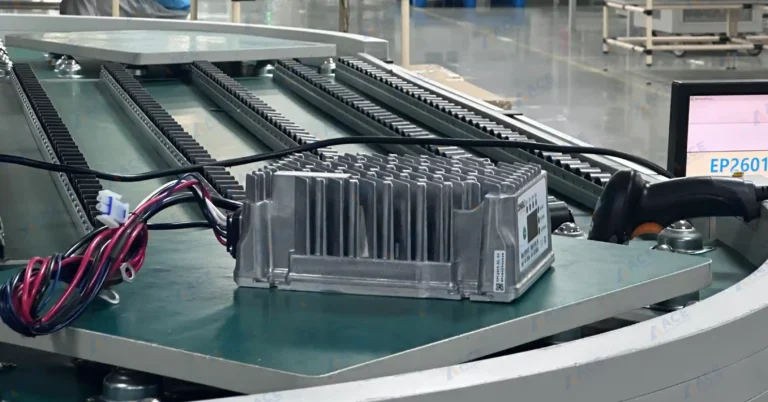
Energy storage PCBAs staged on production racks before enclosure integration, wiring connection, and final box build assembly.
The power PCBA went through our standard PCB assembly process: solder paste printing, pick-and-place for SMT components, reflow soldering, followed by through-hole insertion and wave soldering for larger components such as transformers, relays, and high-current connectors. All boards passed through inline 3D AOI during production to catch solder bridging, tombstoned components, insufficient wetting, and missing parts.
After PCBA assembly and AOI clearance, each board went through a board-level power-on test. A custom test fixture — built to the customer's specifications — applied the working input voltage and verified that the main power rail was not shorted, all voltage rails were present within tolerance, and the board started without immediate faults.
Boards that passed this initial electrical check were cleared for box build assembly. Boards that showed any issue went back for diagnosis and rework. This step was important because catching a fault at the board level saves the labor of installing a defective board into an enclosure, running wiring, and then discovering the problem during finished-unit testing.
Aging test was not performed at this stage. The 24-hour burn-in was applied to fully assembled finished units — after the PCBA, wiring harnesses, enclosure panels, connectors, and all mechanical parts were installed. Board-level testing and finished-unit aging serve different purposes and occur at different stages of the production flow.
Box Build Assembly: From PCBA to Finished Unit
A completed 6000Wh mobile energy storage unit after enclosure assembly, wiring, panel installation, and final functional checks.
Once a board passed the power-on test, the box build assembly stage began. Each unit went through these assembly steps:
- PCBA mounting — secure the power PCBA into the enclosure at the designated mounting points using the specified fasteners
- Wiring harness routing — route internal wires through the defined paths inside the enclosure, following the customer's assembly drawing for bend radius and connector orientation
- Connector mating — mate each board-side connector to its corresponding harness connector, and each harness connector to its panel-side socket or switch
- Panel installation — install the front control panel, AC output sockets, emergency stop switch, and rear panel with all gaskets seated correctly
- Mechanical assembly — install wheels, handle, and enclosure fasteners, ensuring all screws were tightened to the specified torque without cross-threading
- Visual pre-test check — confirm that all panels were properly seated, no wires were pinched, all connectors were fully engaged, and the enclosure surface was clean before moving to functional testing
Finished-Unit Functional Testing
The end customer provided a custom test fixture and a documented test procedure for finished-unit verification. The test equipment was shipped to our facility and set up on a dedicated test station.
The functional test for each finished unit checked:
- Power-on sequence — correct startup behavior, no inrush anomalies
- AC output — voltage and waveform at each output socket within specification
- Control panel functions — display readout, mode switching, emergency stop response
- Connector integrity — all external sockets delivering expected output under load
Because the test equipment and procedure were provided by the end customer, our role was to set up the test station, follow the documented test sequence for every unit, and record the results. For projects that need custom test fixture development, firmware loading, or programming before functional testing, our functional testing and programming services can be included in the manufacturing scope.
Units that passed functional testing moved to the aging test station. Units that showed any fault were diagnosed, reworked, and retested before proceeding.
Finished-Unit Aging Test: 24-Hour Continuous Burn-In
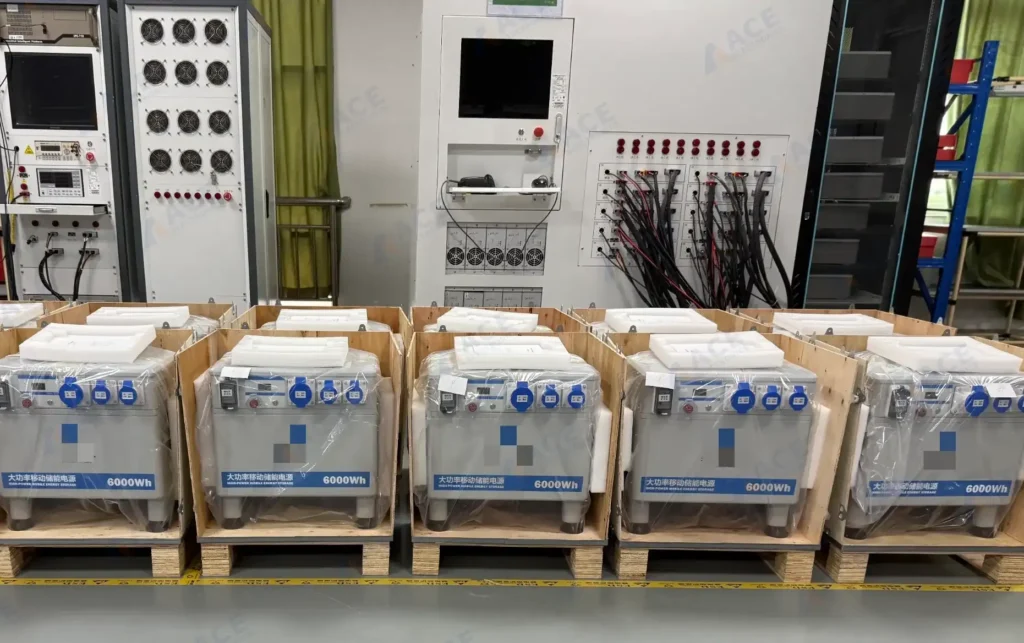
Multiple mobile energy storage units arranged for 24-hour aging test after PCBA integration and box build assembly.
The purpose of the aging test in this project was to verify that the complete product — assembled PCB, wiring, connectors, control panel, output sockets, and mechanical assembly — could sustain continuous operation under load. A board-level test alone cannot catch connector seating issues, wiring routing problems, panel contact faults, or enclosure-related thermal effects that only appear when the unit runs as a complete assembly.
Aging Test Parameters
| Parameter | Detail |
|---|---|
| Batch size per cycle | Determined by available test rack capacity |
| Test condition | Finished unit, enclosure closed, all panels installed |
| Load type | Duty-cycle operation simulating typical field use |
| Monitoring | Individual output monitoring per unit |
| Duration | 24 hours continuous |
| Check interval | Visual and data check every 8 hours |
| Pass criterion | Stable operation for full duration, no faults, no thermal anomalies |
Units that failed aging were diagnosed, reworked, and re-tested through a full 24-hour cycle. Only units that passed the complete aging cycle moved to final inspection and packaging.
Final Inspection and Packaging
Close-up view of the output panel, AC sockets, emergency switch, and enclosure before final crate packaging.
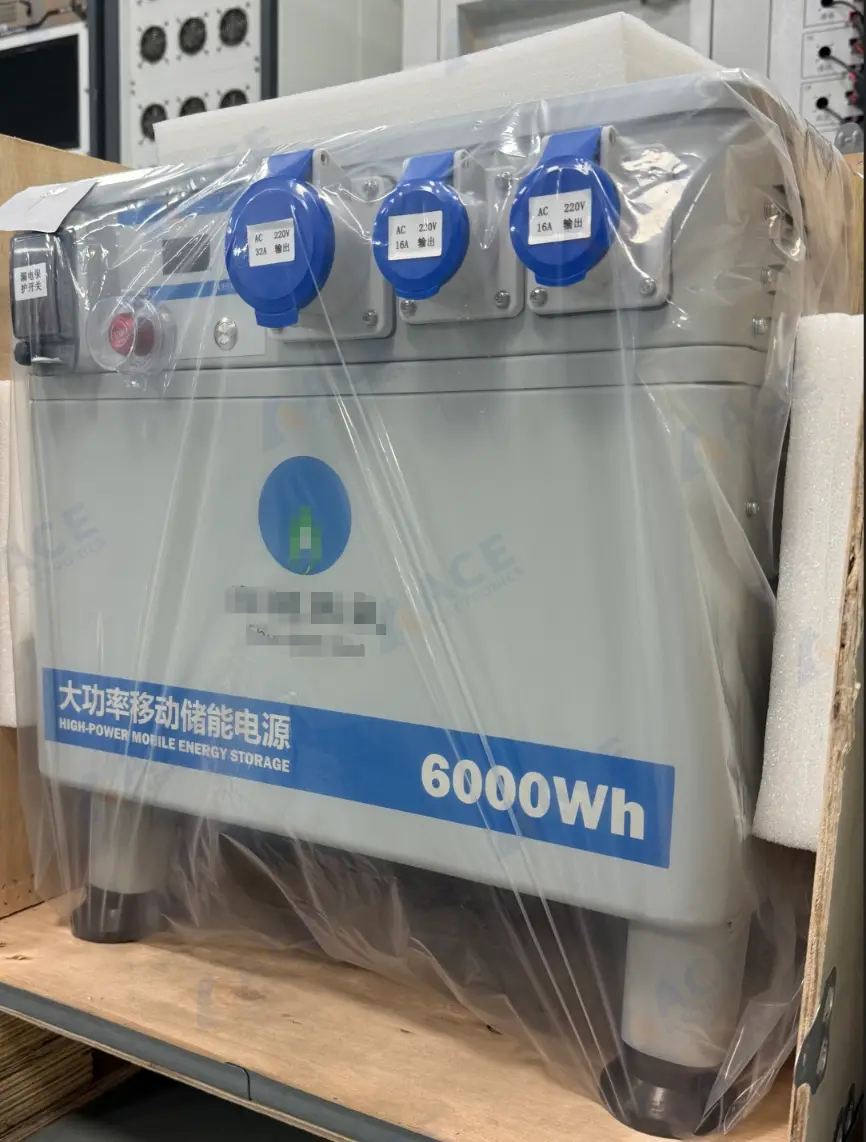
After aging test, each unit went through a final inspection before packaging. The checklist included:
| Check Item | What We Verified |
|---|---|
| Enclosure surface | No dents, scratches, or handling marks on visible surfaces |
| Panel fit | Front and rear panels properly seated, gaskets compressed evenly |
| External sockets | Clean, undamaged, no foreign material inside socket openings |
| Emergency stop switch | Operated smoothly, no binding |
| Wheels and handle | Securely fastened, rotated and extended freely |
| Labels | Correct placement, legible, matched customer specification |
| Pre-pack condition | Unit clean, dry, all protective films removed or applied as specified |
Finished mobile energy storage units packed in custom wooden crates for shipment after final assembly and inspection.
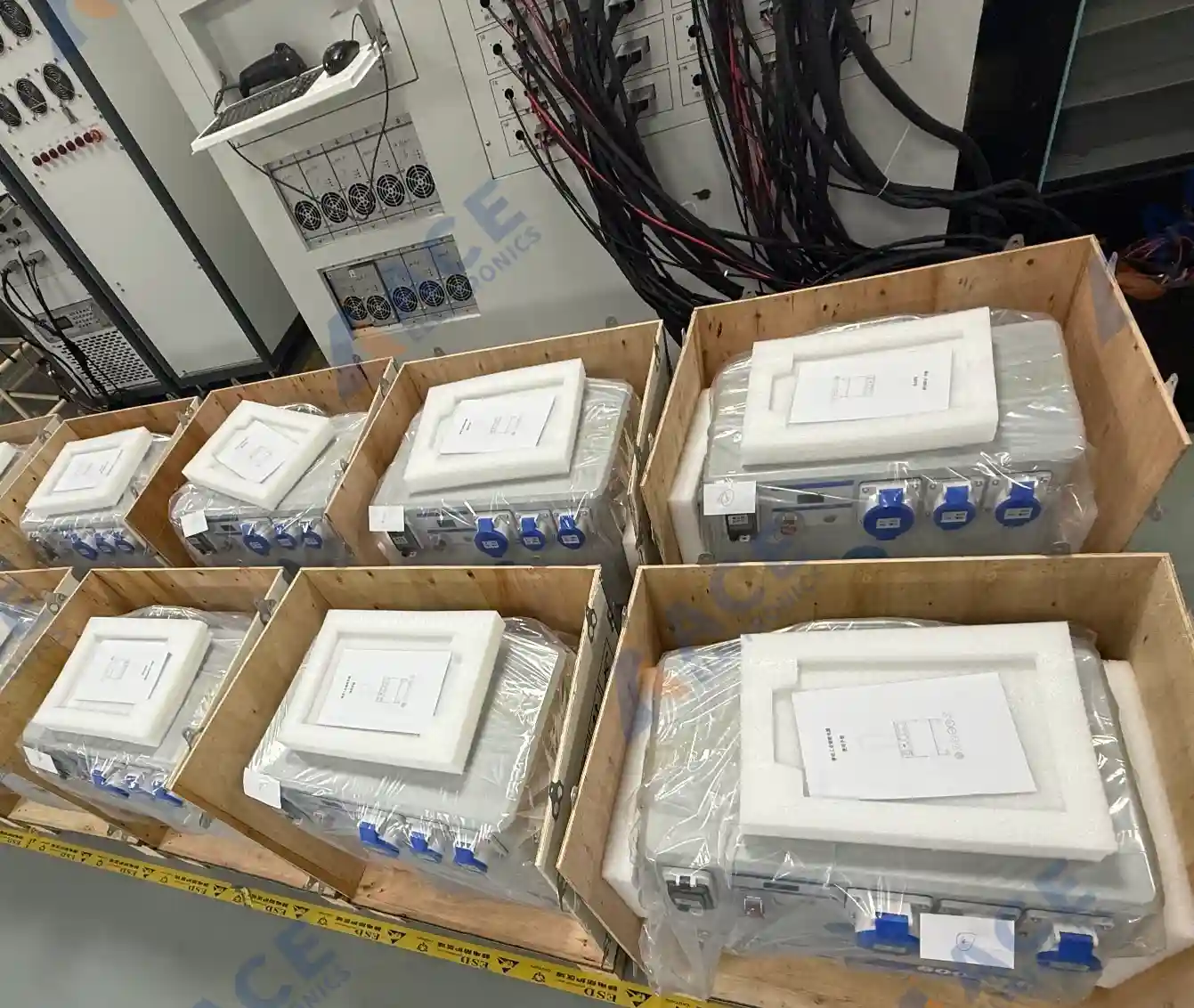
Packaging used custom wooden crates — not standard cardboard cartons. Each unit was secured inside the crate with custom-cut foam cushioning that held the unit in place without putting pressure on the handle, wheels, or protruding control panel components. The crates were labeled per the customer's shipping requirements. This packaging approach reflected the weight and value of the 6000Wh units, which required more protection during logistics than a standard electronics product.
Production Results and Timeline
Based on our internal production records for this 1,000-unit pilot run:
- All 1,000 units completed the full production flow: component sourcing → PCBA assembly → board-level test → box build assembly → functional test → 24-hour aging → final inspection → crate packaging
- Units that showed issues at any test stage were diagnosed, reworked, and retested before moving forward
- The complete order was delivered within the agreed production window
- All units were shipped in custom wooden crates with protective foam inserts
What This Means for Energy Storage Equipment Buyers
For companies developing mobile energy storage products or similar power electronics equipment, this project illustrates several practical manufacturing considerations:
Board-level testing is not the last step. A PCBA can pass an initial power-on test but still fail after the full assembly is complete. Enclosure fit, wiring routing, connector seating, and sustained thermal operation all affect the final result. Manufacturing partners who only test at the board level leave the integration risk with the customer.
Aging should be done on the finished product. The aging test on this project — 24 hours of continuous operation under load — was performed on fully assembled units. Running aging only at the PCBA stage would not expose faults related to the enclosure, connectors, wiring, or control panel.
Turnkey coordination reduces customer-side labor. The customer did not need to manage separate component vendors, a PCB assembly shop, a box build assembler, a test provider, and a packaging supplier. One production flow meant one set of communication points, one quality control process, and one team accountable for the finished units. This is the same manufacturing model we used in an earlier energy storage PCBA box build assembly project for a 1,000-unit small storage device, and in a larger industrial energy storage inverter turnkey project covering component sourcing through finished product assembly and packaging.
The RFQ package matters. Before quoting this project, we reviewed the customer's BOM, Gerber files, enclosure drawings, wiring diagrams, test procedure, and packaging specification. For buyers preparing a similar box build assembly contract manufacturing project, having these files ready reduces quotation delays.
Frequently Asked Questions
What is included in PCBA box build manufacturing for energy storage equipment?
What is included in PCBA box build manufacturing for energy storage equipment?
PCBA box build manufacturing for energy storage equipment typically includes component sourcing, PCB assembly, board-level electrical testing, enclosure assembly, internal wiring and connector mating, mechanical assembly, finished-unit functional testing, aging test on the completed product, final inspection, and packaging.
Is the aging test done on the PCBA or the finished unit?
Is the aging test done on the PCBA or the finished unit?
The aging test is done on the finished unit — after the PCBA, wiring harnesses, enclosure panels, control interface, and all mechanical parts are fully assembled. Board-level testing (power-on check) happens before box build assembly. These are two separate stages with different purposes. Running aging only at the PCBA level cannot verify connector seating, wiring integrity, panel function, or thermal behavior of the complete product.
What files are needed for a PCBA box build assembly quote?
What files are needed for a PCBA box build assembly quote?
For a box build assembly quote, send the BOM, Gerber files, assembly drawings, enclosure drawings or 3D files, wiring diagrams, functional test requirements, labeling specifications, packaging instructions, target quantity, and delivery schedule. If some files are not yet finalized, send what you have. We can review the current files and identify what additional information is needed.
Can ACE Electronics handle the full project from component sourcing to packaging?
Can ACE Electronics handle the full project from component sourcing to packaging?
Yes. ACE Electronics supports component sourcing, PCB assembly, box build assembly, functional testing, aging test, labeling, and packaging under one production flow. This makes overall quality control more consistent and reduces the coordination work normally required when splitting these steps across multiple suppliers.
Looking for a box build assembly manufacturer in China for energy storage equipment?
Looking for a box build assembly manufacturer in China for energy storage equipment?
If you are preparing an energy storage product for production and need a manufacturing partner who can manage the full process — from PCBA through finished-unit box build assembly and testing — send your BOM, Gerber files, enclosure drawings, wiring diagrams, and test requirements. We run a DFM review on every inquiry and respond with practical production feedback.
If your project involves mobile energy storage equipment, power electronics, or similar products that require PCBA assembly, enclosure integration, wiring, functional testing, and finished-unit aging under one production flow, send your BOM, Gerber files, assembly drawings, enclosure files, test requirements, and target quantity for a production review.
Have a project ready for manufacturing?
Fill out the form below and our engineering team will get back to you within 24 hours.