
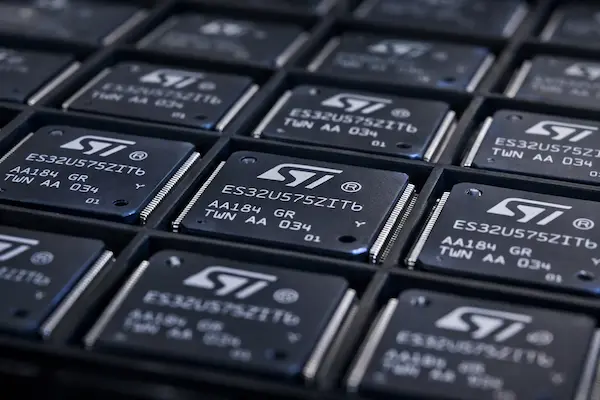
STMicroelectronics has reportedly told customers that prices across multiple product lines will rise from April 26, 2026, according to TrendForce’s March 26 report. For European OEMs and turnkey PCBA buyers, that means higher BOM risk, shorter quote validity, and less room to delay purchasing decisions.
This is not just an ST issue. Earlier in March, TrendForce also linked NXP, Texas Instruments, and Infineon to price increases. That points to a broader repricing cycle across industrial, analog, and power semiconductors.
For buyers using ST parts in industrial control, power conversion, embedded systems, and long-life products, the message is clear: review the BOM now, not after the next quotation round.
ST is following a broader supplier pricing move
TrendForce said ST’s reported price increase covers multiple product lines and takes effect on April 26. The drivers are familiar: higher material costs, rising energy and transport expenses, and added costs to secure fab and OSAT capacity.
The same pattern is showing up across the sector. TrendForce had already reported planned or reported price increases from NXP, TI, and Infineon. These companies overlap with ST in many of the same categories, including industrial MCUs, power devices, analog components, and interface ICs.
This matters because it suggests a market-wide pricing reset, not a one-off supplier action. Buyers should not expect normal negotiation conditions if several major industrial chip vendors are moving at the same time.
21st Century Business Herald described the 2026 chip price wave as one that began in memory and is now spreading into power devices, foundry, and packaging. That helps explain why mature-node and industrial parts are getting harder to buy on old commercial terms.
Weak demand in some sectors does not mean soft ST pricing
Some buyers may expect weaker demand to limit price increases. Europe’s market signals are mixed. Industrial demand is uneven. Automotive visibility is selective. Some consumer-linked electronics remain soft.
That does not automatically lead to lower pricing.
Reuters reported on March 13 that ST is using robots and retraining workers in older European fabs to avoid closures. That points to continued cost pressure inside a mature manufacturing base. A supplier in that position has good reason to protect margins.
At the same time, ST is expanding in higher-value segments. On March 9, the company announced high-volume production of its silicon photonics platform for hyperscale AI infrastructure, with plans to more than quadruple output by 2027. eeNews Europe highlighted the same move in the context of AI data-center demand.
The result is straightforward. ST still serves industrial and embedded customers, but it is also investing in faster-growing and higher-value markets. That gives the company less reason to stay aggressive on pricing in legacy industrial categories.
The impact will hit quotes and production schedules firstly
Most buyers will feel this first in quotations and build planning, not in dramatic shortage headlines.
The most exposed products are the ones built around ST parts that are hard to replace. That includes industrial MCUs, power management devices, analog front ends, interface chips, and embedded control components tied to validated firmware, compliance requirements, or long approval cycles.
For those programs, the effects are practical:
- BOM cost becomes less stable, especially where there is no approved alternate.
- Quote validity needs to be shorter because part pricing can change before the PO is placed.
- Lead-time risk becomes a commercial problem as well as a supply problem. Parts may still be available, but not on the same terms.
- Sourcing flexibility narrows when redesign or requalification takes time.
- Production schedules need to follow secured material, not just assembly capacity.
To navigate these challenges, OEMs need more than just a supplier; they need a partner that can lock in pricing and verify alternates in real-time. ACE Electronics specializes in mitigating these exact risks through proactive BOM Optimization and direct channel access. Request a Quote today to secure your 2026 production schedule.
Channel conditions may tighten faster than many buyers expect
When several major suppliers raise prices in the same period, distributors and EMS partners usually respond quickly. Quote windows get shorter. Margin protection gets tighter. Backlog commitments become more selective.
That can happen before buyers see a clear shortage in the open market.
Europe is especially exposed because ST is deeply built into industrial control systems, power electronics, smart infrastructure, medical devices, and other long-life products. These designs are harder to rework than short-cycle consumer products, so even a moderate price move can have an outsized effect on the BOM.
There is also a regional split. Asia’s strongest semiconductor demand is increasingly tied to AI infrastructure and high-value capacity commitments. Europe remains more dependent on industrial continuity and long-support embedded platforms. That makes European OEMs more sensitive to supplier-led pricing changes in ST-heavy designs.
What OEMs should do now
European OEMs should treat this ST price increase as an active procurement issue.
- Review every active BOM for ST concentration.
- Identify the ST parts that cannot be changed without redesign or requalification.
- Shorten quote validity on ST-heavy projects.
- Refresh semiconductor pricing before PO release.
- Pull forward purchases for critical ST lines in industrial, infrastructure, medical, and embedded builds.
- Ask EMS and sourcing partners to confirm channel position, backlog status, and approved alternates before committing delivery dates.
- Tie production schedules to secured semiconductor coverage, not just line availability.
The practical recommendation is simple: if ST is a meaningful share of your BOM, secure supply early and quote more carefully. Waiting for a better buying window is risky when suppliers across the industrial chip market are moving in the opposite direction.
Don't wait for the next price hike. If your upcoming projects rely on ST components, contact our procurement team now.
We can help you review your BOM for risks and secure traceability before market conditions tighten further.
Contact our Component Sourcing Specialists at bill@acepcba.com
Sources
- TrendForce report on STMicroelectronics’ reported April 2026 price increase
- TrendForce report on the broader March 2026 chip price increase wave involving NXP, TI, and Infineon
- Reuters report on STMicroelectronics’ March 13, 2026 restructuring and factory strategy update
- STMicroelectronics press release on its 2026 annual general meeting materials and business update
- STMicroelectronics press release on Q4 and full-year 2025 financial results
- eeNews Europe report on ST’s silicon photonics production ramp for AI data centers
- 21st Century Business Herald report on March 2026 semiconductor price increases and supplier moves
- ACE Electronics component sourcing service page