
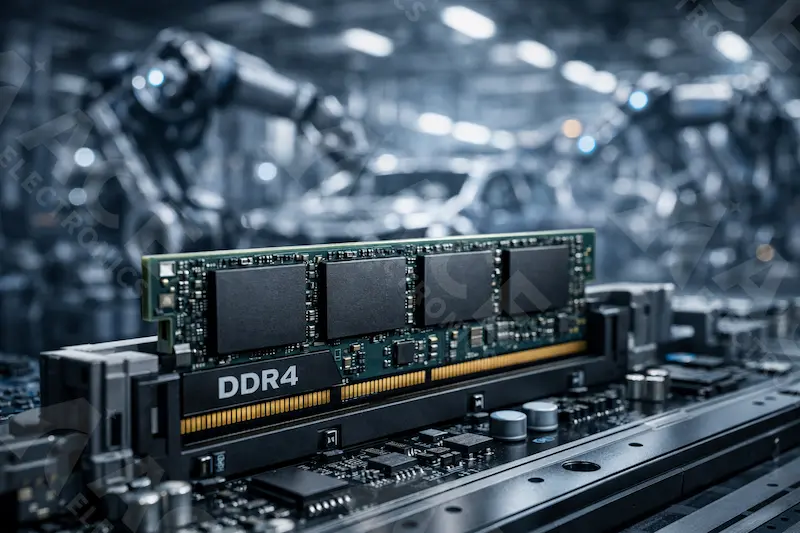
Europe’s DDR4 market is tightening for a reason that matters more than any short-term sales wobble: supply is being structurally redirected away from legacy DRAM just as industrial, automotive, medical, and long-life embedded platforms still need it. That is why DDR4 is behaving differently from a normal cyclical memory market. End demand is mixed, but pricing risk remains upward because available supply is no longer elastic.
For European OEMs and EMS buyers, this is not just a memory-market headline. It shows up directly in BOM review, alternate-part approval, quote validity, and build scheduling. In turnkey projects, DDR4 is now one of those line items that can quietly turn a “priced and planned” build into a commercial risk.
That is especially relevant for ACE Electronics customers because many of the programs handled on ACE’s component sourcing page sit exactly in the exposed zone: industrial control, automotive-adjacent electronics, communications hardware, and mature products that still rely on validated DDR4 platforms.
This is a supply squeeze first, not a Europe demand recovery
Micron’s March 18 fiscal Q2 2026 results framed the market clearly: strong demand, tight industry supply, and continued constraints beyond 2026. In its prepared remarks, Micron said both DRAM and NAND supply-demand conditions should remain tight beyond calendar 2026, and that server demand is being constrained by inadequate memory supply. That matters for DDR4 even though the loudest headlines are about AI memory, because capital, cleanroom space, and management attention are all moving toward higher-margin products.
The timing of new capacity reinforces the point. On March 15, Micron said the newly acquired Tongluo site in Taiwan will begin retrofit work immediately, but meaningful shipments from the existing fab are not expected until fiscal 2028. In other words, the market is dealing with shortage conditions now, while meaningful relief is still far out.
TrendForce’s March 20-25 spot updates showed the same pattern in day-to-day trading. Broader DRAM spot activity stayed subdued, but low-density DDR4 pricing kept edging higher. Mainstream DDR4 8G (1Gx8) 3200 stayed around $34.0-$34.1, while DDR4 512x8 2400/2666 moved from $6.58 on March 20 to $6.80 on March 25. That is not the profile of a healthy, well-supplied legacy market. It is the profile of a market where selective parts stay tight even when overall sentiment looks cautious.
Europe is seeing a different mix of signals than Asia’s hyperscale buildout
The confusing part of the market is that not every indicator points in the same direction. That divergence is real, and it is exactly why DDR4 procurement has become difficult.
On the supply side, Asia is sending a clear message: advanced DRAM capacity is being pulled toward AI infrastructure. Micron said memory has become a strategic asset in the AI era. Samsung’s HBM4 ramp and the broader industry push toward next-generation DRAM underscore the same capital-allocation logic. Tom’s Hardware also reported March remarks from SK Group chairman Chey Tae-won that memory shortages could persist for years because wafer supply still trails demand. Even if the exact timing varies by vendor, the direction is the same: conventional DRAM is competing with a structurally stronger buyer base.
On the demand side, downstream device markets are softer. IDC’s March 5 smartphone market update said Q4 2025 shipments still grew despite the memory shortage because brands pulled demand forward ahead of price hikes. TrendForce’s March 5 panel forecast then showed how that dynamic is rolling over in 2026, with memory shortages and rising costs weighing on new handset shipments. Micron went further on March 18, saying DRAM and NAND constraints could push PC and smartphone unit demand down by low double digits in 2026.
Europe does not sit neatly in either camp. S&P Global’s March 10 electronics supply chain outlook described weak consumer electronics orders globally, but it also pointed to improving industrial electronics demand, helped in part by German manufacturing and defense spending. That matters because Europe’s real DDR4 exposure is not only in retail PCs. It is in factory automation, power electronics, medical devices, gateways, controllers, and long-support embedded systems that cannot switch memory generations quickly.
So the regional divergence is this: Asia is dictating the supply agenda through AI and advanced memory investment; consumer channels globally are showing demand destruction; Europe’s industrial base is still creating real pull for mature memory. That combination keeps DDR4 commercially tight even when shipment headlines look weak.
Why legacy DDR4 is becoming commercially awkward for OEM buyers
DDR4 is no longer just “older and cheaper.” It is becoming older, harder to replace, and less attractive for major suppliers to prioritize.
TrendForce’s March 10 notebook analysis captured the downstream effect well. It warned that rising memory and CPU costs could push a mainstream notebook’s retail price up by nearly 40%, with memory and CPU together reaching 58% of BOM cost. Even though that note was about notebooks rather than industrial hardware, the lesson carries over: when memory stops behaving like a stable commodity, platform economics change quickly.
For Europe, the awkward part is product mix. Many industrial and embedded programs still rely on lower-density DDR4 devices and established controller ecosystems. Those parts are precisely where buyers lose flexibility first. The March TrendForce spot data showed higher resilience in low-density DDR4 pricing than in broader market sentiment, which suggests scarcity is becoming more acute in the legacy end of the stack.
That is also why Europe can see weak distributor sentiment and firm DDR4 quotations at the same time. Consumer demand hesitation does not automatically release the right memory die, speed grade, density, or qualification status back into the pool. A machine controller in Germany and a medical device build in Italy cannot simply switch into DDR5 because hyperscalers are buying HBM.
For turnkey PCBA buyers, this is the point where procurement discipline matters more than spot-market watching. A sourcing process built around traceable channels, approved alternates, and BOM-level risk review is more useful now than trying to time a memory correction that may not come soon.
What this means for BOM cost, lead time, and quotation control
For OEMs and turnkey PCBA buyers, the operational implications are now more important than the market narrative.
- BOM cost: DDR4 should no longer be modeled as a defensive cost line simply because it is legacy memory. Low-density and long-life parts can rise or stay firm even when broader demand is soft.
- Lead time risk: the market has not shown near-term capacity relief. Micron’s own expansion timeline points to 2027-2028 benefits, not a quick 2026 correction.
- Sourcing flexibility: second-source options are narrower on qualified industrial DDR4 than on mainstream client memory. Flexibility falls fastest where validation cycles are longest.
- Quotation validity: fixed pricing windows should be shorter than buyers were comfortable with in 2024 or early 2025. In this market, a quote that assumes stable memory replacement cost for too long is exposed.
- Production scheduling: memory-dependent builds should be tied to secured allocation, not to forecast-only demand. The old habit of locking assembly slots before locking memory supply is now riskier.
This is also where ACE’s site positioning is directionally right. The practical value of a strong component sourcing workflow is not just lower unit pricing. It is the ability to combine traceability, approved substitutions, incoming inspection, and build-plan-aligned purchasing when a legacy memory category stops behaving like a normal commodity.
What OEMs should do now
European OEMs should treat DDR4 as a constrained strategic component, not as a routine commodity line item.
The practical response is disciplined rather than dramatic.
- Lock demand for validated DDR4 platforms earlier, especially for industrial, automotive-adjacent, medical, and embedded programs.
- Separate quotations for flexible and inflexible builds. If a design cannot change density, supplier, or speed grade without requalification, price it on that basis.
- Shorten quote validity on DDR4-heavy BOMs and build explicit memory refresh checkpoints into customer approvals.
- Reserve buffer stock for low-density and legacy-qualified parts rather than for the easiest mainstream modules to replace.
- Review whether any 2026-2027 programs should migrate away from DDR4 now, because waiting for a cheaper legacy market looks increasingly unrealistic.
- Align customer delivery promises to secured memory allocation, not to nominal assembly capacity.
- For outsourced builds, make sure your EMS partner can document source traceability, alternate-part approval, and incoming inspection before the PO is placed, not after.
The procurement recommendation is simple: if your European product line still depends on DDR4, buy for continuity, not for a hoped-for price correction. The market is not signaling near-term normalization. It is signaling that legacy memory will remain available, but on tighter, less forgiving terms.
Sources
- Micron fiscal Q2 2026 results announcement
- Micron fiscal Q2 2026 prepared remarks and presentation materials
- Micron announcement on completing the acquisition of PSMC’s Tongluo P5 site in Taiwan
- TrendForce March 10, 2026 report on memory market and supply conditions
- TrendForce press center
- TrendForce March 5, 2026 report on DRAM or NAND pricing trends
- IDC smartphone market share data
- S&P Global Market Intelligence electronics supply chain outlook for March 2026
- Tom’s Hardware report on long-term memory supply tightness