
When authorized lead times for DDR4 or DDR5 become too long, many buyers start by looking for spot stock. The problem is that buying spot memory does not always help the production move faster. A part change can still delay the project if it triggers firmware review, customer approval, traceability checks, or extra validation before production release.
For that reason, this is usually a delivery decision before it becomes a purchasing decision. Memory supply still affects planning in many OEM projects, but this article is not meant to recap the market. It is meant to help buyers choose between waiting for authorized supply, using an approved alternate, keeping sourcing in-house, asking a PCBA partner to source under clear rules, or redesigning for better long-term supply stability.
Why DDR4 and DDR5 Delays Create Delivery Risk, Not Just Purchasing Pressure
DDR4 and DDR5 are not always easy to replace in an OEM project. A memory part may already be tied to an approved supplier, a tested product version, or a customer-approved configuration.
So when the original part is late, the problem is not only supply. The team also needs to check what happens if the memory changes. A new part may require firmware review, more testing, record updates, or customer approval before production can move forward.
That is why available stock does not always solve the delivery problem. The buyer may get the memory, but the project can still stop at approval, document changes, extra testing, or customer confirmation.
What You Should Clarify Before Looking for Faster Supply
Before you look for faster supply, first confirm whether memory is really on the critical path. If PCB timing, firmware readiness, or another long-lead part is still holding the project, changing the memory plan may not improve delivery. It may only add more coordination work across purchasing, engineering, and production.
Then check whether an approved alternate already exists. Do not rely on memory alone. Look at the BOM, AVL, qualification file or checking with your engineering team. If an alternate is already listed there, the decision is much easier and much safer than starting a new substitution path.
Your engineering team may be able to judge whether an alternate memory part is technically acceptable. But that does not finish the decision. The buyer still needs to confirm what the change will do to release timing, customer approval, traceability, and sourcing execution. A part that looks acceptable from an engineering view may still create delay if the approval path, documentation, or supply control is not clear.
You should also decide who will control the sourcing decision. In some projects, the buyer keeps direct control of memory sourcing. In others, the PCBA partner sources under clear approved rules. Shared control can also work, but only if both sides agree in advance on part selection, substitution authority, and lot acceptance.
Traceability should be checked early, not after the buy. If the project requires clear source records, lot consistency, or chain of custody, visible stock is not enough. The material may arrive quickly and still create delays later if the source records are incomplete or the lot cannot be accepted for production.
Buyer Pre-Check Before Changing DDR4 or DDR5 Supply
Before changing the sourcing plan, you should ask:
- Is memory actually the first item putting shipment at risk?
- Is an approved alternate already listed in the BOM, AVL, or qualification file?
- Would a memory change trigger firmware review, qualification work, or customer signoff?
- Does this project require strict lot traceability or controlled source records?
- Who should own the sourcing decision for this build: your company, or your contract electronics assembly partner, or both?
- Would a faster purchase still delay production release?
- Is this a one-time shortage issue, or a sign that the current memory strategy is too narrow?
The Main Purchasing Options When DDR4 or DDR5 Lead Times Are Too Long
1. Wait for Authorized Supply and Protect Approval Stability
This option means staying with the original approved source and adjusting the production plan around that timing.
It makes sense when the memory part is already tied closely to customer approval, qualification history, firmware behavior, or a narrow approved vendor range. In that situation, changing the part may create more risk than waiting.
The benefit is stability. Approval status, traceability, and production records stay clear. The risk is schedule pressure. If the authorized lead time does not support the customer delivery plan, the build may need to move with the supply date.
2. Use an Already Approved Alternate
This means moving to a memory part that is already approved for the project.
This is often the most practical option when it is available. It can help protect shipment timing without starting a new approval cycle. But you still need to confirm that the alternate applies to the exact product version, customer requirement, and revision you are working on.
The main benefit is lower switching risk. The main risk is assuming that an approved alternate is approved for all cases. In practice, approval may be limited to a specific product variant, customer requirement, or hardware revision.
Case Snapshot: When Shared Sourcing Support Reduced Memory Cost
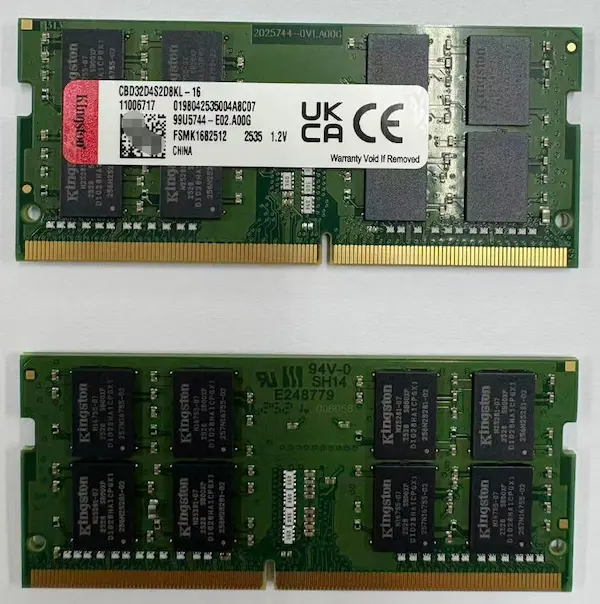
In one mini PC board project, the customer was using Kingston DDR4 3600 16GB memory. ACE Electronics was already buying ADATA DDR4 3600 16GB in larger volume for another customer project.
After confirming that ADATA could be used as an approved replacement, the customer changed from Kingston to ADATA under a shared sourcing arrangement.
This reduced memory cost by 11.5% per unit. It also reduced purchasing work for the customer, because the buyer did not need to manage a separate low-volume memory order.
3. Keep Memory Sourcing Under Your Own Control
This means the OEM buyer purchases the memory directly, while the PCBA partner assembles under that supply arrangement.
This option makes sense when the buyer wants tighter control over source selection, approved channels, or traceability records. It also makes sense when the OEM already knows the memory supply path better than the PCBA partner.
The main benefit is control. The buyer decides where the memory comes from and how it is managed.
The main risk is extra work. The buyer must handle delivery timing, lot coordination, and source quality. Self-sourcing is not always the safer option. If the buyer does not have strong incoming quality control, lot management, or enough schedule margin, buying memory directly can create more pressure instead of reducing it.
4. Ask Your PCBA Partner to Source Under Clear Approved Rules
This means the PCBA partner buys the memory, but only within rules agreed in advance.
This works well when the buyer wants sourcing support but still wants control over approval. The rules should be clear. For example: approved AVL only, no substitution without written signoff, lot traceability required, and buyer notification before PO release.
The main benefit is easier execution. The buyer gets sourcing support without giving up control of the approval boundaries.
The main risk is confusion if the rules are vague. If the buyer and the PCBA partner do not define the limits clearly, the project can still be delayed even after the memory arrives.
5. Redesign for More Stable Future Supply
This means changing the design, the approved memory range, or the qualification strategy so the product is less exposed to the same sourcing problem later.
This is usually not the fastest answer for the current shipment. But it should become a serious option when the same memory constraint keeps affecting multiple production runs, or when the approved memory window is too narrow to support normal forecast planning.
The main benefit is better long-term supply stability.
The main risk is time. Redesign may require engineering work, testing, document updates, and customer communication. It may solve the next problem well, but not the current one.
Decision Matrix: How the Main Options Compare
| Option | Best for | Delivery impact | Approval burden | Traceability control | Main risk |
|---|---|---|---|---|---|
| Wait for authorized supply | Projects with narrow approved memory limits | May delay shipment | Low | High | Delivery schedule slips while waiting |
| Use approved alternate | Projects with an alternate already cleared | Can improve timing | Low to medium | Medium to high | Alternate may not fit every build or product version |
| Self-source memory | Buyers who need tighter source control | Depends on buyer execution | Medium | High | Buyer carries more timing and source risk |
| PCBA source under approved rules | Shared-control projects | Can improve execution speed | Medium | Medium | Approval limits may be unclear in practice |
| Redesign | Repeated supply instability | Low short-term benefit | High | Depends on redesign scope | Too slow for an urgent build |
Why Visible Stock Can Still Delay Shipment
Visible stock does not automatically reduce delivery risk.
A buyer may find DDR4 or DDR5 available in the market, but that does not mean the project can ship faster. If the part falls outside the approved memory range, the team may need engineering review before production can move. If traceability is incomplete, the material may not be acceptable for a controlled build. If the supply comes from mixed lots or an unclear source path, the team may need more checks before releasing it into production.
From a buyer’s point of view, shipment timing depends on approved execution, not just on stock visibility. A part can be physically available and still fail to support the delivery plan if the team cannot release it with confidence.
This is where urgent sourcing decisions often go wrong. The team sees stock and assumes the schedule problem is solved. Then the delay moves somewhere else. Approval takes time. Validation takes time. Records need to be updated. The memory arrives, but the build still does not move as planned.
The better question is not “Can we get the part?” The better question is “Can we use this part without creating a new hold on production release?” Buyers should look at approval status, lot consistency, traceability, and any added validation before treating visible stock as a delivery solution.
When Buyers Should Bring a PCBA Partner Into the Decision
Buyers should bring a PCBA partner into the discussion when memory availability starts affecting the full BOM execution, not just one line item. At that point, the issue is no longer only about where to buy the part. It becomes a question of how the sourcing decision affects material readiness, build timing, and shipment release.
A PCBA partner should also be involved when approved alternates exist but the execution risk is still unclear. On paper, the alternate may be acceptable. In practice, the buyer may still need to confirm whether the sourcing path supports the planned build and the required records.
This is also the right time to involve a PCBA partner when sourcing responsibility needs to be split clearly. Some OEMs want to keep control of memory selection while asking the PCBA partner to support assembly and execution. Others want the PCBA partner to source under clear approved limits while the buyer keeps approval authority. These decisions are easier to manage when both sides align early.
It also helps to involve the PCBA partner when prototype, pilot, and production builds need different sourcing logic. A supply path that works for a prototype build may not be suitable for pilot or volume production. Buyers need to know where those boundaries sit before making a rushed commitment.
In this kind of decision, ACE Electronics is best positioned as a practical support partner. The point is not to promise that every hard-to-find memory part can be secured. The point is to help the buyer compare sourcing paths against BOM limits, approval rules, traceability needs, and likely delivery impact.
Situations Where This Type of Support Is Most Useful
This type of support is most useful when one memory line is holding up shipment and the team needs to decide whether waiting, alternate sourcing, or a different execution plan makes more sense.
It is also useful when the team is deciding whether to source memory directly or let the PCBA partner source it under approved rules. In that case, the key question is not just who can buy faster. It is who can support the build with the right level of control.
Another common case is when stock is visible, but engineering or project teams still have approval concerns. Buyers may need help deciding whether the available material is actually usable in the current build.
Support is also valuable when the product has narrow approved memory options. If the BOM or customer requirement leaves little room for substitution, the sourcing path needs to be judged more carefully.
Finally, this support matters when the team is deciding between waiting, alternate sourcing, and redesign. Those choices solve different problems. Waiting may protect stability. Alternate sourcing may support near-term delivery if approval is already in place. Redesign may reduce repeated supply pressure later. The right choice depends on the project, not just on urgency.
Conclusion
When DDR4 or DDR5 authorized lead times are too long, the best decision is not always the fastest purchase. Buyers need to look at delivery impact, approval stability, traceability, sourcing ownership, and future supply risk together.
In some projects, waiting for authorized supply is still the safer path. In others, an approved alternate or a tightly controlled sourcing arrangement may protect shipment timing with less risk. And when the same issue keeps returning, redesign may be the better long-term answer.
If your team is deciding whether to wait, use an approved alternate, keep memory sourcing in-house, or ask a PCBA partner to support execution under clear rules, ACE Electronics can help review the BOM context, sourcing ownership, approved options, and likely delivery impact before material is committed.
+++FAQ+++
Should buyers source DDR4 or DDR5 themselves or let the PCBA supplier source it?
It depends on who needs to control the sourcing decision. Buyers should source memory themselves when they need tighter control over source selection, approved channels, or traceability records. Letting the PCBA supplier source it can work well when the approved range is clear and both sides agree on the sourcing rules.
When is authorized supply still the safer option?
Authorized supply is still the safer option when the memory part is closely tied to customer approval, qualification records, firmware behavior, or a narrow approved vendor range. In that situation, changing supply may create more delay than waiting.
What makes an alternate memory part risky even if it is available?
Availability does not remove approval risk. An alternate part may still create problems with product fit, customer approval, traceability, lot consistency, or added validation before the build can be released.
When should a buyer involve a PCBA partner in the sourcing decision?
A buyer should involve a PCBA partner when memory availability starts affecting BOM execution, shipment timing, or sourcing ownership decisions. It is especially helpful when the buyer needs to split control between part approval and build execution.
When does redesign make more sense than another emergency buy?
Redesign makes more sense when the same memory sourcing issue keeps coming back or the approved memory range is too narrow for stable long-term planning. It is usually a planning decision for future builds, not the fastest answer for an immediate shipment gap.
+++FAQ+++
Author: Bill Ho, Sales Engineer & Chief Editor at ACE Electronics.
Industry Experience: 10 Years Experience in PCB Fabrication and PCB Assembly.