
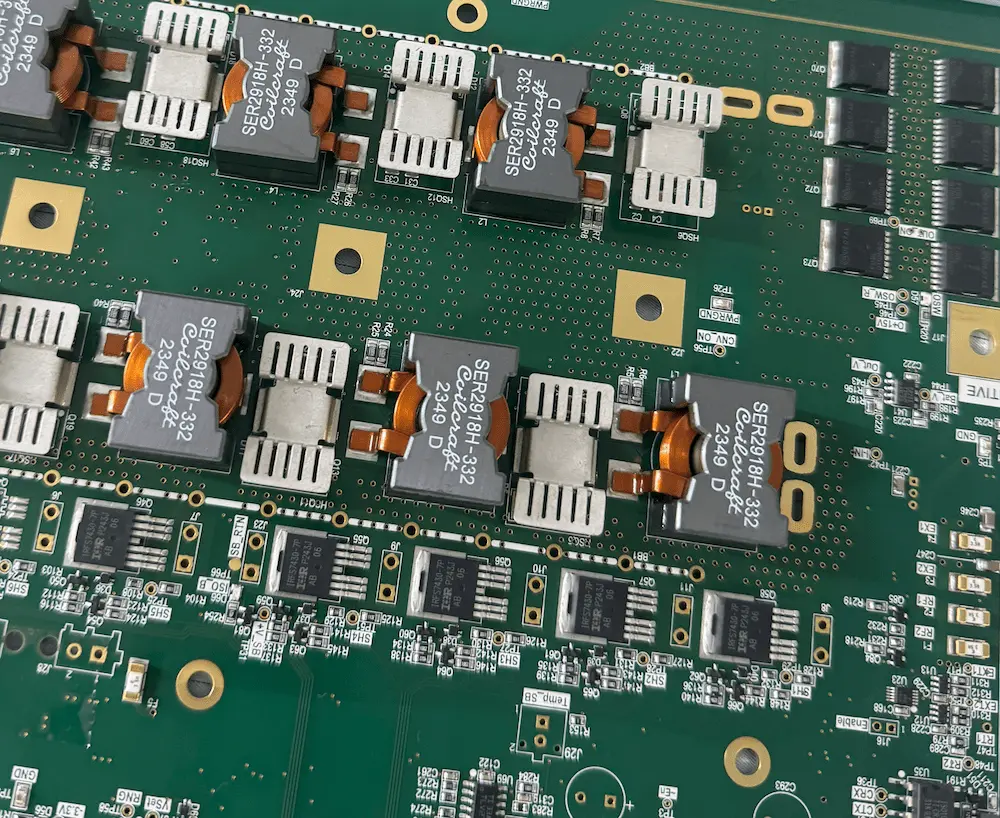
Hydrogen forklift control boards often operate in demanding industrial environments. In cold-chain warehouses, industrial storage areas, and high-humidity logistics environments, these boards may face condensation, dust, temperature cycling, and electrical stress over long service periods. In this kind of application, standard PCB assembly alone is often not enough. The board protection strategy has to be built into the manufacturing process from the start.
In one long-running project for a U.S. customer, we supported the production of hydrogen forklift control boards through a turnkey workflow1 that included PCB fabrication, component sourcing2, cleaning, masking, in-house3 Parylene C4 coating, and final inspection. Because the customer is protected by NDA, we cannot publish the company name, board model, or shipment volume. What we can share is the engineering side of the work: why Parylene C was chosen, what process risks had to be controlled, and how this approach fits similar high-reliability industrial PCB projects.
Project Snapshot
| Item | Details |
|---|---|
| Customer | U.S. customer under NDA |
| Main application | Hydrogen forklift control boards |
| Cooperation length | About 10 years |
| Scope | PCB fabrication, sourcing, PCBA, functional testing, cleaning, masking, in-house Parylene C coating, final inspection5 |
| Main goals | Moisture protection, corrosion resistance6, insulation support, stronger long-term reliability |
| Extra support | DFM review, BOM risk control, cost optimization, connector substitution planning |
Why We Chose Parylene C
For this project, the protection material was Parylene C. The main goal was to improve moisture resistance, corrosion protection, insulation support7, and long-term stability on control boards used in a demanding industrial environment.
This coating was a good fit for several practical reasons:
- it forms a thin, uniform, vapor-deposited8 protective layer
- it reaches complex board geometries more consistently than many liquid-applied alternatives
- it supports insulation performance where condensation risk is a concern
- it adds protection without the thick build-up associated with heavier coating systems
In similar industrial electronics applications, a thickness range of 15 to 25 microns is commonly used as a practical balance. Too thin, and coverage quality may become less reliable. Too thick, and coating time, cost, and stress risk can all increase. That range is industry context, not a released customer-specific spec.
| Parameter | Specification | Reference / Test Method |
|---|---|---|
| Base Material | Parylene C | Project material specification |
| Target Thickness | 15–25 µm | Base on project coating requirement |
| Dielectric Strength | Typical 5,600 V/mil | ASTM D1499 |
| Operating / Service Temperature | Typically suitable for low-temperature (–160℃) to High-temperature (100℃) environments; | Inside temperature cycling Test / supplier datasheet |
| Coverage Characteristic | Uniform, continuous conformal film over complex geometries | Visual inspection and process validation |
Material Properties:
- Excellent conformal coverage over sharp edges, lead frames, and trace corners due to molecular-level vapor deposition
- Transparent, thin, and uniform coating suitable for high-reliability electronic protection
- No thermal curing step required after deposition, which helps reduce thermal stress on sensitive assemblies
The Main Challenges for This Project
1. Cleaning after assembly
One of the first risks before coating is contamination left on the board after assembly. Flux residue, surface oils, and handling contamination can interfere with coating quality. If the board enters coating in that condition, the film may later show adhesion problems, blistering, or delamination.
To control this, cleaning was treated as a defined process step rather than a quick preparation step. The board had to reach coating in a condition that supported reliable deposition rather than undermining it.
2. Masking around connectors and functional areas
Because Parylene C is vapor-deposited8, it can reach narrow spaces that are difficult to protect with casual masking methods. That helps overall coverage, but it also creates a serious risk around connector contacts, test points, and other no-coat areas.
In this project, standard tape alone was not enough for the most sensitive connector zones. To solve that, we used custom masking fixtures and boots for high-risk interfaces. That gave us a tighter seal around critical connector areas, reduced unwanted vapor penetration, and improved repeatability across builds.
3. Long-term sourcing pressure
The project also involved major semiconductor and power-device brands, along with connector-related cost and availability pressure. In a long-running industrial build, sourcing is not only about placing orders. It is about continuity, BOM stability, and practical substitution planning.
To support that, we combined BOM risk review, cost optimization10, and selected high-end China-based connector replacement planning where appropriate. The goal was to keep the supply path practical without reducing quality control.
4. Process coordination across multiple steps
Once a project includes PCB fabrication, sourcing, assembly, testing, cleaning, masking, coating, and inspection, every handoff creates another chance for delay or inconsistency. Splitting those steps across multiple vendors usually makes coordination harder.
To avoid that, the project stayed inside one connected manufacturing path from PCB through protected finished assembly.
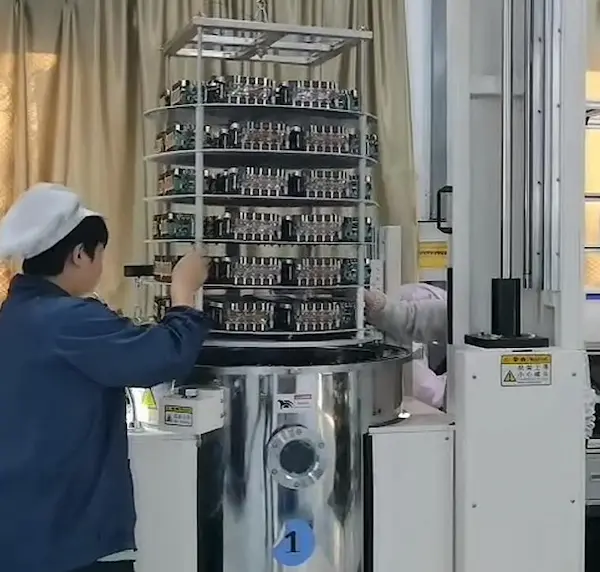
Our Turnkey Manufacturing Process
We manage the entire production chain in-house through eight controlled stages:
-
PCB Fabrication
Multi-layer boards with controlled impedance11 for power circuits -
Component Sourcing
Authorized distribution channels with active BOM risk monitoring -
SMT & THT Assembly
Automated placement with optimized thermal profiles -
Functional Testing
ICT and boundary scan verification performed before coating -
Precision Cleaning
Ultrasonic wash followed by deionized water rinse to remove ionic residues -
Selective Masking
Custom silicone fixtures for connectors and test points -
Parylene C Deposition
Room-temperature vapor-phase polymerization (15–25 micron target thickness) -
Final Inspection
Visual verification, thickness measurement, and electrical testing
All stages remain within one facility to eliminate inter-supplier handoff risks.
We also supported DFM review, BOM risk control, and cost optimization before production moved forward. That reduced avoidable manufacturing issues early.
On the coating side, the key was process discipline. The boards were cleaned, masked, coated, and inspected within one internal flow. Keeping the work in-house made it easier to coordinate assembly, testing, coating, and final review without relying on multiple outside vendors.
The Process Controls That Mattered Most
1. Cleaning before deposition
Cleaning quality directly affects coating reliability. If contamination remains under the film, the long-term protection value drops. In this kind of application, poor cleaning can weaken the whole protection strategy. We residue testing (ROSE) per IPC-J-STD-00112 standards before coating application
2. Manual masking on connector-heavy areas
This was one of the most important controls in the project. Because the board included many automotive-style connectors, the masking work could not be casual. Our team used special masking glue by hand to protect the areas that had to remain free of coating. That helped us control no-coat zones more precisely before Parylene deposition.
3. Functional testing before Delivery
We included functional testing as part of the assembly, not as a separate afterthought. That helped us keep board function and protection quality inside the same workflow.
4. Final inspection
After the full manufacturing and protection process, the boards went through final inspection before release.
What Can Go Wrong Without This Protection Strategy
In hydrogen forklift environments, repeated condensation can leave moisture on the board surface. Once that moisture combines with ionic contamination on an energized assembly, electrochemical migration13 can begin. Over time, dendritic growth14 and leakage paths may form.
In similar applications, unprotected or weakly protected boards may begin showing reliability risk much earlier than expected, especially when condensation and contamination appear together. Lower-grade coating approaches may delay the problem, but once weak coverage or cracking appears, moisture ingress becomes much harder to control.
| Risk Factor | Standard Conformal Coating | Parylene C Vapor Deposition |
|---|---|---|
| Moisture Ingress Pathways | High risk at brush stroke boundaries and edges | Pinhole-free barrier with uniform edge coverage |
| Ionic Contamination Risk | Residue may migrate under coating film | Contamination fully encapsulated and isolated |
| Condensation Tolerance | Degradation observed within 6–12 months in cycling environments | No measurable degradation after 5+ years field exposure |
| Dielectric Performance | Air gaps provide ~1 kV/mm resistance | 7,000+ volts/mil uniform dielectric strength |
| Rework Complexity | Solvent removal possible | Requires mechanical abrasion for repair |
Comparative data based on 10-year field monitoring in hydrogen forklift applications.
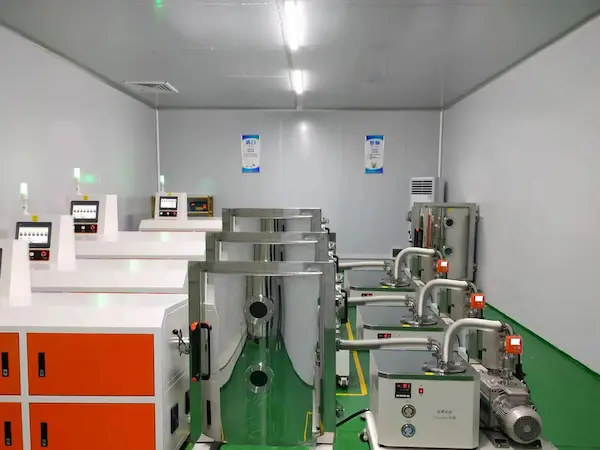
Why Our One-Stop Assembly Service Worked
The value in this project did not come from coating alone. It came from keeping sourcing, assembly, cleaning, masking, coating, and inspection connected in one controlled workflow.
That gave the customer:
- one manufacturing path from bare PCB to protected assembly
- fewer handoff risks between process steps
- tighter coordination between assembly and coating
- better control of high-risk connector and no-coat areas
- a more practical long-term production model for a demanding application
For a long-running industrial control board project, that kind of process integration matters.
Applications That Match This Protection Level
This type of protection strategy is a good fit for:
Transportation and Energy Systems
- Hydrogen fuel cell control modules
- Battery management systems for industrial vehicles
- Automotive motor controllers exposed to temperature cycling
Industrial Automation Equipment
- Programmable logic controllers in wash-down environments
- Motion controllers with dust and moisture exposure
- Human-machine interface boards in factory floors
Environmental Stress Conditions
- Cold storage facilities with daily ambient temperature transitions
- High-humidity warehouse operations (relative humidity >85%)
- Chemical exposure from industrial cleaning agents or hydraulic fluids
Complex Geometry Assemblies
- High-density connector arrays requiring selective coating zones
- Mixed-technology assemblies containing tall components or heat sinks
Conclusion
For hydrogen forklift control boards, the key question is not only whether to apply a coating. The more important question is whether the entire manufacturing process is built to support that coating properly.
In this project, Parylene C was part of a full workflow that included PCB fabrication, sourcing, assembly, testing, cleaning, masking, coating, and final inspection. That is what made the protection strategy practical for real production, not just for theory.
Consider Parylene coating evaluation if your application meets three or more criteria:
- [ ] Device operates outdoors or in uncontrolled humidity environments
- [ ] Regular thermal cycling between -20°C and +60°C occurs during operation
- [ ] Field failure would create safety risks or downtime costs exceeding $10,000
- [ ] PCB contains fine-pitch components with gaps below 0.5mm
- [ ] Previous field failures show evidence of corrosion or dendritic growth
- [ ] Design requires 10+ year service life without maintenance access
If you have interesting in other normal protection methods, like conformal coating, please check this blog which will show you the details, we ACE Electronics could also provide the normal conformal coating service for your electronics projects!
Unsure about your requirements?
Submit your Gerber files and BOM for complimentary DFM review.
+++FAQ+++
Why use Parylene C on hydrogen forklift control boards?
Because it helps improve moisture resistance, corrosion protection, insulation support, and long-term reliability in demanding environments.
Why does cleaning matter before Parylene C coating?
Because residue left on the board can reduce adhesion quality and long-term coating reliability.
What is the biggest masking risk in a Parylene C-coated control board?
One of the hardest issues was masking the many automotive-style connector areas that had to remain free of coating.
What thickness range is commonly used in similar industrial PCB applications?
A range of 15 to 25 microns is often used as a practical balance between coverage quality, process efficiency, and stress control, depending on the board and the application.
Why keep PCB assembly and Parylene C coating under one supplier?
Because it reduces handoff risk and makes sourcing, assembly, testing, coating, and inspection easier to manage as one process.
+++FAQ+++
Author: Bill Ho, Sales Engineer & Chief Editor at ACE Electronics.
Industry Experience: 10 Years Experience in PCB Fabrication15 & PCB Assembly.
Discover the benefits of a turnkey workflow in streamlining PCB manufacturing processes. ↩
Learn about the significance of functional testing in ensuring PCB quality and performance. ↩
Exploring this resource will reveal how in-house processes enhance quality control and reduce risks in PCB manufacturing. ↩
Explore the advantages of Parylene C in enhancing PCB reliability and protection in harsh environments. ↩
Discover the importance of final inspection in ensuring PCB quality before shipment. ↩
Learn about methods to improve corrosion resistance in PCBs for better durability. ↩
Understand the importance of insulation support in PCB design for electrical safety. ↩
Learn about vapor-deposited coatings and their advantages in PCB protection. ↩
Explore this link to understand ASTM D149's significance in testing dielectric strength, crucial for PCB reliability. ↩
Discover ways to optimize costs in PCB manufacturing without compromising quality. ↩
Learn about controlled impedance and its significance in high-frequency PCB applications. ↩
Explore this link to understand IPC-J-STD-001, a crucial standard for ensuring quality and reliability in PCB assembly processes. ↩
Understand the risks of electrochemical migration in PCBs and how to mitigate them effectively. ↩
Discover the factors leading to dendritic growth and its implications for electronic reliability. ↩
Explore this resource to understand key techniques and standards that enhance PCB fabrication quality and reliability in demanding environments. ↩
Have a project ready for manufacturing?
Fill out the form below and our engineering team will get back to you within 24 hours.